
Around 9PM last night while sitting with coffee and re-reading a few OpenLedger threads ☕📱, one detail kept pulling my attention back.
Not the AI agent narrative. Not infrastructure throughput. Not even the scaling discussion 🔄📊
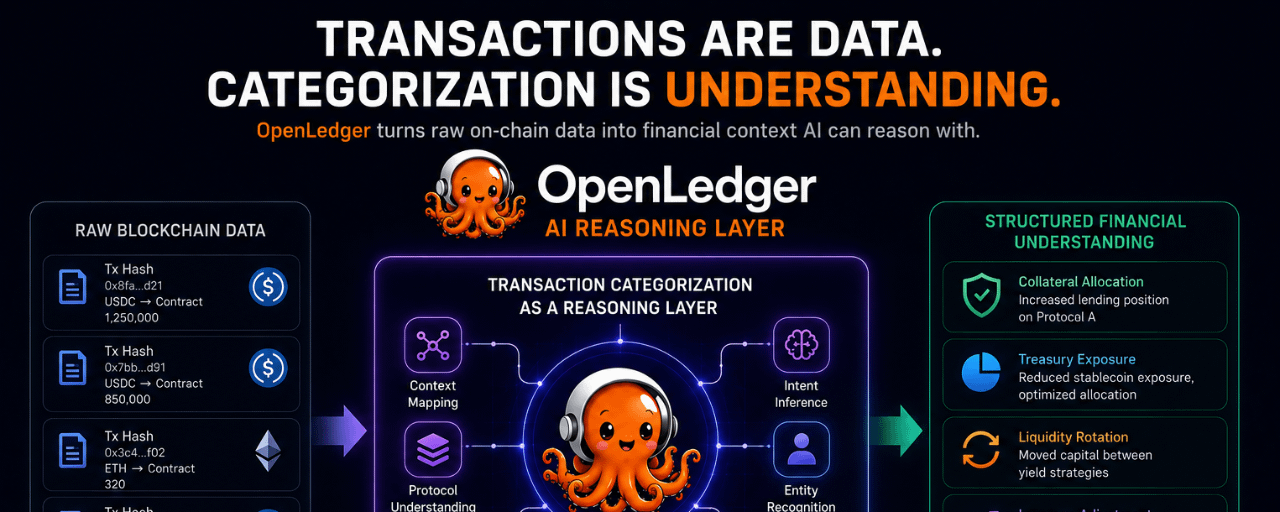
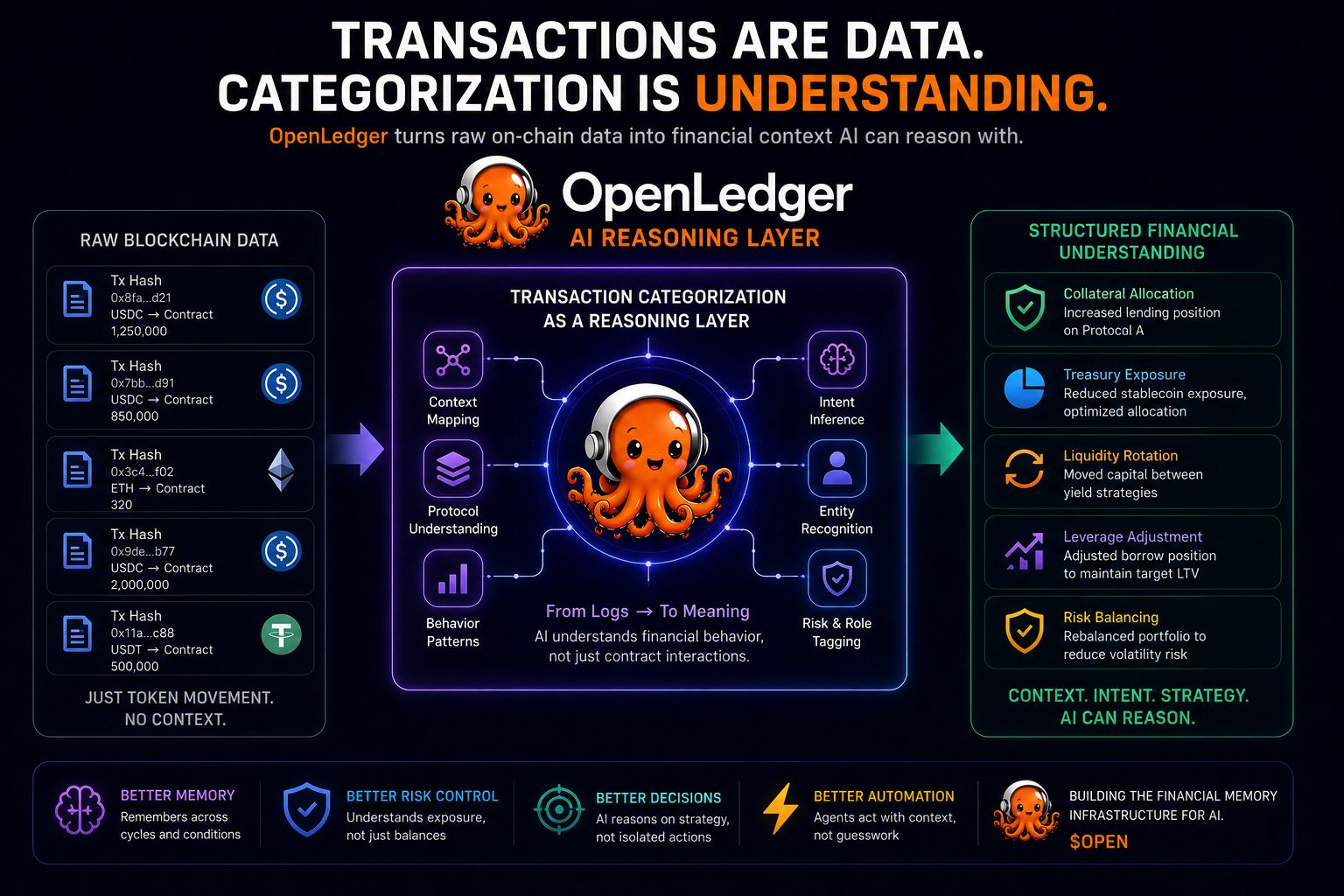
What made me stop longer was how they described transaction categorization as a reasoning layer for machines instead of just analytics for humans.
At first I honestly thought it was just another “AI-native” way of describing dashboards. But the more I dug into it, the more I realized this direction feels fundamentally different from how most on-chain data systems currently work 👀🧩
Over the past few months I’ve been exporting my own wallet history pretty often to track liquidity movements across chains.
And every single time I run into the same problem:
the transaction itself is visible, but the meaning behind the transaction is extremely blurry ⚡🌍
A stablecoin transfer could mean:
deploying liquidity,
reducing leverage exposure,
treasury routing,
collateral management,
vault rotation,
yield optimization,
or internal rebalancing 📈🔧
But on raw blockchain data, almost all of these actions collapse into the exact same thing:
token movement.
That’s where I started realizing something important.
Blockchains are incredibly good at recording state transitions.
But state transitions are not the same thing as financial understanding 🔄⚙️
I used to assume advanced AI systems could simply read raw transaction history and infer context automatically. Just feed enough data into the model and let reasoning emerge naturally.
But after looking deeper into OpenLedger’s direction around AI finance infrastructure, I think that assumption might actually be wrong.
Because machines don’t naturally understand intent from blockchain logs the same way humans do 🧠📊
For example:
If an AI agent sees USDC moving into a lending vault, a human familiar with DeFi can often intuitively guess: “okay, this is probably collateral deployment or liquidity management.”
But to a machine, that same transaction may carry almost no semantic meaning without additional context layers 👀⚡
And I think this is exactly where OpenLedger’s approach becomes interesting.
What they seem to be building is not just transaction indexing infrastructure, but a semantic abstraction layer where machines can reason about financial behaviors instead of raw contract interactions 🌐🚀
That distinction sounds subtle.
But I think it changes everything.
Instead of: “wallet A transferred tokens to contract B”
the system begins interpreting behavior as:
collateral allocation,
treasury exposure reduction,
liquidity rotation,
leverage adjustment,
yield deployment,
or risk balancing 🔧📈
At that point, categorization stops being a dashboard feature.
It starts becoming machine-operable financial context.
And honestly, I think that matters a lot for the future of AI finance systems.
Because once workflows become multi-chain and multi-step, raw transaction data becomes incredibly noisy 🔄🧩
Bridge stablecoins across chains. Refill collateral. Increase leverage. Move liquidity between vaults. Rebalance treasury exposure.
Viewed independently, these actions are just disconnected logs.
But financially, they may represent one continuous strategic behavior.
That’s the part I keep thinking about.
Current blockchain infrastructure often feels like a massive surveillance camera system recording every movement in extreme detail 📹⚡
But cameras alone do not explain intent.
They don’t explain:
who is managing liabilities,
who is allocating treasury capital,
who is hedging risk,
or which financial objective the movement actually serves 🌍📊
Traditional accounting exists because raw money movement alone is insufficient for understanding financial systems.
And OpenLedger gives me the impression they’re trying to bring a semantic accounting layer into on-chain AI infrastructure.
If that works, AI agents stop reasoning purely on isolated transactions and start reasoning on structured financial continuity instead 🧠🔧
That’s a completely different level of machine understanding.
One AI system only sees token transfers.
Another AI system starts understanding:
collateral health,
treasury exposure,
liquidity rotation,
portfolio stress,
and evolving risk conditions across the broader financial environment ⚙️📈
That’s where transaction categorization quietly becomes a reasoning substrate for AI finance.
Of course, I still see a lot of unresolved trade-offs 👀🌐
Crypto financial behavior is much messier than traditional accounting.
One liquidity movement may simultaneously:
optimize yield,
reduce risk,
hedge volatility,
and rebalance exposure.
If categorization layers oversimplify those behaviors, then higher-level AI reasoning could become distorted too ⚡🧩
And DeFi changes extremely fast.
Every cycle introduces new primitives, new vault structures, new leverage models, and new coordination mechanisms.
So the real question becomes:
can semantic systems adapt quickly enough, or will humans still need to continuously retrain the financial context layer themselves? 🔄📊
I honestly don’t know yet.
But after reading deeper into OpenLedger’s architecture, I’m starting to think the next competition in blockchain infrastructure may not simply be about storing transactions better.
It may be about helping machines actually understand what those transactions mean inside a much larger financial system 🧠🚀🌍
And I think that’s a far more interesting direction than most people realize.