
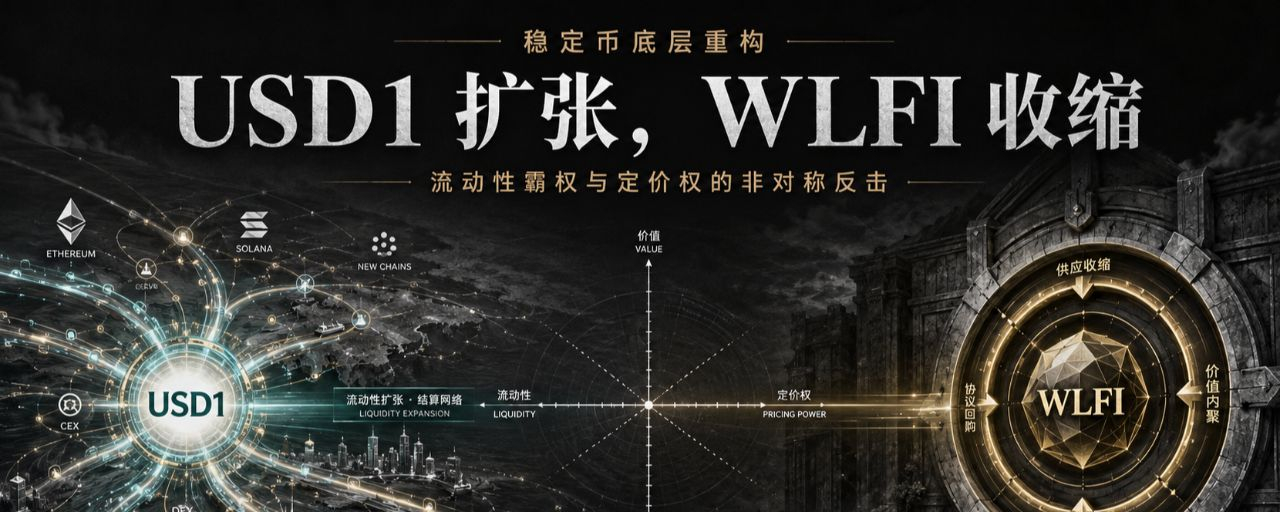
The market is going through a covert underlying restructuring, yet most folks only see the surface-level price fluctuations of the coins. When we examine the recent USD1 network expansion alongside WLFI's deflationary contraction in the same coordinate system, it becomes clear that this is not just a typical battle for stablecoin market share; it's an extremely precise monetary policy experiment. This is an asymmetric counterattack concerning liquidity hegemony and pricing power.
The competitive logic of stablecoins over the past few years has been quite singular; issuers could attract a large amount of speculative hot money in a short time just by offering high liquidity mining annual yields on decentralized exchanges. However, this market cap built on internal token subsidies is fundamentally extremely fragile. Without real liquidity anchoring scenarios, once the subsidies stop, liquidity can dry up instantly. The current battlefield is completely different. What truly determines whether a stablecoin can survive and even become a market benchmark is no longer just the number of trading pairs, but whether it can deeply embed itself into the underlying clearing layer of the global financial network.
This is precisely where USD1's recent strategy is most aggressive. It bypasses the lengthy process of gradually building retail consensus typical of traditional stablecoins and directly strikes at the liquidity heart of the crypto market. When Binance decided to raise the collateral ratio of USD1 in its margin system to 99.99% and simultaneously launch a hundred times leveraged BTCUSD1 perpetual contract, USD1's nature underwent a qualitative change. It is no longer just a dollar token used for hedging; it has officially become a top settlement asset in the eyes of large institutions and quantitative teams. In the derivatives market, the currency used for quoting and settlement often possesses the strongest liquidity hegemony. When contracts worth hundreds of billions start using USD1 as the collateral and settlement unit, it becomes an indispensable infrastructure for the entire market operation. This penetration into the core clearing layer is a moat that no high-yield subsidy can replace.
At the same time, USD1's reach is spreading across multiple chains in a grid-like fashion. From Ethereum to Solana, and even to emerging networks like Monad and Plume, this all-encompassing cross-chain layout is not merely for promotion but aims to lay down a liquidity superhighway with USD1 as the single pricing unit between isolated public chain islands. The future financial infrastructure will compete precisely in this capability of extending liquidity to the utmost.
Meanwhile, in the off-chain world, through TownSquare's asset pipeline worth up to one hundred million USD, USD1 is completing another crucial piece of the puzzle. It's attempting to seamlessly transmit high-quality liquid asset yields from traditional financial markets onto the chain. This means that USD1's value support point will gradually shift from relying solely on cryptocurrency collateral to a continuous cash flow from the real world. Once this structure is established, USD1 will gain self-sustaining capabilities, completely breaking free from dependency on internal token subsidies.
Just as USD1 wildly expands its business landscape, WLFI, acting as the core hub of the ecosystem, has activated an extremely strict deflationary mechanism in reverse. This is the most ingenious design of this dual-token model. In macroeconomics, if a sovereign nation wants its currency to become a global reserve, it must export its currency, which often leads to trade deficits and currency instability. In the World Liberty Financial system, USD1 plays the role of a circulating currency that expands everywhere, while WLFI absorbs systemic volatility through its balance sheet function.
Recently, the project team directly burned up to three billion WLFI and pushed for complete transparency in the unlocking schedule. This is not merely a market cap management tactic but a clear strategic signal to the market. In the past, to promote USD1's expansion, WLFI undertook a substantial amount of subsidy tasks, leading the market to harbor concerns about future dilution selling pressure. The current large-scale burning and transparency are proactive measures to clear this trust deficit. This indicates that the project team has realized that the era of relying on issuing more tokens for growth is over; the future core lies in capturing and solidifying value.
The current dual-track structure is now crystal clear. USD1 is aggressively expanding externally, seizing clearing rights from major exchanges and pricing power over real-world assets; WLFI, on the other hand, is fortifying its position internally, stabilizing value expectations through extreme supply contraction. One side is the infinite extension of liquidity, while the other side is the extreme concentration of pricing power.
If we are still evaluating WLFI using traditional governance token models, we will undoubtedly miss the true significance of this transformation. When USD1's clearing depth in the derivatives market rivals that of established stablecoins, and when cross-chain liquidity and real-world treasury yield pipelines are fully integrated, what WLFI is tied to is no longer a flimsy lending or issuance protocol. It will become the ultimate pricing hub for this vast and complex on-chain dollar liquidity network. This is a textbook-level underlying reconstruction, and we are witnessing the birth of a new generation of financial infrastructure.