
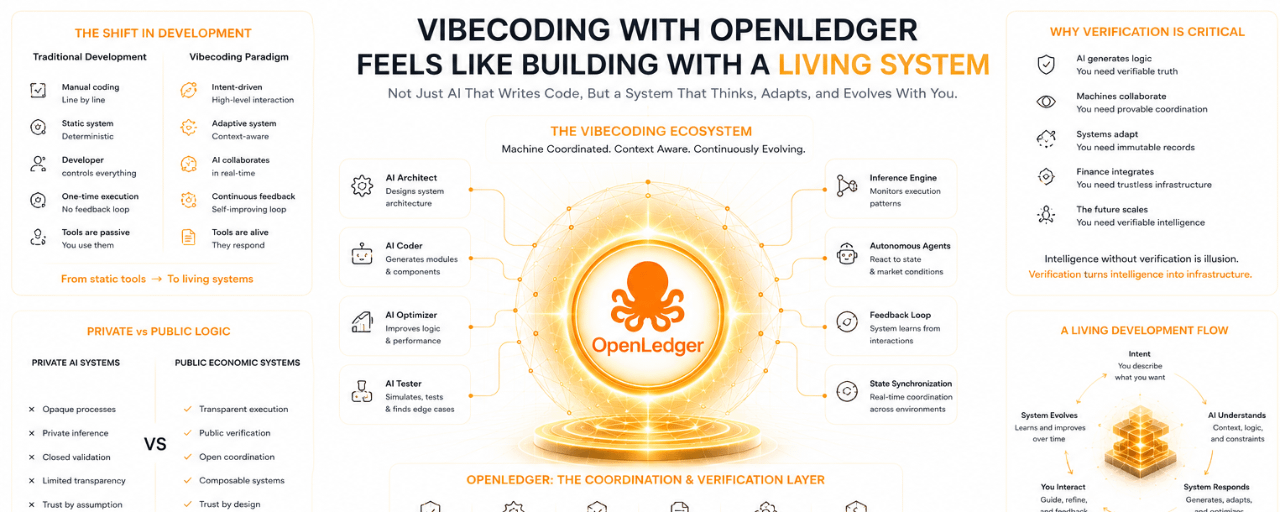
I think the weirdest thing about Vibecoding isn't just that AI codes faster, but the feeling that developers are starting to no longer 'control' the system in the old way. Previously, building software felt like sitting in front of a static machine; I would give commands, the machine would execute, and everything was deterministic to some extent. But the longer I use Vibecoding, the more I feel differently. It's like I'm no longer directly writing code but interacting with something that can adapt, infer intentions, and sometimes even suggest the next direction. It's no longer an IDE in the traditional sense; it feels more like a living system.
Interestingly, this feeling initially sounds a bit overhyped. I used to think so too. Many current AI demos create a sense of 'alive' just because the interface is good enough to mimic human conversation. But Vibecoding with OpenLedger makes me think a bit deeper because here, AI is not just generating text or autocompleting syntax anymore; it is starting to participate in the entire feedback loop of development.
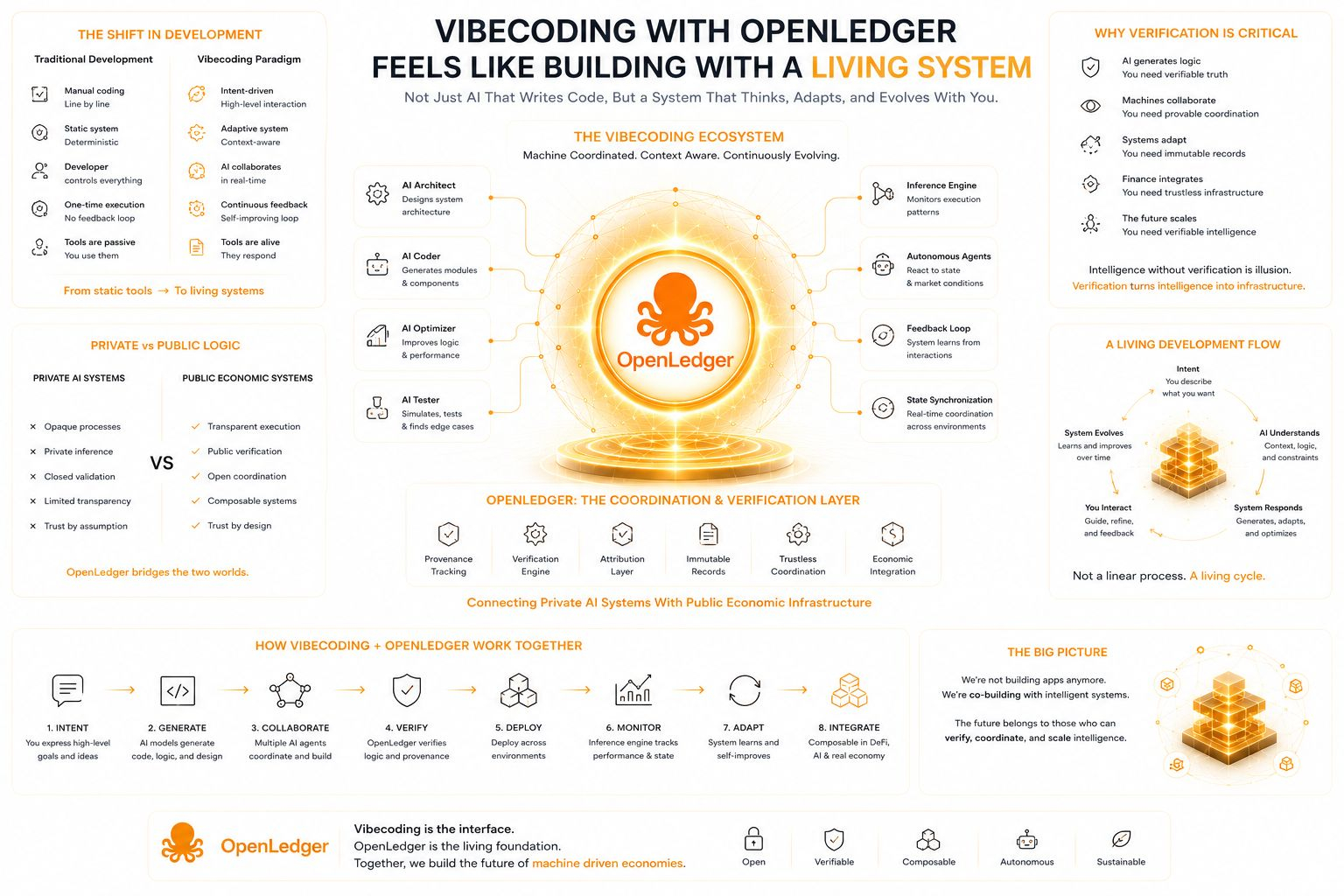
I see it more as a form of machine-coordinated development rather than traditional software engineering; it's not just about AI helping to write functions faster anymore. One model generates architecture, another model optimizes logic, the inference layer tracks execution patterns, and autonomous agents respond to the system's state almost in real-time. When many machine systems start to coordinate like this, the feeling of 'building with a living system' begins to feel quite natural.
If we reduce everything to the simplest primitives, software used to be a static instruction set. Now, AI-native development is starting to resemble an adaptive system more. The system not only executes instructions but also reacts to the intentions, contexts, and behaviors of the builders.
The interesting thing is that this leads to a significant shift in trust.
Because when humans no longer manually control every line of logic, verification suddenly becomes the central issue. An AI-generated module can operate perfectly on the surface but still contain assumptions that the developer isn't aware of. An autonomous trading agent can optimize yield extremely well but simultaneously introduce risk patterns that no one fully understands, and if machines start to coordinate with machines in the development flow, then the important question is no longer 'Is the AI coding well?' but 'How do we verify machine-generated behavior?'
That's where OpenLedger has caught my attention quite a bit.
I don't think they're trying to build another AI coding assistant. In fact, if you only look from the perspective of consumer products, the market has many flashier options. But I see OpenLedger as a layer of coordination for machine-generated work. This is important because as Vibecoding becomes stronger, development shifts from human execution to machine orchestration, and as orchestration increases, the verification layer underneath will almost certainly need to evolve.
The difference lies in private and public systems.
Currently, most Vibecoding still exists in a private environment. Prompt private, inference private, execution private. Users just need the output to work, but blockchain and AI native DeFi operate on the opposite logic. An AI-managed vault can't just 'look right'; it needs to be sufficiently transparent for capital to trust the underlying system. Autonomous liquidity is the same way; it's not just execution but also the provenance of that execution that matters.
I think there's an interesting consistent logic between AI and crypto that few people talk about. AI optimizes for intelligence. Blockchain optimizes for verification. One side is trying to make machines think better while the other side is trying to make systems more trustless, and if machine-driven finance really scales in the coming years, then these two will almost certainly have to merge somewhere.
@OpenLedger echo I feel like they're trying to build that intermediary layer quite early.
It's not just a place where AI generates code or automates workflows, but a space where machine-generated activity can be verified, attributed, and eventually integrated into the economic infrastructure in a more public way. This sounds a bit abstract, but I think that's the direction everything is heading. When AI begins to deeply participate in development, liquidity management, and strategy execution or autonomous coordination, then 'truth' is no longer an optional feature.
The interesting thing is that the market right now is still pricing the most visible aspects of AI. Faster demos, quicker app builds, and prettier UIs, but the underlying infrastructure is what ultimately determines whether the system will endure. Like the early internet, the most exciting part wasn't TCP/IP, but eventually, the entire ecosystem ran on it.
And I think Vibecoding with OpenLedger reveals a rather unusual insight. The future of development may not be humans just using tools anymore, but rather humans collaborating with machine systems in a way that's more like an ecosystem. A system that continuously responds, optimizes, self-adjusts, and learns from its own interaction flow.
The real challenge is that I'm still not sure if people are ready to trust such systems. The more abstraction there is, the less direct visibility people have into the underlying logic. But perhaps that's also a natural direction of software evolution—from manual execution to autonomous coordination.
If that's true, then the feeling of 'building with a living system' might not just be a vibe anymore.
#OpenLedger $OPEN
