
Most AI projects right now feel empty the second you look past the marketing. Same recycled promises everywhere. Same dramatic threads about “changing the future.” Same polished websites filled with words nobody even talks like in real life. Every project suddenly claims to be building the next generation of intelligence, but when you actually look deeper, most of them are just repackaging the same centralized systems with a crypto label attached on top. That’s why so many people stopped caring. The excitement faded because the space became flooded with noise. Too many founders trying to manufacture hype. Too many tokens pretending to be technology. Too many people chasing trends without even understanding what problem they’re supposed to solve anymore.
And honestly, the weirdest part is that the real issue inside AI is sitting right in front of everyone, but most conversations still avoid it completely. AI today is controlled by a very small number of companies. They own the infrastructure, the compute power, the models, the cloud systems, and increasingly the data pipelines too. Everything runs through them. Developers depend on them. Startups depend on them. Even many “open” AI tools still quietly rely on the same centralized providers underneath the surface. The industry talks constantly about innovation while power keeps concentrating in fewer hands every single year. That’s the part that feels uncomfortable once you really sit and think about it.
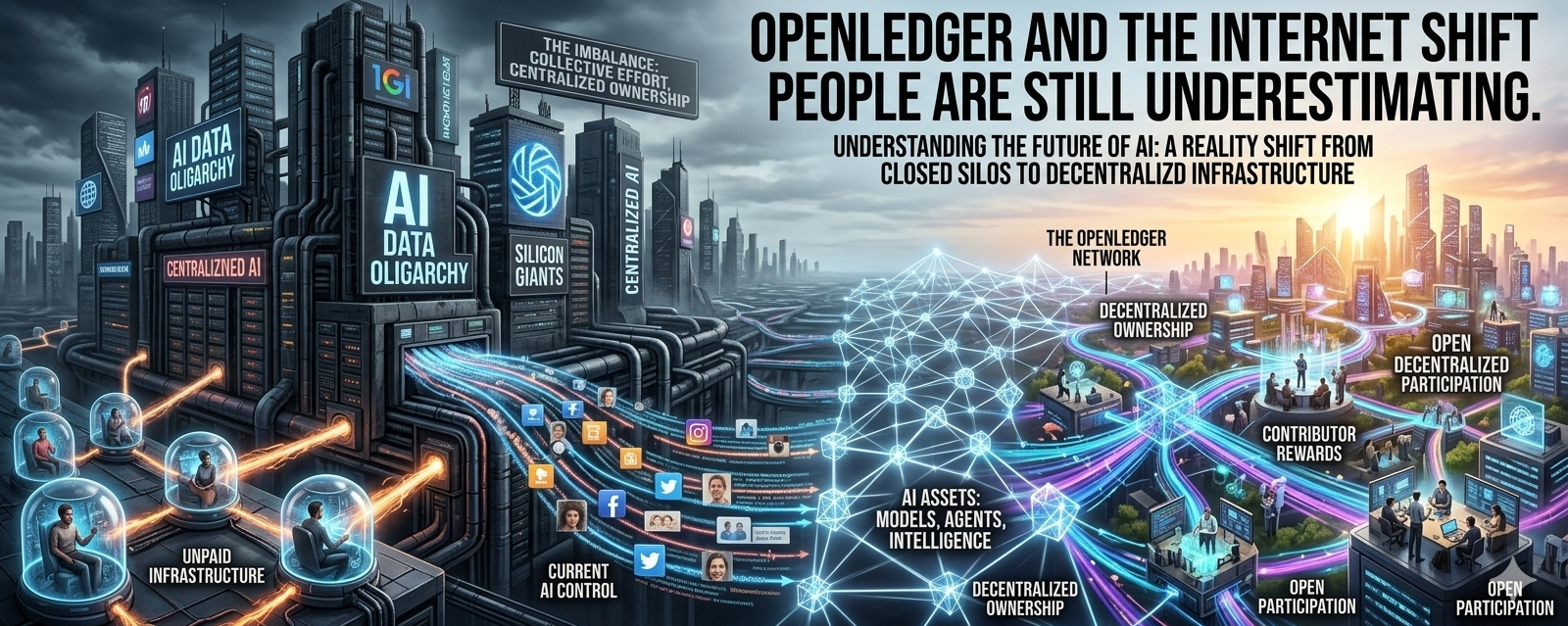
Because AI doesn’t appear out of nowhere. It runs on human behavior. Human conversations. Human creativity. Human patterns. Human mistakes. The internet itself became training material and most people never fully realized it was happening in real time. Every search, every post, every interaction, every preference, every habit people leave online slowly turns into fuel for these systems. Then giant companies package that intelligence into products worth billions while the people generating the raw value remain completely disconnected from the upside. Users became unpaid infrastructure for an economy they don’t control.
That imbalance is exactly why projects like OpenLedger even get attention in the first place. Not because people suddenly became blindly bullish on crypto again. If anything, crypto already burned a huge amount of trust over the years. Too many scams, too many fake ecosystems, too many influencers pretending every low-cap token was somehow revolutionary technology. Most people are exhausted by that cycle now. But underneath all the speculation and nonsense, OpenLedger is at least pointing toward a real problem instead of inventing fake ones for engagement. And right now that already makes it more interesting than most projects entering the AI conversation.
The core idea behind OpenLedger is actually simple once you strip away all the crypto vocabulary around it. Right now AI assets mostly live inside closed systems. Data stays trapped. Models stay trapped. Developers build useful tools that become dependent on one company’s ecosystem forever. The platforms collect the leverage while contributors slowly lose ownership over what they create. OpenLedger is trying to build around the idea that AI resources should move more freely instead of remaining locked inside centralized corporate walls. Data, models, agents, and intelligence systems should function more like open economic assets that people can contribute to, build on, monetize, and interact with across a network.
And honestly, that idea makes more sense the longer you look at where the internet is heading. Because AI is no longer just some niche technology experiment anymore. It’s becoming infrastructure underneath everything. The systems are getting smarter, faster, and cheaper every month. Soon AI agents won’t just answer questions or generate content. They’ll automate workflows, handle transactions, interact with applications, coordinate tasks, and potentially make decisions across huge sections of the digital economy. That sounds exciting until you realize how dangerous it becomes if all of that power stays concentrated inside a handful of companies controlling the rails underneath the system.
That’s the real conversation people keep dancing around. Everybody argues about meme coins and temporary market trends while the structure of the internet itself is quietly changing underneath them. Intelligence is becoming infrastructure. Data is becoming economic power. Access to compute is becoming leverage. And the companies controlling those layers are growing stronger incredibly fast. Smaller developers already struggle to compete because modern AI systems require expensive hardware, massive datasets, and infrastructure access most independent builders simply cannot afford. Even open-source AI still depends heavily on centralized cloud providers because the barrier to entry remains extremely high.
So when OpenLedger talks about decentralizing AI ownership and coordination, people listen. Not because they think blockchain magically solves everything, but because the current setup already feels broken. Regular users continuously create value online without participating in the systems profiting from that value. That tension becomes harder to ignore as AI moves deeper into everyday life. The internet trained these models collectively, but the ownership structure around them became incredibly concentrated anyway.
And maybe blockchain actually has a real use case here for once. Not for random speculative garbage. Not for another meaningless token with a cute logo and fake community hype. Actual infrastructure. Actual coordination systems. Ways for contributors, developers, and smaller participants to retain ownership and economic participation inside AI ecosystems instead of becoming invisible raw material feeding giant centralized platforms forever. That was supposed to be one of the original promises behind crypto before the entire industry got swallowed by endless casino behavior and short-term greed.
Of course, none of this guarantees OpenLedger succeeds. Execution is always the hardest part. Every project sounds ambitious during hype cycles. Reality comes later when networks need real usage instead of temporary speculation. Incentives attract bad actors. Open systems attract spam. Farming behavior starts. Communities become obsessed with price action instead of utility. The cycle repeats over and over because money moves faster than technology matures. OpenLedger could absolutely struggle with the same problems every crypto project eventually faces. That possibility is real.
But at least the direction feels connected to an actual shift happening in the world right now instead of manufactured narrative farming. Because whether people fully realize it or not, AI is becoming one of the most important economic and political technologies on earth. Governments know it. Corporations know it. Investors know it. The systems being built today will shape who controls information, automation, digital labor, and online infrastructure for years. That’s why questions around ownership suddenly matter so much more now than they did before.
Who owns the models? Who controls the data? Who decides access? Who benefits financially from these systems becoming smarter? What happens when AI agents become deeply integrated into everyday online activity? What happens when intelligence itself turns into a marketplace? Nobody really has clean answers yet. That uncertainty is exactly why decentralized AI projects keep appearing now. They see the same future coming. They understand that leaving the entire intelligence economy under centralized control creates risks people still haven’t fully processed.
And honestly, that’s probably why OpenLedger feels more interesting than most AI projects floating around today. It’s not selling some fantasy about overnight wealth or pretending the future arrives through marketing slogans alone. It’s trying to build around the idea that intelligence itself is becoming an economy, and economies eventually force difficult conversations about ownership, participation, and power whether people are ready for them or not.
Maybe it works. Maybe it doesn’t. Maybe the execution becomes harder than expected. Maybe speculation eventually contaminates the entire ecosystem like it always does. All of that is possible. But at least the problem it’s aiming at feels real. And right now, that already separates it from most of the noise flooding both crypto and AI.
Because the internet is entering a different era now. AI isn’t slowing down. The infrastructure race is accelerating. Data has become one of the most valuable resources on earth and most people handed it away years ago without understanding what it would eventually become. Now the entire industry is scrambling to figure out how ownership fits into a future where intelligence itself becomes part of the global economy.
That’s the shift people are still underestimating.
