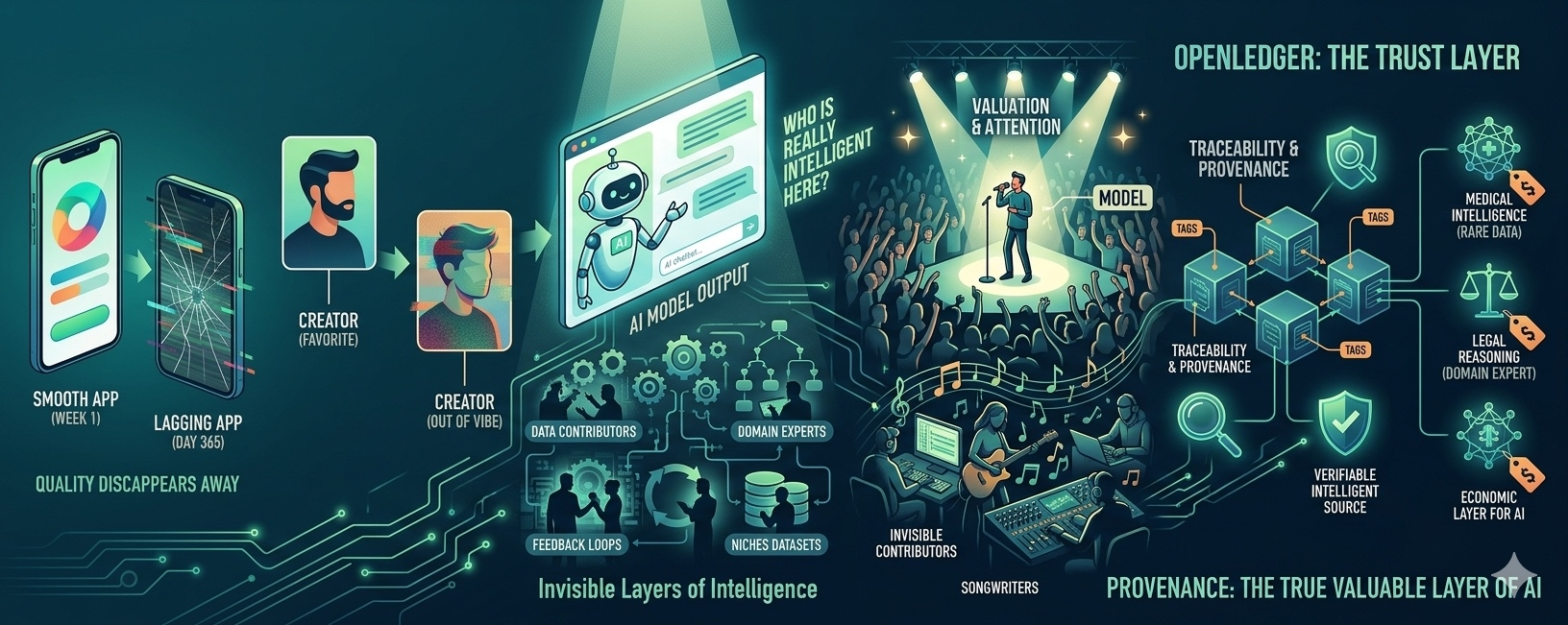
I've noticed something pretty funny but all too common: we usually only start paying attention to the source of quality when that quality dips.
You’ve been using an app that runs smoothly for a whole year, then one day it suddenly feels sluggish, and you have no idea why. You used to follow a creator you really liked, but at some point, their content just doesn't have the same vibe anymore. The strange thing is, most of the time, what changes isn't on the surface. The surface often stays the same; it's just what's behind the scenes that quietly shifts without anyone noticing.
I don't know why that feeling comes back when I read more deeply about @OpenLedger
I've always thought of AI as a battle of models. The higher benchmarking model wins, the better reasoning wins, the longer context wins. Every time a new model launches, the internet acts like the race has entered a new era. But the more I look closely, the more I see the entire industry is too focused on what's on stage, forgetting a very simple question:
Who is actually making this AI smart? It sounds strange at first, but when you think about it, this is a very important question.
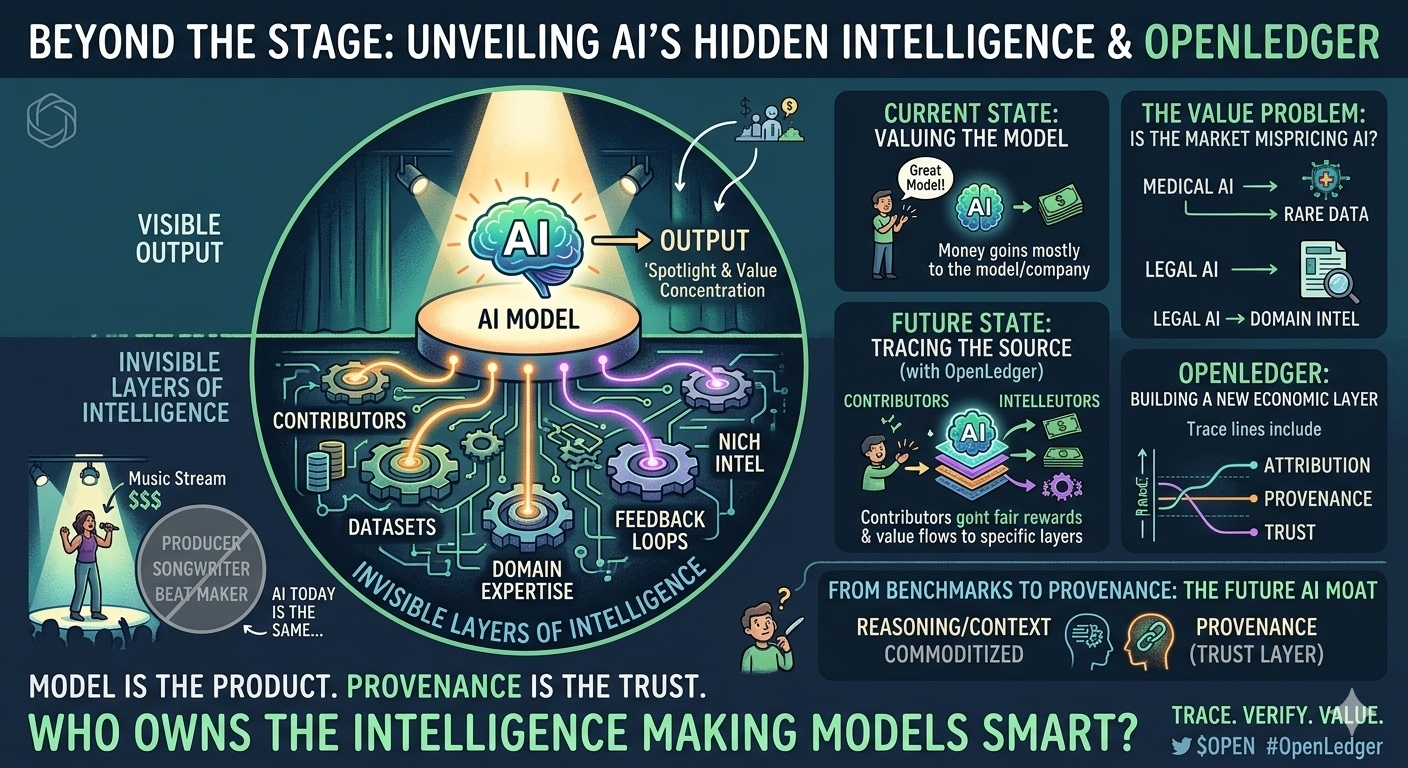
We often look at the final output and automatically assume the intelligence lies in the model. If a chatbot responds well, we think the model is smart. If AI analyzes deeply, we think the reasoning is strong. But a strong model doesn't just appear out of thin air. Behind it are data, feedback loops, domain expertise, contributors, and many layers of intelligence that most users never really see.
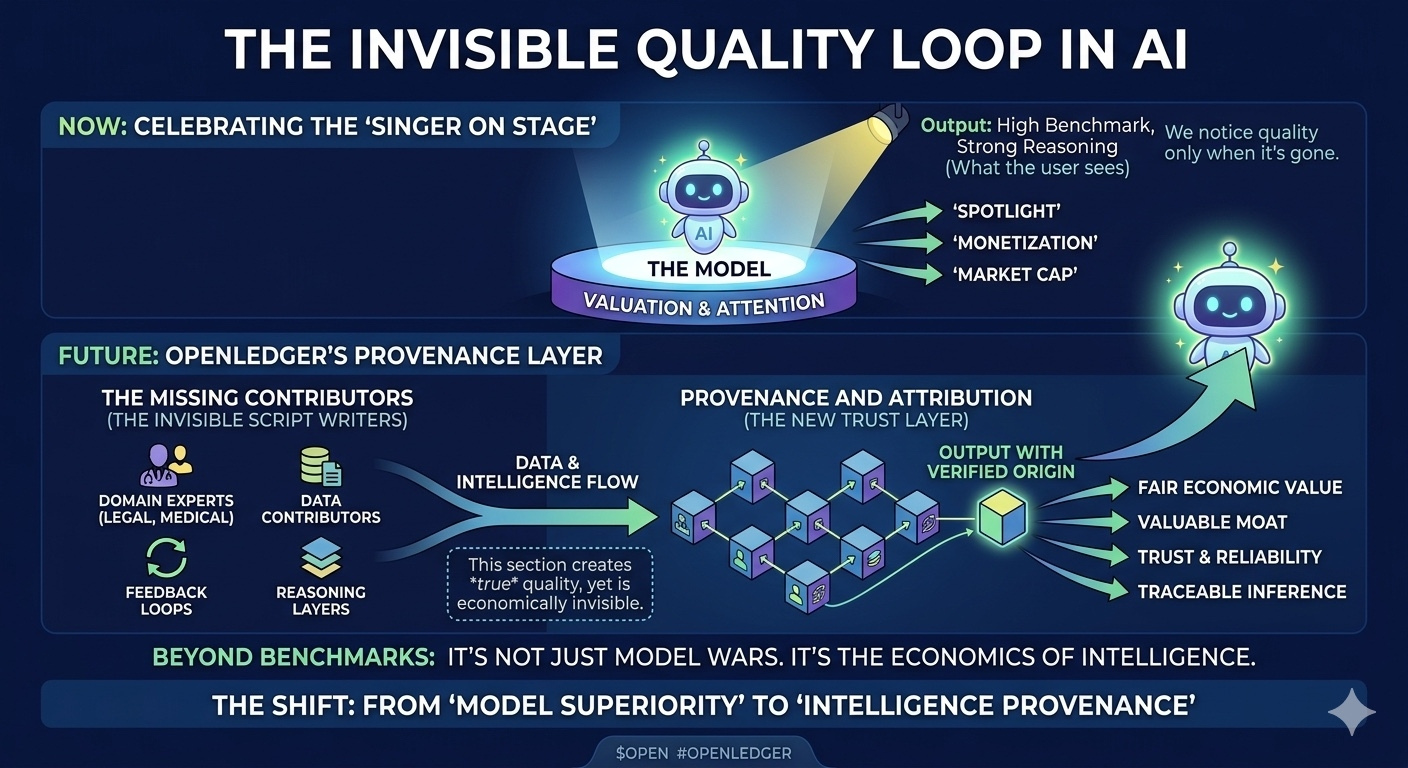
What I find interesting is that the part that creates true quality is almost invisible from an economic standpoint.
A model that produces excellent output and almost all the spotlight is on the model or the company in front. Valuation rises, attention rises, monetization rises. But the layers of intelligence behind it, the contributors that help improve the output, or the data sources that create real advantages almost vanish from the value narrative. The more I think about it, the more I see this isn't just a fairness issue.
Many people see this as a familiar story: those who contribute should be compensated. That's true, but I think the issue is much larger. If the part that creates intelligence remains invisible, the market will struggle to understand what is truly creating value for AI. And when the market can't see the source of value, it often misprices it.
A stronger medical model may not necessarily be due to better architecture. It could be stronger because it is 'fed' by a rare, high-quality dataset with greater specialization. A better legal AI assistant isn't necessarily due to groundbreaking reasoning, but because there's stronger domain intelligence behind it. But currently, that differentiating part is often mixed into a black box that's hard to see through. This reminds me a lot of the music industry.
You listen to a song on Spotify, but the money doesn't just flow to the singer on stage. Producers, songwriters, beat makers, or publishers all have their own attribution because everyone understands that a hit song doesn’t just appear from one person. Without those invisible layers behind it, the song might never have become a hit.
The interesting thing is that AI right now is somewhat backwards in this regard.
An excellent output appears, and almost all the spotlight shifts to the final model. But behind it may be very niche contributors, quality datasets, or domain experts creating the crucial intelligence that no one really sees. We're rewarding the 'singer on stage,' while very few know who is writing the music behind the scenes.
This is when I started paying more attention to OpenLedger. Initially, I was quite skeptical because crypto has had too many narratives about AI in the past few years. Decentralized compute, decentralized inference, decentralized model economy… I've read so much that sometimes it feels like it's just the same story with different packaging. In the end, it still comes back to the question of who has the stronger model or larger compute.
But the deeper I dive into OpenLedger, the more I realize they are starting from a slightly different question. It's not: 'How do we build a stronger model?' but rather: 'If AI creates intelligence, where does that intelligence actually come from?'
The moment I started finding this question interesting was when I realized: if contributions in AI can be traced at the time of inference, meaning you know this output improved thanks to which source, dataset, or contributor, then the narrative is no longer just about fairness.
It begins to become provenance. And provenance is often very important as the market begins to mature.
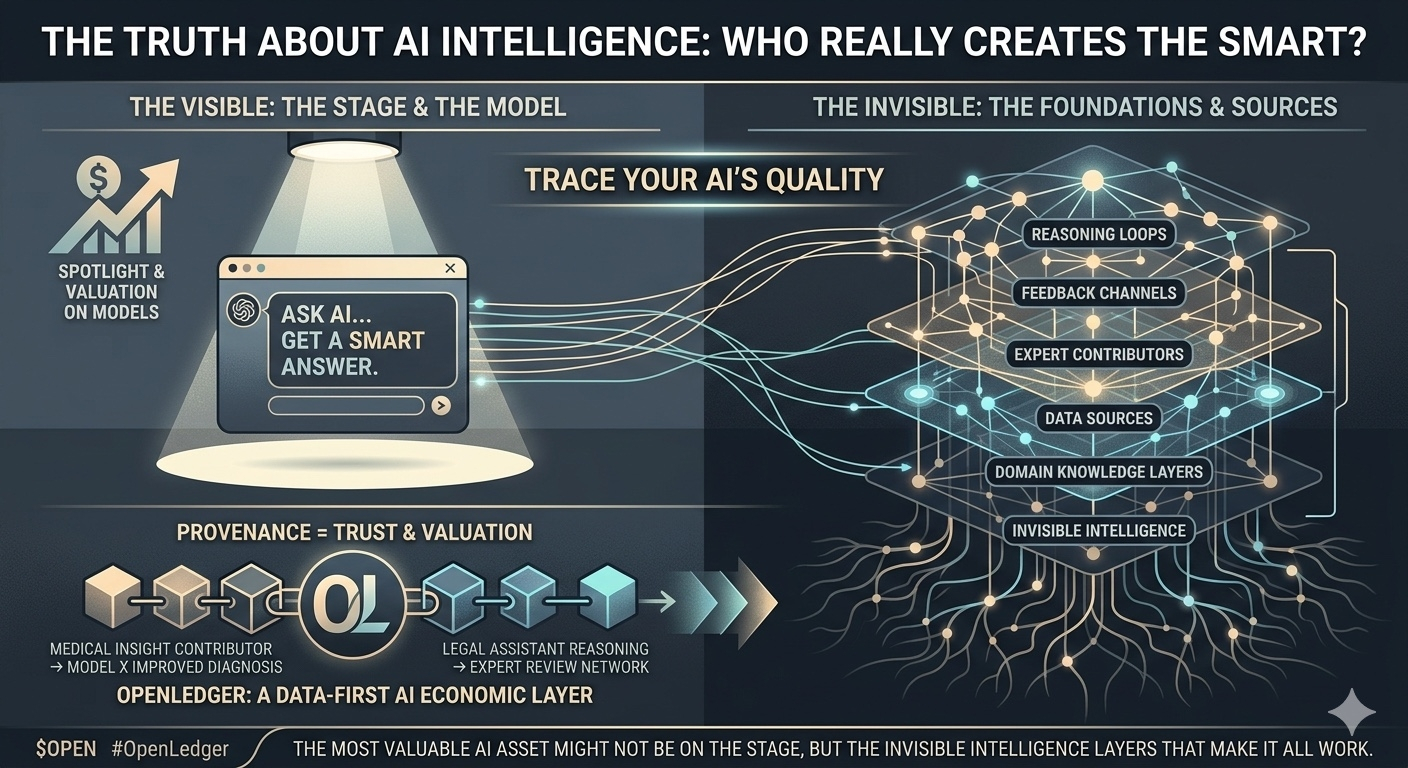
We are willing to pay more for food with clear origins. We trust brands that can prove their supply chain. Simply because when quality matters, people start caring about what's behind creating that quality.
I think the future of AI will be like that too. A good output alone may not be enough. When AI steps into finance, research, healthcare, or autonomous agents, people will start asking harder questions. Where does this intelligence come from? Who is influencing its quality? Are the incentives behind it aligned? And if the output is wrong, can we trace back its origins?
That's when I began to see that OpenLedger might not just be building another AI protocol. It feels like they are trying to create a new economic layer for AI.
Because when something can be traced, verified, and consistently creates value, the market will usually find a way to price it. A high-quality source of medical intelligence could hold its own value. A contributor layer that consistently improves reasoning could become valuable infrastructure. A domain-specific intelligence network could become a true moat rather than just 'supplementary data.' It sounds far-fetched, but the internet has gone through something similar.
There was a time when attention was seen as free. Followers or communities were just for 'fun.' But then the creator economy emerged, and suddenly influence became a real asset. A new economic layer formed from what was previously seen as invisible. I wonder if AI is standing at the right moment for something similar.
Today, we are still talking a lot about benchmarking, reasoning, or model performance. But in a few years, the strong model might not be rare anymore because everyone will be good enough. What may be rarer is: Intelligence with clear and trustworthy provenance. A model could just be the final product of AI. But provenance is the new trust layer of AI.
And if that trust layer really forms, the biggest question in the industry might no longer be: 'Which model is smarter?' but rather: 'Who owns the source of intelligence that makes that model smarter?'
Because sometimes the most valuable thing in AI has never been what's under the spotlight. But rather the invisible layers behind it that give the entire stage a reason to exist in the first place.