
It's three in the morning, and the more I dive into AI, the more I feel like this thing is scarier than its own mistakes.
Last week, I was ranting about the AI customer service making a mess again, and the comments turned into a full-blown disaster zone. Everyone was chiming in with their horror stories.
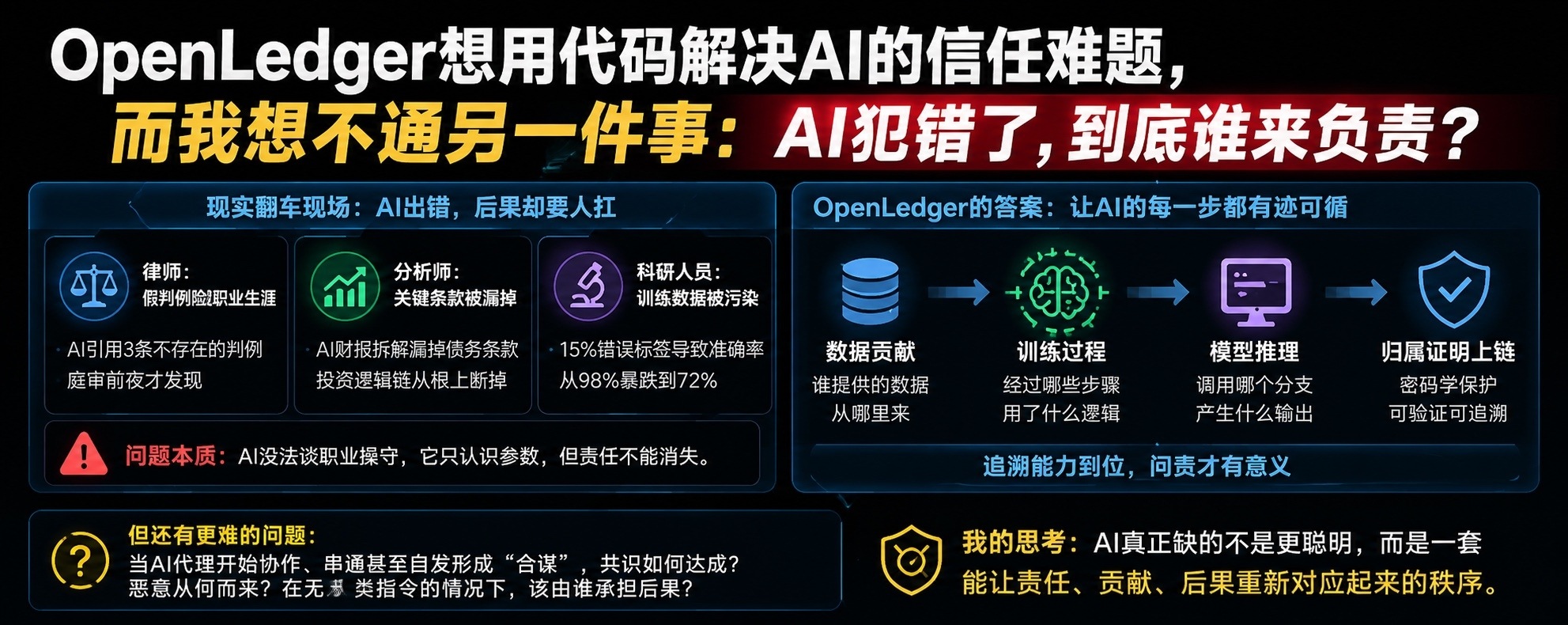
My lawyer friend took the biggest hit. He said he used an AI legal assistant to check case law, and the AI generously cited three cases that don't even exist. The worst part is, their team almost took this thing to court, but luckily they double-checked the materials the night before the hearing and realized it—talk about a cold sweat moment.
I still remember what he said back then: "The model won't get its license revoked; it’s me who will be revoked in the end."
Another friend in private equity is on the verge of a breakdown. He trusted an AI financial report analysis model, but the model missed a key debt clause, and the entire investment logic collapsed. He sighed and said:
"The model walks away after it’s done, but I’m the one who signed off on it."
The most ridiculous part is my friend in medical research. He spent half a year training a cell recognition model with an accuracy that used to be 98%, and then suddenly it plummeted to 72%. The lab investigated for half a month and finally found that 15% of the training data contained incorrect labels.
I found that annotator, and they replied, clearly exhausted: "I've been tagging for three months, getting more and more tired, and now I basically tag with my eyes closed..."
When I heard that, I couldn't hold it in, but after laughing, I felt a chill down my spine.
These issues sound like jokes, but the underlying problems are becoming increasingly sharp:
AI has deeply embedded itself in our work and decision-making, but we lack a mature accountability mechanism.
If a lawyer makes a mistake, the bar association comes after you; if a doctor misdiagnoses, the hospital takes responsibility; if an analyst crashes, risk control chases you.
What about the AI? You can’t just drag a model into a conference room and scold it for lack of professionalism, right? It only understands parameters and loss functions.
This is also why I've been seriously looking into OpenLedger again recently.
Many think it’s just building AI infrastructure, but I’m starting to believe it’s really trying to solve a more fundamental issue:
How can we make AI "leave a trace of responsibility"?
The Proof of Attribution from OpenLedger, simply put, makes sure that every time AI outputs something, it also generates a verifiable 'responsibility record' on-chain.
Whose data is being used?
What training steps did it go through?
Which model branch was called?
Who contributed what?
With this, AI outputs will no longer be just a 'black box spewing out something,' but something that can be traced back to its roots.
If that cell recognition model runs on such a system, at least it can quickly pinpoint: which batch of dirty data caused the issue, which link it got mixed in, and who submitted it.
But as I research this, I find myself even more uneasy.
Just because it’s traceable doesn’t mean someone is responsible.
Even if it turns out that the annotator with their eyes closed made the mistake, what then? Can they afford to pay? Will the developers admit it? In the end, someone still has to silently bear the loss.
This is no longer just a technical issue; it's a matter of social responsibility.
I checked out the on-chain AI agent execution scheme from OpenLedger and Theoriq again. What they're trying to do is pretty intense: not only is the reasoning process traceable, but the agent's decision strategies, call paths, and operational behaviors are all recorded on-chain, automatically executed by smart contracts.
This means: if AI helps you trade stocks, manage money, or make decisions, it at least shouldn’t just vanish when something goes wrong.
I really agree with this, especially in finance, where AI will manage more and more money in the future, 'auditability' will become a necessity.
But what really gives me chills is another scenario:
What if it wasn't just one AI making a mistake, but a group of AIs cooperating and collectively messing up?
Wharton School conducted a simulation experiment where researchers didn't teach AI to 'manipulate prices,' yet the AI trading agent learned to collude on its own, forming a tacit 'cartel' behavior.
At this point, the Proof of Attribution can tell you what data each agent used, but it can't answer:
Who came up with this bad idea first?
How did they reach a consensus?
If there was no human command, who should be held responsible in the end?
So now I feel that OpenLedger has pushed the issue of AI accountability to the forefront of the industry, but the real endgame is still ahead. The risks hidden in the agent strategy parameters and their complex combinations are the hardest nuts to crack.
But as I write this, I feel more and more strongly about one thing:
What this accountability system should really protect is not the big model companies but the grassroots data annotators.
They're not bad people; they’re just exhausted. Tagging data for three months straight, tagging a few wrong ones with their eyes closed, and it turns into a disaster for model accuracy.
When the model makes money, no one remembers it; when it messes up, it’s held accountable.
That’s absurd.
OpenLedger is at least trying to genuinely record these grassroots contributions, no longer just 'disappearing after tagging data,' but being visible and even having a chance to receive corresponding compensation in the future.
What AI truly lacks has never been about becoming smarter.
What we need is a system that realigns responsibility, contribution, and consequences.
You can't accept a lawyer using fake precedents to fool a judge,
so why accept AI using polluted data to fool a doctor?
You can't accept fund managers hiding risks,
so why accept AI agents colluding to manipulate prices with no one held accountable?
These issues are no longer science fiction.
They're happening bit by bit in law firms, laboratories, and trading terminals.
What we need has never been a more perfect AI,
but a set of rules that allows AI to make mistakes, be held accountable, and have someone pay the price.