

CodexField is undergoing a complete upgrade to become a unified asset market system for the AI era. In this system, it will possess capabilities for autonomous trading, intelligent execution, cross-chain liquidity aggregation, and asset verification. It will be able to support various elements such as crypto assets, RWA, strategic assets, and model assets under the same framework, autonomously generating profits based on AI capabilities.
In the new ecological system of CodexField, CodexField has further expanded into two major ecological product systems, including the AI Vault revenue system powered by the Codex AI Engine, and five major sectors — CDX trading platform, CDX DEX, aggregation ecology, CDX Wallet, and content/model asset system. This product matrix further constitutes the complete foundation for the execution, clearing, entry, depth, and asset sources of the ecosystem. The five major product sectors have already been gradually introduced to the market, and CodexField's role in the market is shifting from a tool-based product to a foundational infrastructure capable of supporting multi-asset liquidity and automated management.
Recently, CodexField further opened the AI Vault product, which operates based on the self-developed Codex AI Engine, providing participants with sustainable on-chain income paths through real-time data analysis, automated strategy execution, and cross-market scheduling. With the launch of the AI Vault, the value cycle mechanism of CodexField officially enters operational status, transitioning ecosystem growth from a user-driven model to an AI-led continuous growth structure.
Value Cycle Engine: AI Vault Ecosystem
CodexField's AI trading engine (Codex AI Engine) is the execution hub of the entire ecosystem, responsible for real-time decision-making, path selection, and automated ordering in a multi-chain, multi-asset environment. Based on the self-developed AI strategy system, the system can continuously analyze depth, price slippage, funding costs, and transaction probabilities based on on-chain data, order flow structure, and market micro-indicators, thereby finding the optimal execution path for trading, strategy, and fund scheduling at any given time.
During operation, the AI engine dynamically adjusts its decisions based on market changes, including reassessing risk status, rebuilding paths, adjusting positions, or taking early losses. All behavioral data, execution effects, and market feedback will be included in training samples, continuously improving the stability and efficiency of yield through iterative cycles—forming a self-evolving system that gets stronger as it runs.
The AI engine not only undertakes strategy execution but also serves as a risk buffer within the ecosystem. When on-chain liquidity tightens, market volatility increases, or a certain asset pool experiences fund imbalance, the system actively adjusts internal liquidity allocation, accesses external depth, and reduces risk exposure to ensure the overall resilience of CodexField. As the ecosystem expands, the AI engine will gradually become a protocol-level liquidity source, providing the network with continuous income, depth, and stability.
Based on entirely new execution capabilities, the AI Vault has realized a fully automated income system. The AI Vault utilizes the engine's real-time decision-making and cross-market scheduling capabilities to aggregate trading profits, arbitrage opportunities, derivative income, and multi-platform incentives into a continuous income stream, providing participants with stable output without manual operation. As more assets and funds flow into the ecosystem, the AI Vault will become one of the core growth engines after the value cycle of CodexField is initiated.
The three phases of AI Vault development
In the overall architecture of CodexField, the AI Vault plays a core role in income production, asset scheduling, and ecological value return. To ensure the sustainability and scalability of the income system, the AI Vault will gradually release capabilities in three phases, each corresponding to stronger market reach, richer strategy scenarios, and more robust value cycle systems.
In the first phase, the system uses PoA as the initial source of funds and user participation.
Users receive CODEX rewards after contributing assets and participation in PoA. If sold, it will trigger a protocol layer buyback, with 35% of the buyback shares directly injected into the AI Vault to reward participants from the genesis phase. In this way, the vault gains initial income from real market behavior early on, establishing a foundational funding pool for subsequent strategy execution and capacity expansion, and providing clear and visible incentive paths for the first batch of users.
Entering the second phase, the income source of the AI Vault begins to officially grow from 'within the ecosystem'.
The AI engine will execute quantitative strategies on the CDX trading platform and CDX DEX, including spot and perpetual spread capture, market-making liquidity supplement, risk indicator balancing, and automated trading strategies relying on internal depth. In this phase, the system's income structure becomes clearer, consisting of real trading volume, market-making profits, and internal strategy execution yields, all distributed transparently and verifiably according to rules to users participating in the vault. This is a key point for the AI Vault transitioning from 'initial accumulation' to 'strategy execution' and marks the first formation of the value return system.
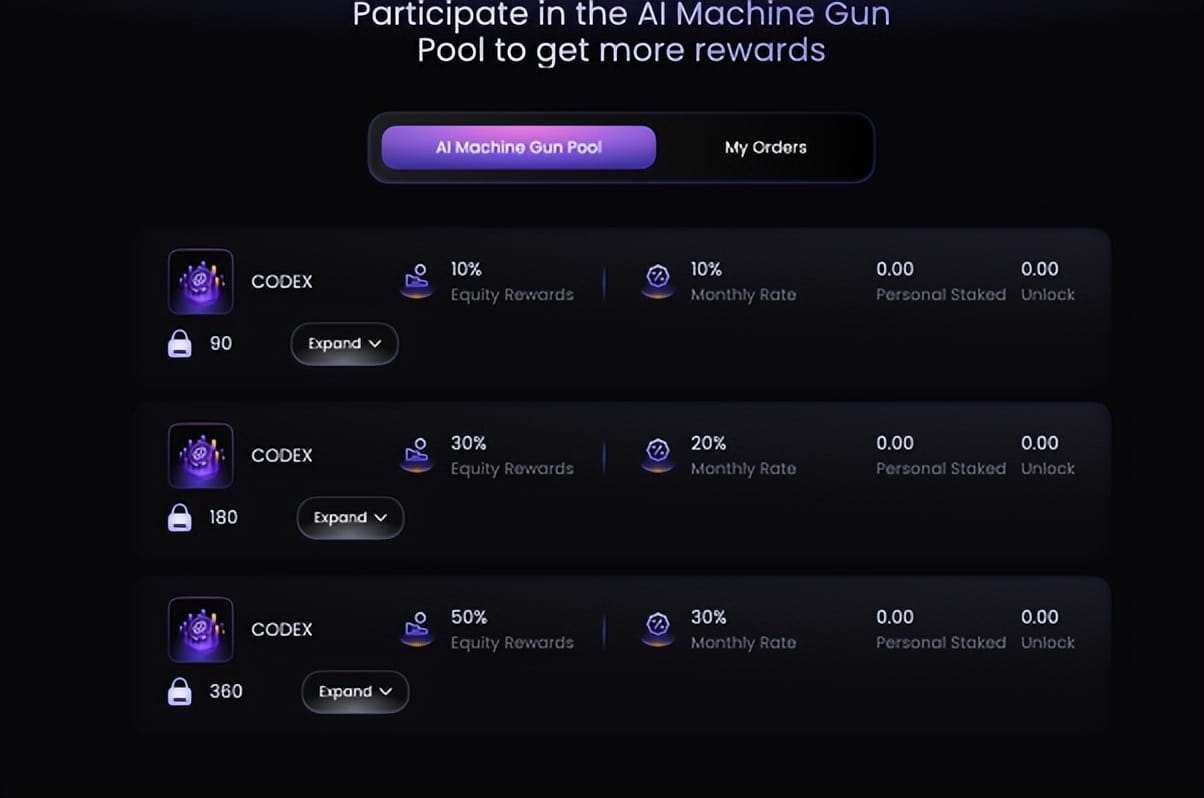
Once the AI execution capabilities mature, the vault will enter the third phase, fully moving towards open cross-market strategy execution.
In this phase, the capabilities of the Codex AI Engine will expand to the entire network: automatically scheduling strategies across chains, exchanges, derivatives, and multi-asset systems, including arbitrage, trend-following, portfolio management, and external depth utilization. As a result, income sources upgrade from 'internal scenarios' to 'full network capture', not only expanding the scale of income but also providing CodexField's value cycle with greater external incremental space. At this point, the AI Vault is no longer just an internal tool of the ecosystem but becomes the strategy production engine of CodexField, continuously injecting real market profits into the system, providing long-term and stable value support for CODEX.
In fact, for the entirely new three phases, a clear evolutionary path is forming, namely from the early accumulation of PoA to internal strategy execution of the system, and then to income capture oriented towards the entire network. As the phases progress, CodexField's value cycle expands from 'internal growth' to 'external income-driven', forming a sustainable, scalable, and verifiable income system, laying a solid foundation for the long-term value of CODEX.
Value cycle system fully initiated
With the opening of the AI Vault, CodexField's ecological structure for the first time has a complete value flow path: asset entry, strategy execution, income return, and redistribution form a continuous link, and the system begins to possess self-driving and self-accumulating capabilities. The CDX trading platform, CDX DEX, aggregated ecosystem, CDX Wallet, and content and model asset systems that have been successively launched will also be naturally integrated into the same operational architecture, transforming CodexField from a tool-based component into an infrastructure layer capable of supporting multi-asset management and automated execution.
The addition of the AI Vault provides the ecosystem with a long-term, verifiable income source directly linked to the real market, making the value growth logic of CODEX clearer and more structured. As more assets and external markets are connected to the execution network, the income space of CodexField will expand from within the ecosystem to a broader on-chain environment, forming a continuously enhanced value return capability.
Under the new framework, CodexField is rapidly evolving towards 'execution system + income network + multi-asset carrier layer', laying a solid foundation for future scaled growth and providing more solid support for the long-term value of CODEX.
In the future, with enhanced automated execution capabilities, further opening of multi-chain depth, and comprehensive expansion of derivatives and cross-market scheduling capabilities, CodexField will gradually evolve into an infrastructure layer capable of supporting multi-asset collaboration and intelligent management, with CODEX taking on more core functions in key links such as trading, execution, strategy deployment, and income return, becoming an important asset supporting the continuous growth of the entire system.
As the trend of AI-driven finance, asset networking, and intelligent execution systems continues to mature, CodexField will continuously expand towards a global, multi-market, and multi-asset execution framework, bringing long-term, certain, and verifiable value space to users, institutions, and ecosystem partners.