Once, I was scrolling through some old transactions in @OpenLedger not to find any errors, just to see what a state really looks like as it 'travels' across multiple chains. But the more I looked, the more it didn't resemble a neat flow like I initially thought.
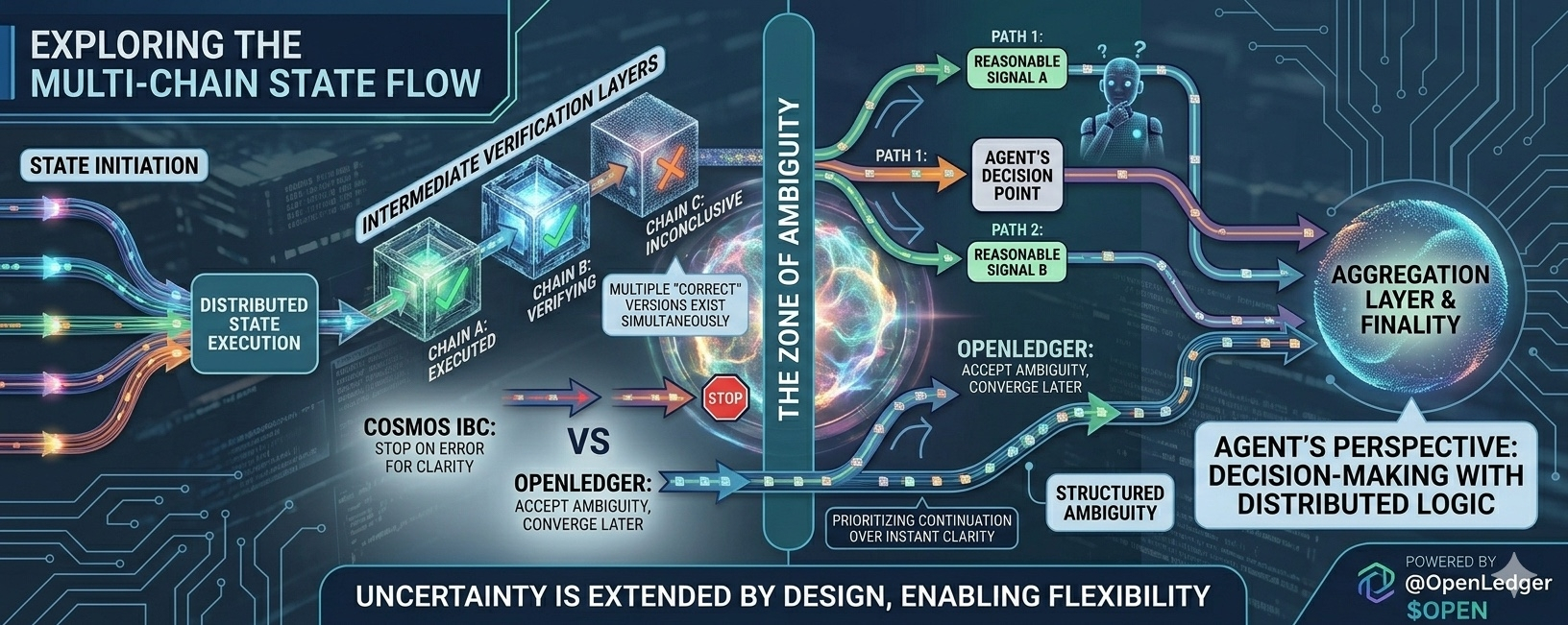
A state moves through multiple chains, verified through different layers, and only then is it considered final after aggregation. It sounds like a typical pipeline, but when you look into the actual flow, it feels anything but tidy.
I imagine an agent standing in this system. It doesn't see the whole verification process happening behind the scenes. It only sees a few intermediate signals that are reasonable enough to act on. And it proceeds.
Initially, I thought the issue was latency. Like, the data wasn't syncing in time, causing everything to be out of sync. But upon reflection, that's not it. It's not about being fast or slow. It's that there are too many versions of the same state existing simultaneously.
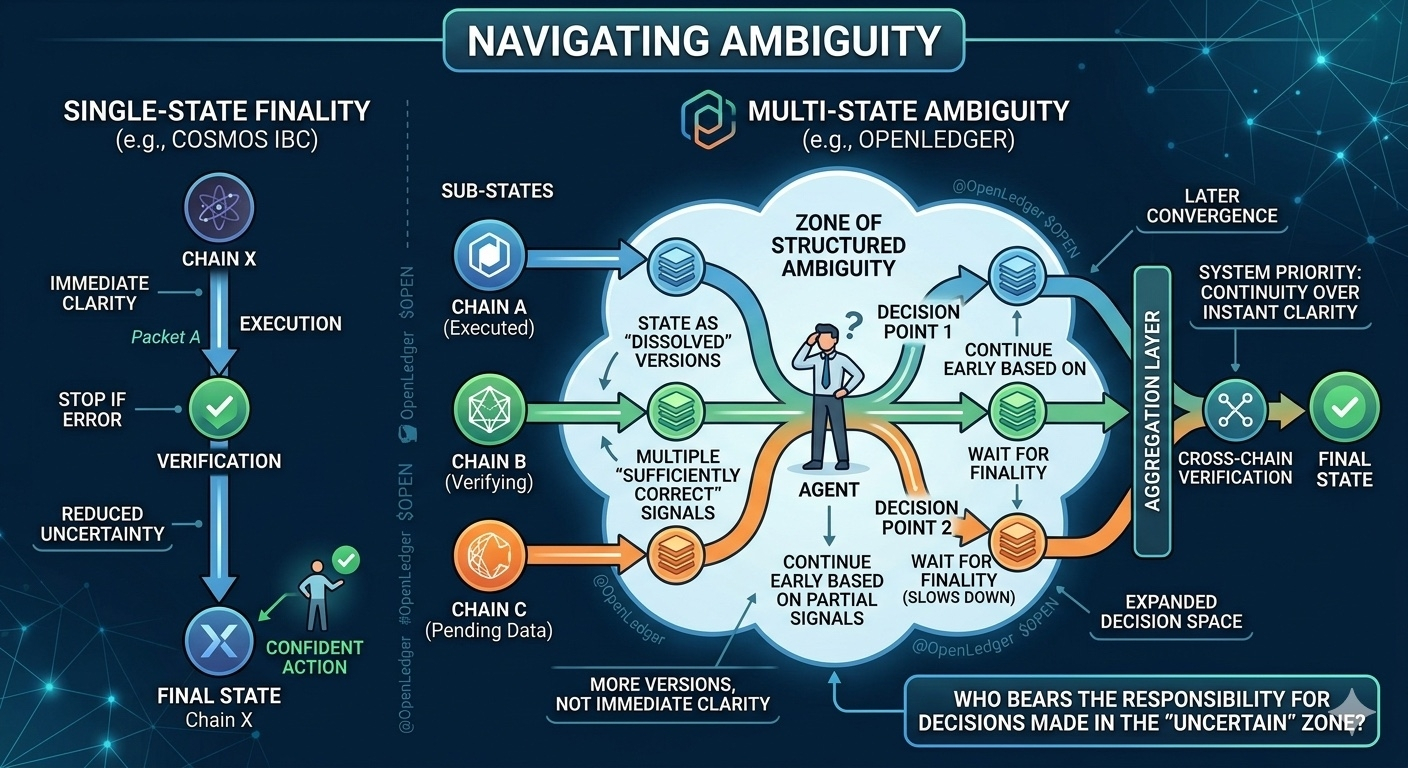
Chain A says it's executed. Chain B says it's verifying. Chain C doesn't have enough data to conclude anything. No one is wrong. Each side is just viewing a different slice of the same event.
There's a part in the Octoclaw docs where I read that the state is only considered final after passing through cross-chain verification and an aggregation layer. I remember pausing for a few seconds. Because it sounds like a safer mechanism, but it also implies something else: throughout the preceding process, nothing is truly considered finalized. It's all left hanging.
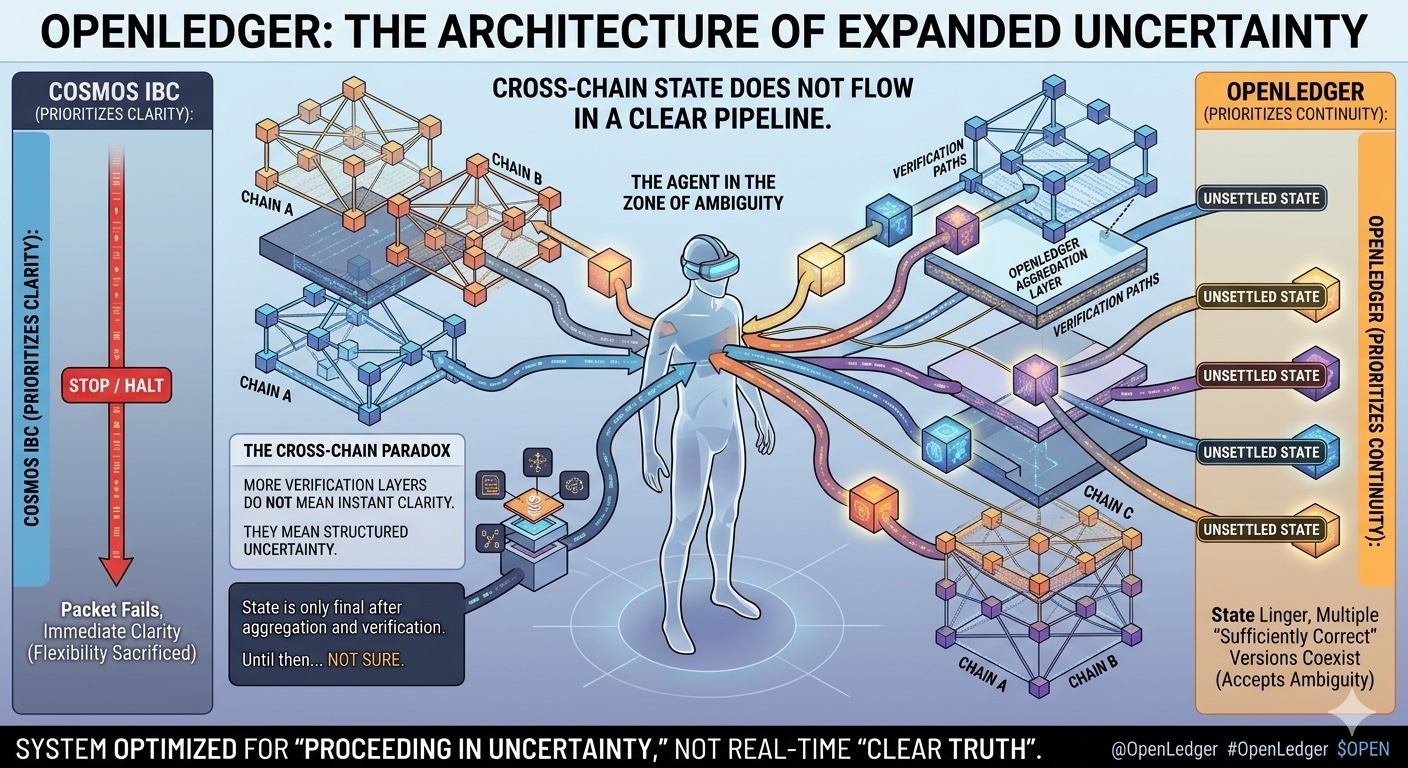
And this 'hanging' state initially feels very small. Almost negligible. But as more chains, more routes, and more layers of verification are added, it stops being a small gap. It becomes a region. A region where the agent must stand to make a decision.
I tried to think simpler. It's like having multiple people recount a story, but each one remembers a different part. No one is wrong. But piecing it together doesn't give you a complete story immediately.
If I were human, I could choose to trust one person first and adjust later. But an agent doesn't do that. It optimizes based on signals. And when all signals are 'reasonable to some extent', it starts acting sooner than you might expect.
It's a bit ironic that the more layers of verification there are, the system doesn't make everything clearer at that moment. It just allows many 'sufficiently correct' versions to coexist in the same moment. I remember Cosmos IBC doing the opposite. An incorrect packet halts the process entirely. No prolonged ambiguity. They choose clarity, even at the cost of some flexibility.
OpenLedger doesn't do that. It lets everything proceed, then converges later. It seems softer, more open, but the price is that there isn't a single version of 'what's happening' at the current moment.
And this is where the philosophical difference starts to become clear. Cosmos tries to minimize ambiguity as much as possible. OpenLedger accepts that ambiguity and allows it to exist as a normal part of the system.
There's no absolute right side. Just two different ways to handle the same annoying thing: uncertainty.
Looking at it positively, OpenLedger's approach opens up the possibility for connecting multiple systems without needing them to sync completely from the start. It's like having many different roads leading to the same city, without all needing to have the same traffic lights right away.
On the other hand, this places the agent in a much more complicated decision space. Not due to a lack of data, but because there are too many reasonable versions of the data.
There's an interesting detail I've noticed. The more layers of verification added, the system doesn't immediately reduce uncertainty. It just makes the uncertainty 'more structured'. Instead of being completely ambiguous, it becomes ambiguously explainable in multiple ways. I'm still not sure if this is a strength or a weakness. It could be both.
It's like standing in a room with many doors. Each door has someone saying 'you can go'. No door says 'don't go'. But no door lets you know for sure what's behind it. You still have to move forward, but in a way that's more about guessing than certainty.
OpenLedger is focusing on expanding connectivity between systems without forcing them to sync from the get-go. From a scaling perspective, it makes sense. Very much so.
But from the agent's perspective, the issue is different. It's not about a lack of information. It's about having to make a decision while information hasn't yet converged into a single shape. There's a strange feeling here. It's not that the system lacks logic. It's that logic is dispersed into many valid versions simultaneously.
I've sometimes thought that this system might not be optimized for 'clarity of truth', but rather for 'the system's ability to proceed in an unclear state'. These two things don't always go hand in hand. Because if you prioritize moving forward, you have to accept a longer period of ambiguity. If you prioritize clarity, you have to accept more stops. There are no free choices.
I've tried flipping the question. If we force everything into a clear state right away, does multi-chain still make sense? Or does it just revert to the old model, having many chains but still locked into a single consensus point?
Looking back, I don't see OpenLedger trying to make the state clearer in real-time. It accepts that the 'unclear state' is a default part of the system.
And when 'unclear' becomes the default, the remaining question is who will be responsible for the decision made while everything is still pending. It's not about expanding the state but rather about uncertainty being designed to stretch.