
Recently, discussions have arisen among investors about the CSRC's regulatory actions towards Hong Kong online brokers. Especially regarding compliance issues surrounding Tiger Brokers, Long Bridge Securities, and Futu, the question of 'Will mainlanders still be able to trade US stocks in the future?' has become one of the hottest topics in the investment circle.
Some people are starting to panic, worried that their US stock accounts might suddenly become invalid; others are searching for so-called 'workaround solutions', and some are even selling various gray area account opening pathways on social platforms.
However, if you look at regulatory documents, policy logic, and real operations together, you'll find an important fact:
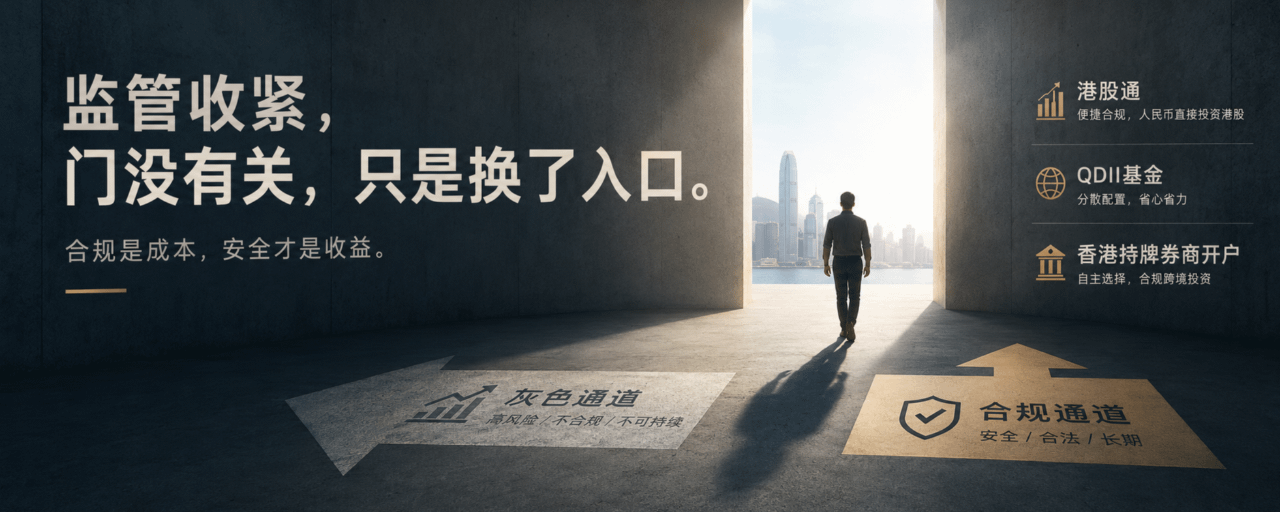
China has not prohibited mainland residents from allocating overseas assets; what has truly been blocked are the paths for "gray area cross-border account opening" and "illegal domestic operations."
In other words, the door hasn't closed; it's just that the entry point has changed.
1. What exactly does the CSRC regulate?
Many people see words like 'punishment,' 'rectification,' and 'suspension of new clients' and instinctively think: they can't trade US stocks anymore.
Actually, this is a typical misunderstanding.
The focus of regulation has never been whether ordinary investors can buy overseas assets, but rather:
Can overseas brokers illegally solicit clients within China?
In recent years, the growth model of some online brokers has been relatively aggressive:
Advertising in the mainland;
KOL traffic-driven account opening;
Promoting on Chinese social media;
Directly serving clients in mainland China.
In regulatory logic, this falls under typical cross-border securities business compliance issues.
Simply put:
You can buy, but others cannot illegally 'sell' to China.
The logic behind this isn't complicated.
Securities business itself belongs to a heavily regulated industry, involving foreign exchange, capital flows, investor protection, and financial security. Allowing overseas brokers to operate unrestricted within China essentially means financial regulation is being bypassed.
So, this regulatory move is essentially:
Regulated channels, not closing off investment.
Many old accounts can still trade normally; US and Hong Kong stock accounts haven't suddenly disappeared.
What really changes is:
Future pathways must be more compliant.
2. Can mainland residents still buy Hong Kong and US stocks in the future?
The answer is clear:
Yes, but the methods are different.
In the future, three main lines will likely form:
First line: Hong Kong Stock Connect (most reliable)
If you're mainly looking to buy Tencent, Alibaba, Meituan, Xiaomi, BYD, SMIC, or Hong Kong dividend assets.
In fact:
Hong Kong Stock Connect is sufficient.
Many think the Hong Kong Stock Connect has a lot of restrictions, but in fact, most mainstream Hong Kong blue chips are covered.
The advantages are obvious:
1. Completely legal and compliant
Direct buying and selling through mainland brokers.
It does not involve cross-border account opening.
There won't be sudden account restrictions.
2. Direct Renminbi trading
No need to hassle with currency exchange.
No issues with transferring overseas funds.
Experience is simpler.
3. Lower risk
Funds always remain within the domestic financial system.
For ordinary investors, this is the path most encouraged by regulators.
Hong Kong Stock Connect account opening process
Step 1: Open an A-share securities account
Any regular broker will do.
For example:
CITIC, Huatai, Guotai Junan, and China Merchants Securities, etc.
Step 2: Meet the 500,000 yuan threshold
Hong Kong Stock Connect privileges typically require:
Average assets over the last 20 trading days must not be less than 500,000 yuan.
Step 3: Activate Hong Kong Stock Connect privileges
Can be completed via mobile app.
Open after risk assessment.
Step 4: Directly trade Hong Kong stocks
Renminbi settlement.
No need for a Hong Kong bank card.
Suitable for groups:
Long-term investors in Hong Kong blue chips.
3. What if I want to buy US stocks?
This is what many people are most concerned about.
Especially:
Apple, Microsoft, NVIDIA, Tesla, Google, Amazon.
Can we still buy in the future?
The answer remains:
Yes, but you need to follow a legal path.
4. The first legal investment plan for US stocks: QDII funds
If you're just looking to invest in US tech stocks, not day trading.
So:
QDII is actually the most suitable method for ordinary people.
Many people underestimate QDII.
In reality, many funds are already highly covered with US stock assets.
For example:
Nasdaq index fund;
S&P 500 index fund;
US tech ETFs;
AI-themed funds.
Advantages:
1. No need to open a US stock account
Can buy using Alipay, Tian Tian Fund, or broker apps.
2. No need to exchange currency.
Directly buy with Renminbi.
3. Completely legal
No regulatory risks whatsoever.
4. Low cost
Long-term returns don't necessarily lose to trading on your own.
Many people overestimate their stock-picking ability.
In fact:
Most people can't outperform the index.
If you're just looking to allocate US stocks.
Buying Nasdaq index funds may be more effective than staying up all night watching the market.
Suitable for:
Office workers;
Long-term investors;
Those who don't want to hassle with accounts.
5. Legal path 2: Opening an account with a licensed Hong Kong broker (future mainstream)
In the future, those who genuinely have demand can still go through:
Licensed local brokers in Hong Kong.
The focus is on:
You need to go to Hong Kong to complete the process yourself.
And not the past way:
"Download the app in mainland; open an account in minutes."
What regulators are more likely to accept in the future is:
Investors actively going to Hong Kong to open accounts.
Core logic is:
This is an investor's independent action.
Rather than overseas institutions operating within the country.
Operational process (legal version)
Step 1: Obtain a Hong Kong and Macau travel permit
Mainland public security entry and exit processing.
Step 2: Go to Hong Kong to apply for a Hong Kong bank card
Common choices:
HSBC;
Bank of China Hong Kong;
Standard Chartered Bank.
Purpose:
Subsequent fund settlement.
Step 3: Open a licensed Hong Kong securities account
Note:
Always choose licensed institutions from the Hong Kong SFC.
Avoid wild platforms.
Step 4: Legal fund arrangement
Many people easily fall into traps here.
Be sure to note:
Don't exchange currency underground.
Don't "find someone to exchange U."
Don't hold accounts for others.
Don't borrow someone else's identity.
These risks are extremely high.
Correct approach:
Comply with personal annual foreign exchange quotas.
Process through the formal banking system.
This is currently the most stable route.
Suitable for:
Have a certain capital scale;
People who genuinely need to trade Hong Kong and US stocks;
Those with cross-border asset allocation needs.
6. Which "wild paths" should you avoid in the future?
After the regulatory upgrade, many past methods have seen risks rise significantly.
1. Underground currency exchange
High risk.
Funds safety cannot be guaranteed.
In severe cases, accounts may be frozen.
2. Open an account by borrowing identity
Friends and relatives opening accounts on your behalf.
Legal and property risks are extremely large.
Account ownership is unclear.
Once disputes arise, they are hard to resolve.
3. Non-licensed platforms
Ultra-high risk.
Especially fake brokers.
Many platforms even lack real custody.
Make money but don't pay out; lose money and face instant liquidation.
4. "Zero-threshold overseas account opening guide"
The more it's promoted:
"Direct unobstructed account opening in the mainland"
The more vigilant you should be.
Because the focus of regulation is right here.
7. What really needs to be considered is not whether you can trade, but why you trade.
Ultimately, what most people are truly anxious about isn't the channels.
But rather:
Worrying about missing global asset opportunities.
In recent years, US tech stocks have created massive wealth effects.
NVIDIA, Apple, Microsoft, Tesla have led many investors to form a perception:
Not buying US stocks means missing out on the future.
But the most important thing in investing has never been:
"Can I buy?"
But rather:
What to buy, when to buy, and how to control risk.
Many people mess around with cross-border accounts, only to end up losing on frequent trading and emotional decisions.
On the contrary, those who truly make money are often:
Choose the right assets and hold them long-term.
In the future, the general direction for Chinese residents to allocate overseas assets will not disappear.
Regulatory crackdowns target disorderly cross-border finance, not global asset allocation.
So, there's no need to be overly pessimistic.
Just:
The era of laxity is over; the era of compliance has begun.
For ordinary investors, a realistic suggestion is:
If the capital isn't large, prioritize Hong Kong Stock Connect and QDII;
If there's a genuine cross-border need, go through a licensed Hong Kong institution to take the compliant route.
Because in the future, the truly valuable ability is not to find loopholes.
But rather:
Survive long-term within the rules.