
After being in this industry for a long time, you will discover an interesting phenomenon: the more a top-tier project is under the spotlight, with a valuation of tens of billions, the more likely it is to stumble in the most basic gutters.
Yesterday, the highly anticipated @megaeth staged an absurd drama under the watchful eyes of the whole internet. The USDC pre-deposit expansion activity, originally planned to be seamless, faced a technical error that led to the limit being 'snatched' ahead of time, causing the cap limit to surge from 250 million, ultimately necessitating an emergency halt.
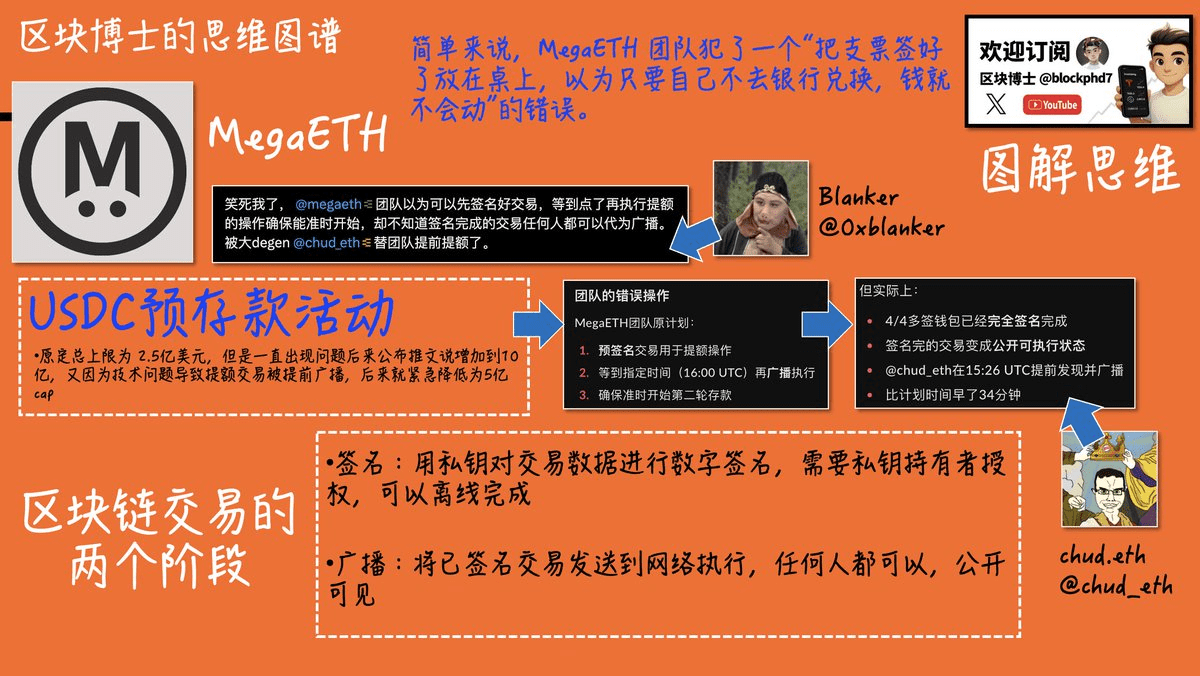
Many people see it as a fruit to be plucked, but what I see is a vivid roadshow of the dark forest rule of Web3. To clarify the intricacies, I reviewed the technical logic of the entire incident and created a (mind map) (see the diagram at the end).
1. Core Misjudgment: Treating blockchain as a centralized server.
The mistake made by the MegaETH team, put simply, is: 'They signed the check and left it on a park bench, naively thinking that as long as they didn't go to the bank, the money wouldn't move.'
In their original plan, the scaling operation was divided into three steps:
1. Multi-signature wallet signs in advance (Signing).
2. Wait until the specified time (16:00 UTC).
3. Official clicks send (Broadcasting).
This is not a problem in Web2's server logic; the permission is in my hands, and if I do not click send, the request will not be executed. But in Web3's underlying logic, this is completely two different matters.
2. Technical Breakdown: Signing does not equal sending a message, but signing is a commitment.
I specifically broke down the difference between 'Signing' and 'Broadcasting' in the diagram, which is a cognitive gap that many developers transitioning from traditional internet often overlook.
Signing (Stamping): It is you encrypting the transaction data with your private key for acknowledgment. It's like stamping a check. Once completed, this string of data has legal effect at the code level.
Broadcasting (Delivering): It is sending the data to miner nodes. It's like throwing a letter into a mailbox.
The key point is: The blockchain network (post office) only recognizes whether the stamp is genuine, and does not care who threw the letter in.
MegaETH's mistake was that they completed the signing in advance and, without knowing how (possibly through API leaks or testnet synchronization), exposed this 'signed raw transaction data' to the public internet. Thus, someone like @chud_eth, who has a keen sense, picked up this 'check'. He took a look and said, 'Oh, all the signatures are in place? Since you're not sending, let me help you click send.'
The result is: Without any official operation, a bystander directly executed the contract interaction for the project.
3. Macro Insights: Operational security risks hidden under high valuations.
What does this mean for MegaETH?
To put it simply, it was an operational accident, slightly losing face, and having to urgently adjust the Cap to respond to the sudden influx of funds. To put it more broadly, it exposed the team's immaturity in operational security.
MegaETH's narrative is very grand: real-time blockchain, sub-10ms latency, 100,000 TPS. They have first-class academic backgrounds and the endorsement of @VitalikButerin. But academic prowess does not equal engineering practical ability. The data that runs in the lab and the real combat in the 'dark forest' filled with MEV bots, hackers, and arbitrageurs are two completely different dimensions.
This time being preempted by @chud_eth was actually lucky. Because he simply executed the operation in advance for the official, rather than exploiting a vulnerability to steal funds. What if this happened in their core Sequencer logic?
For us investors, this is not just a surprise, but also a signal. It reminds us to always be vigilant about the engineering implementation capabilities of the project while chasing high FDV and high-tech narratives.
The phrase Code is Law is not just a belief; sometimes it is also a cruel verdict. It does not care about your 'intention' regarding when it starts; it only executes the instructions it sees.
MegaETH paid this 'tuition fee' without feeling wronged. I hope this can make this high-performance public chain, which carries the hopes of the entire village, truly learn to respect the market and respect the underlying knowledge before the mainnet officially goes live.
Attached image: MegaETH signing incident and blockchain transaction principle breakdown diagram.