My article today
Youssef Iskander
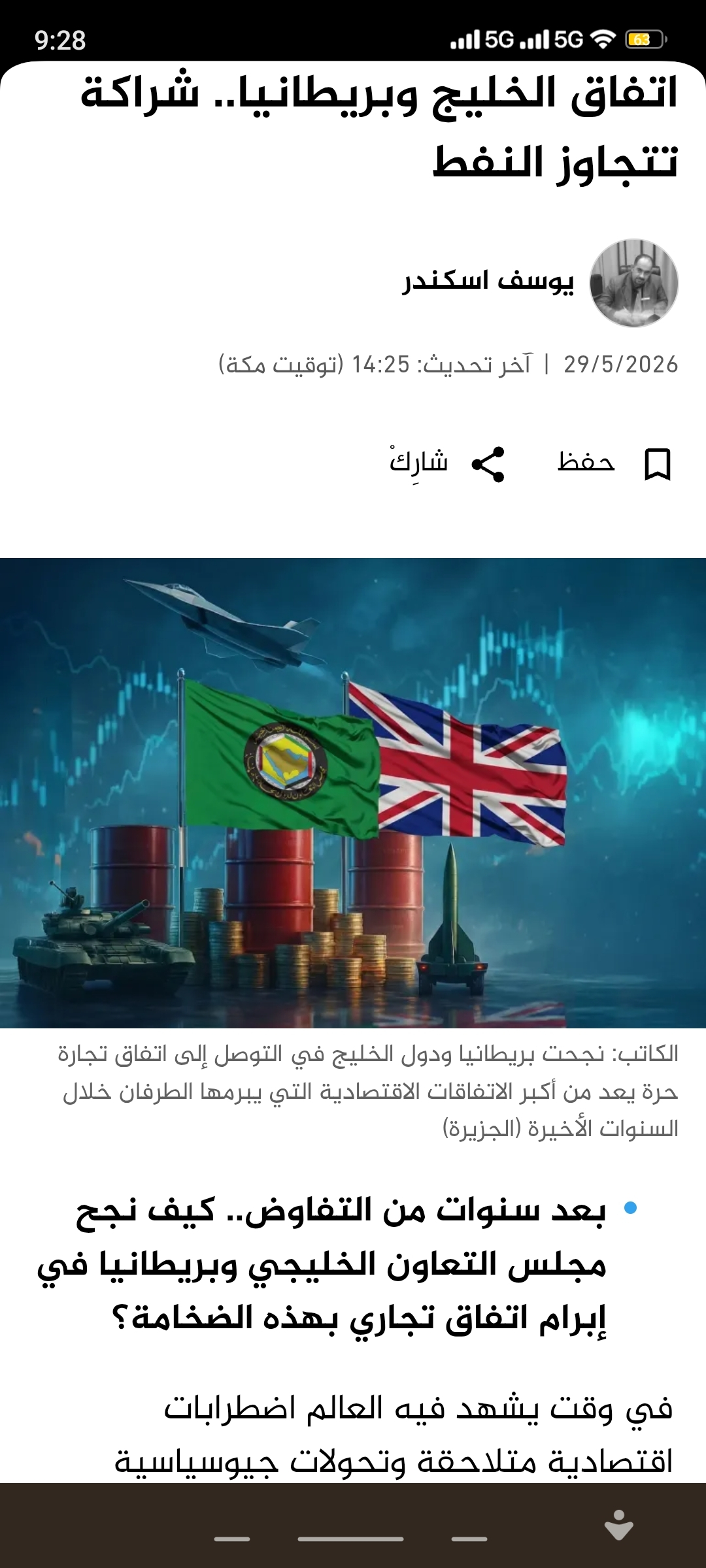
Writer: The UK and Gulf countries have successfully reached a free trade agreement, one of the largest economic deals made by both parties in recent years (Al Jazeera)
After years of negotiation... how did the GCC and the UK manage to strike such a massive trade deal?
At a time when the world is experiencing ongoing economic disruptions and rapid geopolitical shifts, the United Kingdom and the Gulf Cooperation Council have succeeded in finalizing a free trade agreement that stands as one of the largest economic deals made by both sides in recent years, after four full years of negotiations.
The agreement, which includes Qatar, Saudi Arabia, the UAE, Kuwait, Bahrain, and Oman, does not merely represent an understanding of tariffs; it reflects deeper transformations in the shape of international economic relations, and in the Gulf's position within the new global economy.
According to what the British government announced, the agreement is expected to add about £3.7 billion annually (roughly $5 billion) to the British economy, with the removal of hundreds of millions in tariffs on sectors including food, technology, medical equipment, and services. However, the real significance of the agreement lies not just in the numbers but in its timing and its political and economic nature.
The British government has been trying for years to prove its ability to build major trade partnerships outside the European framework, especially with regions that have high financial liquidity and fast economic growth like the Gulf.
Despite the political discrepancies that have occurred in the Gulf region over the past years, the agreement has shown that strategic economic interests are still capable of pushing the council's countries towards collective action when it comes to major international partnerships.
Britain is looking for a post-Brexit world.
From the British side, the agreement seems to be part of a broader strategy to reposition London economically after leaving the European Union.
The British government has been trying for years to prove its ability to build major trade partnerships outside the European framework, especially with regions that have high financial liquidity and fast economic growth like the Gulf.
Therefore, the British focus has been clear on:
Expanding exports.
Supporting financial services.
Facilitating data movement.
Increasing the presence of British companies in the Gulf markets.
Additionally, the timing of the announcement carries political significance domestically, as the British government faces increasing economic pressures and declining popularity, making the agreement presentable as a significant economic achievement capable of supporting the government's image domestically.
Removing tariffs on food and medical technology sectors also reflects a growing Gulf interest in food security and diversifying sources of imports in a region that relies heavily on imports.
The Gulf... from an energy market to a global economic partner.
However, reading the agreement as merely a 'British interest' seems to be an incomplete perspective.
The Gulf itself has changed economically over the past few years. The council's countries no longer operate solely within the logic of energy exports, but within a broader vision based on:
Diversifying the economy.
Attracting technology.
Digital transformation.
Expanding the services sector.
And enhancing the region's position as a global center for trade and investment.
Thus, the agreement included notable clauses that go beyond traditional trade, particularly regarding the free flow of data and digital services, which are directly linked to the Gulf's ambitions in the digital economy, artificial intelligence, and fintech.
The removal of tariffs on food and medical technology sectors also reflects a growing Gulf interest in food security and diversifying sources of imports in a region that relies heavily on imports.
Britain seems eager to reclaim its traditional economic presence in the Gulf amid increasing international competition that includes the United States, China, and the European Union.
Why is the agreement politically important?
The political significance of the agreement may be no less than its economic importance.
The success of the Gulf Cooperation Council in negotiating as a united bloc with a major economic power reflects that the council still has the capacity for collective action on strategic issues, despite occasional competition among some of its members.
The agreement also sends a broader message that the Gulf has become an economic player that is hard to ignore in reshaping global trade alliances, especially with the increasing importance of the region in energy, investment, and global supply chains.
Meanwhile, Britain seems eager to reclaim its traditional economic presence in the Gulf amid increasing international competition that includes the United States, China, and the European Union.
More than a trade agreement.
Ultimately, the agreement does not seem like just a fleeting economic deal, but is part of a new international phase where trade maps and economic alliances are being redrawn.
After four years of negotiations, both parties succeeded in reaching an agreement that reflects a fundamental truth: Gulf-British relations are no longer based solely on oil and energy but are moving towards a broader partnership that includes technology, services, investment, and the digital economy, in a world seeking more flexible alliances amidst rising global disruptions.