
This afternoon, with nothing to do, I was scrolling through Twitter, and everyone was talking about AI, focusing primarily on the 'model layer' competition.
Whose parameters have doubled again? Who's got faster inference speeds? Which company's agent has become smarter in a few dimensions?
But the longer I watch the industry, the more I feel: **everyone might be missing the bigger picture.**
The real endgame of the AI era may not just be a pure model battle, but rather a **'dimensionality reduction strike of the collaboration system.'**
Because no matter how groundbreaking a model is, it didn’t just pop out of thin air.
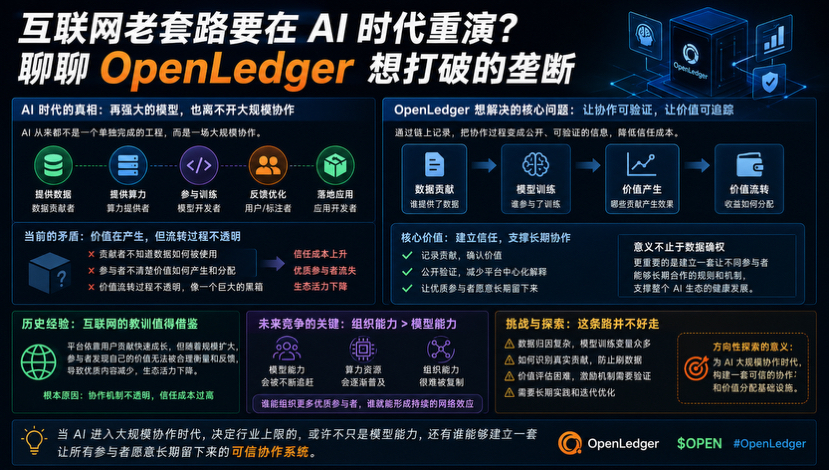
Some are feeding data, some are burning cash for training, some provide computing power, and some are implementing real-world scenarios. AI has never been a lone wolf breaking through as a single technology; it's a massive, collaborative effort on a societal level.
But a strange problem has arisen:
More and more people are participating in building the ecosystem, but fewer and fewer can see how 'interests are flowing.'
* Who contributed the truly valuable data?
* What resources were actually consumed during the training process?
* Whose contribution allowed this model to cross the intelligence tipping point?
* The core issue is: where do the enormous commercial profits ultimately flow?
For the vast majority of participants in the AI era, all of this is a blind spot.
We only know that wealth is pouring in wildly, but we don't understand the logic of its distribution.
This gives me a very familiar feeling — **the early internet's 'dragon script' is replaying.**
Back in the day, the Web2 giants started out the same way. Platforms set the stage, users contributed content for free, developers polished the product, and the community organically drove traffic. Everyone thought they were co-creating a utopia, but once the platform grew into a monopolistic beast, the whole value flow turned into an absolute 'black box.'
You know you're working hard, but you'll never know how much surplus value you've actually created.
The final result is clear to everyone: **trust costs skyrocketed, high-quality creators fled, and the ecosystem has completely devolved into a zero-sum game.**
This is the biggest risk in the AI industry right now.
So I've been deeply observing OpenLedger recently, not just because it has the trendy tags of 'AI' or 'blockchain' that are hot for speculation. What truly attracts me is that it's attempting to solve the most critical infrastructure question mentioned above:
How can we turn a massive AI collaboration into a public, transparent, and tamper-proof ledger?
In simple terms, OpenLedger wants to put the entire process of creating AI value 'on-chain.'
Who provided the golden data? Who contributed effective computing power? Which step truly improved the model's Accuracy?
Many people have a limited perspective, merely interpreting this as 'data rights confirmation.'
But I believe that **it's reconstructing the 'collaboration rules' of the entire AI track.**
Whether an ecosystem can survive and thrive doesn't depend on how elegant your code is, but on **whether participants believe your distribution rules are fair.**
If contributions feel like they’re being thrown into a black hole, with value untraceable and returns solely reliant on the platform's charity, then the more people there are, the faster the trust collapses. In the end, the ones left in the ecosystem are definitely not the top talents but the cheapest laborers who can tolerate being exploited.
From this perspective, OpenLedger's breakthrough approach is quite advanced.
It transforms the unilateral terms that could only be explained by 'centralized platforms' into an on-chain consensus that everyone can openly review and verify in real time.
This transparent mechanism won't instantly make the models smarter tomorrow.
But it will allow the entire AI ecosystem to operate extremely efficiently yet lethally.
We need to recognize a future trend: as AI develops into the second half, the barriers to large models will gradually break down.
Algorithms will be chased by open-source efforts, and computing power will become as cheap as dirt infrastructure. When that happens, what will the truly unreplicable moat be?
It's about organizational capability.
* Who can use the fairest ledger to siphon off the world's top developers?
* Who can attract the most massive high-quality data contributors with real, tangible $OPEN returns?
* Who can organize the largest community of shared interests?
Whoever can do this will gain absolute authority in the next era of AI.
The endgame of e-commerce is the supply chain, the endgame of social media is the network effect, and **the endgame of AI must be a collaborative system.**
Of course, let's be real: this path is extremely difficult.
The on-chain attribution of data is complicated enough to give you a headache. How can multi-variable model training precisely segment contributions? How do we prevent witch-hunt attacks? How do we counter script-based volume inflation?
These hardcore engineering challenges need real capital and practical trial and error. So at this stage, I prefer to see OpenLedger as a pioneering experiment with significant exploratory value.
It may not provide the perfect ultimate answer today, but it throws an unavoidable existential question to the entire industry:
When AI fully enters the 'big collaboration era,' what determines the ceiling is not just the number of GPUs, but who can establish that set of 'trustworthy rules' that everyone is willing to work hard for.
This is the second half worth betting big on.