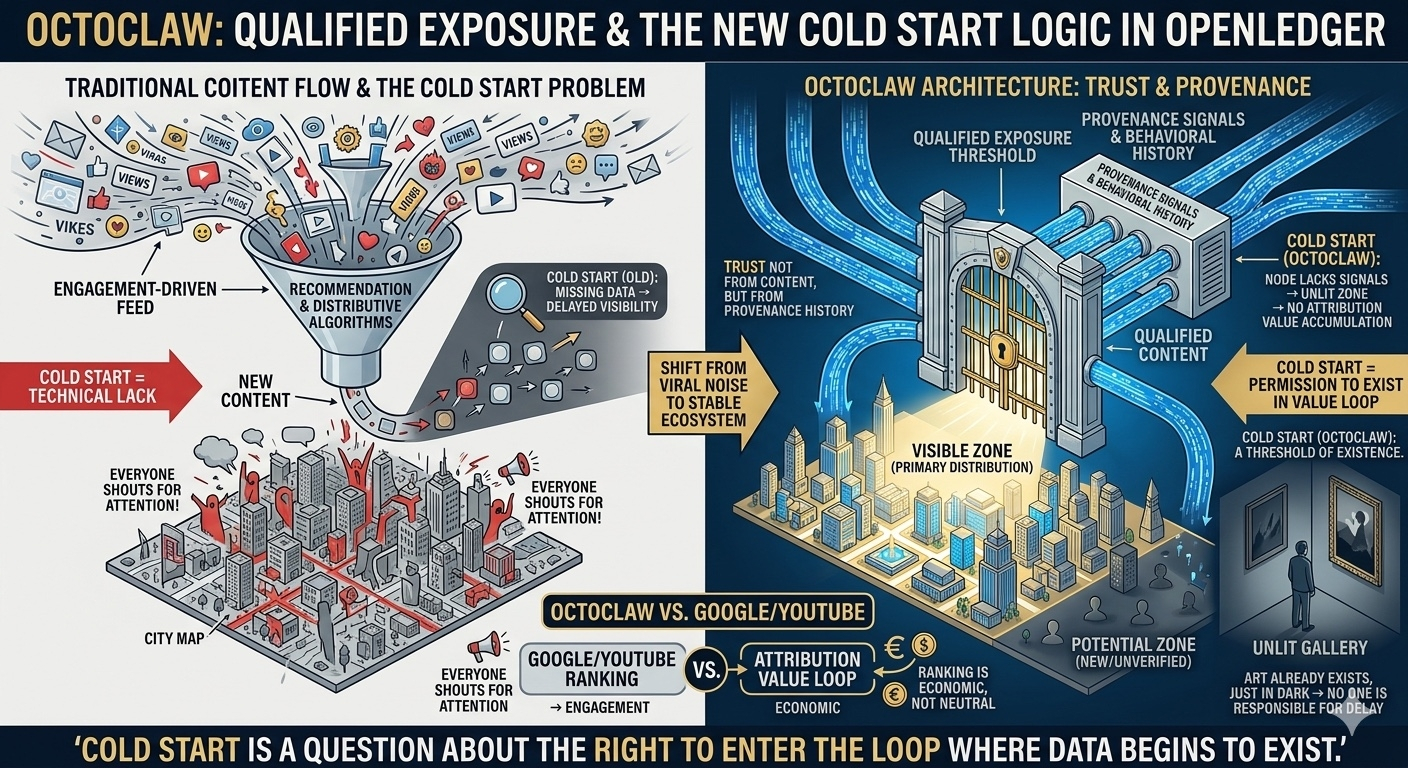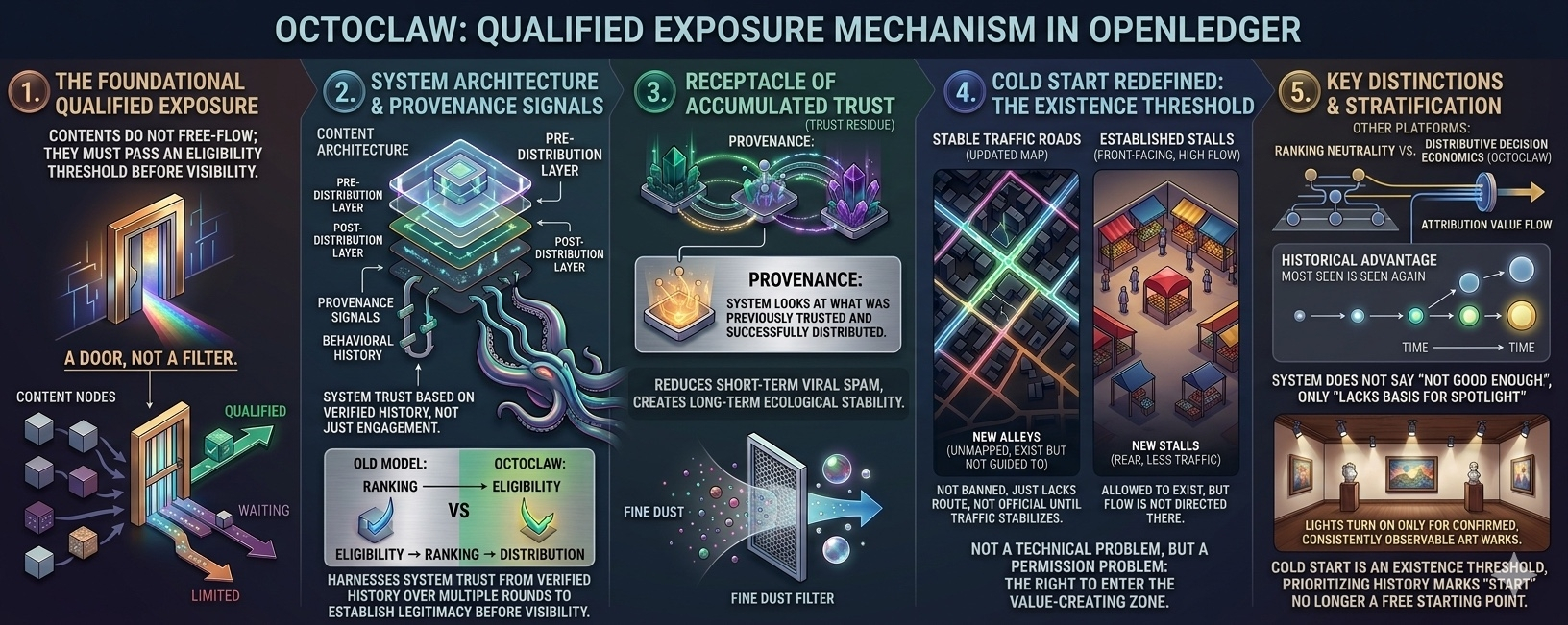
It's the last Sunday of the weekend, and looking at the sun in Hanoi makes me hesitant to hit the streets. I'm going through some OctoClaw documents in OpenLedger. I suddenly realize it doesn't kick off with a story about recommendations or feeds. It starts with something called 'qualified exposure', where the content isn't distributed freely, but must pass through a qualifying threshold before it can be seen. Sounds like quality optimization at first. But the more I read, the more it feels like a door rather than a filter.
In the documentation describing the OctoClaw architecture, the system doesn't just rank content by engagement. It brings provenance signals and behavioral history into play before the distribution layer, meaning the history of content is just as important as the current content itself. Something without a 'trust footprint' won't be placed in the same display space as items with stable histories. This changes the entire order of recommendations.
Cold start, in the old logic, is the problem of lacking data. But in OctoClaw, it resembles a state of not being allowed to create data in the main space. A new node not only lacks history but also lacks the right to be placed where history can begin to form. It sounds a bit backwards. But that’s exactly how this system operates.
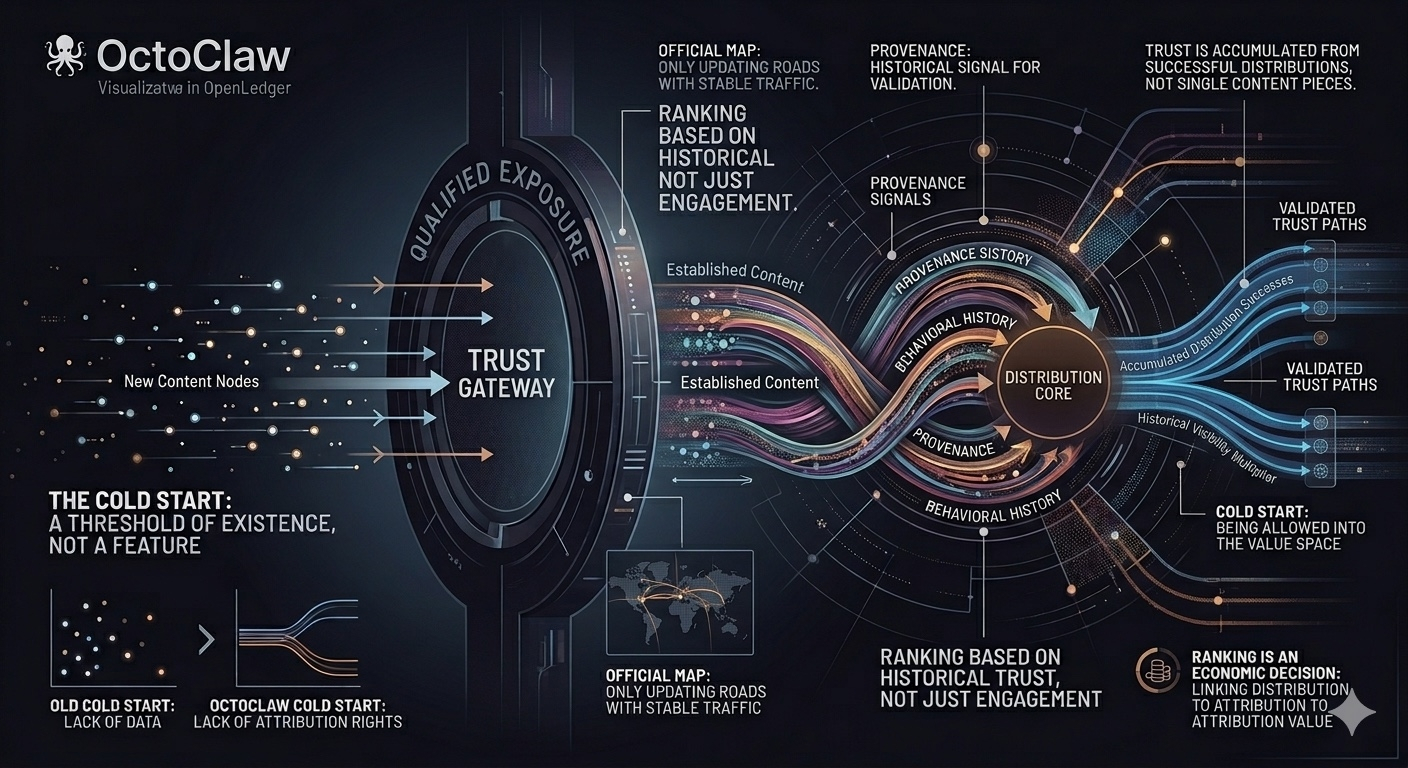
There's a pretty clear image. It's like a city where the map only updates the roads that have stable traffic. New alleys still exist, vehicles can still navigate, but they aren’t in the navigation system. You’re not prohibited from entering, it’s just that there are no routes leading you there. And if no one travels through long enough, that road never becomes an 'official road.'
The key point lies in how OctoClaw uses provenance. The system doesn’t just look at 'what's happening,' but at 'what has been successfully trusted and distributed by the system before.' This means trust doesn’t come from individual content, but from a history verified through multiple distribution rounds. This significantly reduces spam, especially short-lived yet non-sustainable forms of content.
If viewed positively, this is a way to create a stable layer for the data ecosystem. The old internet was often pulled by viral waves that didn’t reflect long-term value. OctoClaw attempts to slow that pace down so that value isn't distorted by speed. Like an air filtration system, it prevents fine dust from going straight into the core.
Compared to systems like Google Search or YouTube recommendations, the difference lies in OctoClaw linking distribution with attribution value. This means each time content appears, it’s not just a display, but part of a value stream recorded in the system. This makes ranking no longer neutral. It becomes an economic decision.
And this is where cold start takes on a new meaning. It's no longer a technical problem. It becomes a question of 'being allowed to step into the value-creating zone.' A new node needs to be not just good, but have enough signals for the system to believe it should be placed in the weighted observation circle. Without those signals, it doesn’t disappear. It just doesn’t have a place to start accumulating history.
There's a more relatable everyday example. It's like a market where long-established stalls are always placed at the front because they have a stable selling history. New stalls are still allowed to exist, still sell, but they are located in less trafficked areas. No one prohibits them, but the foot traffic naturally doesn't flow towards them. And in an attention economy system, the flow of people is everything.
Interestingly, OctoClaw doesn’t need to exclude anyone. It just needs to prioritize what has proven trustworthy. And when trust becomes something accumulated, the system naturally forms a kind of historical advantage without direct design. It’s not about who is better winning. It’s about who has been seen before being more likely to be seen again.
There’s a subtle point: the system doesn’t say 'you’re not good enough.' It simply states 'I don’t yet have enough basis to place you in the main light zone.' It’s a softer expression, but the mechanism behind it is very rigid. And this gap between language and mechanism creates a feeling that’s hard to define.
If we look deeper, this isn't just a story about recommendations. It's about the conditions under which an entity is allowed to exist long enough in the visible zone to become part of the value system. Cold start, therefore, is neither a fault nor a feature. It’s a threshold of existence.
There's another image I think of, it's like an exhibition hall where the lights only turn on when the work has been validated by the system as 'worthy of continuous observation.' The new piece is still there, but hasn't entered the main light zone yet. It's not excluded, just not illuminated. And no one is responsible for how long that light takes to arrive.
The most important thing is right here: the system doesn't need to be wrong to create stratification. It just needs to be consistent in prioritizing history. And when history becomes the input condition for the very thing being initiated, then 'starting' is no longer a free starting point.
Cold start, looking back, is no longer a data issue. It’s a question of the right to step into the loop where data can begin to exist. And that question, in OctoClaw, remains open.