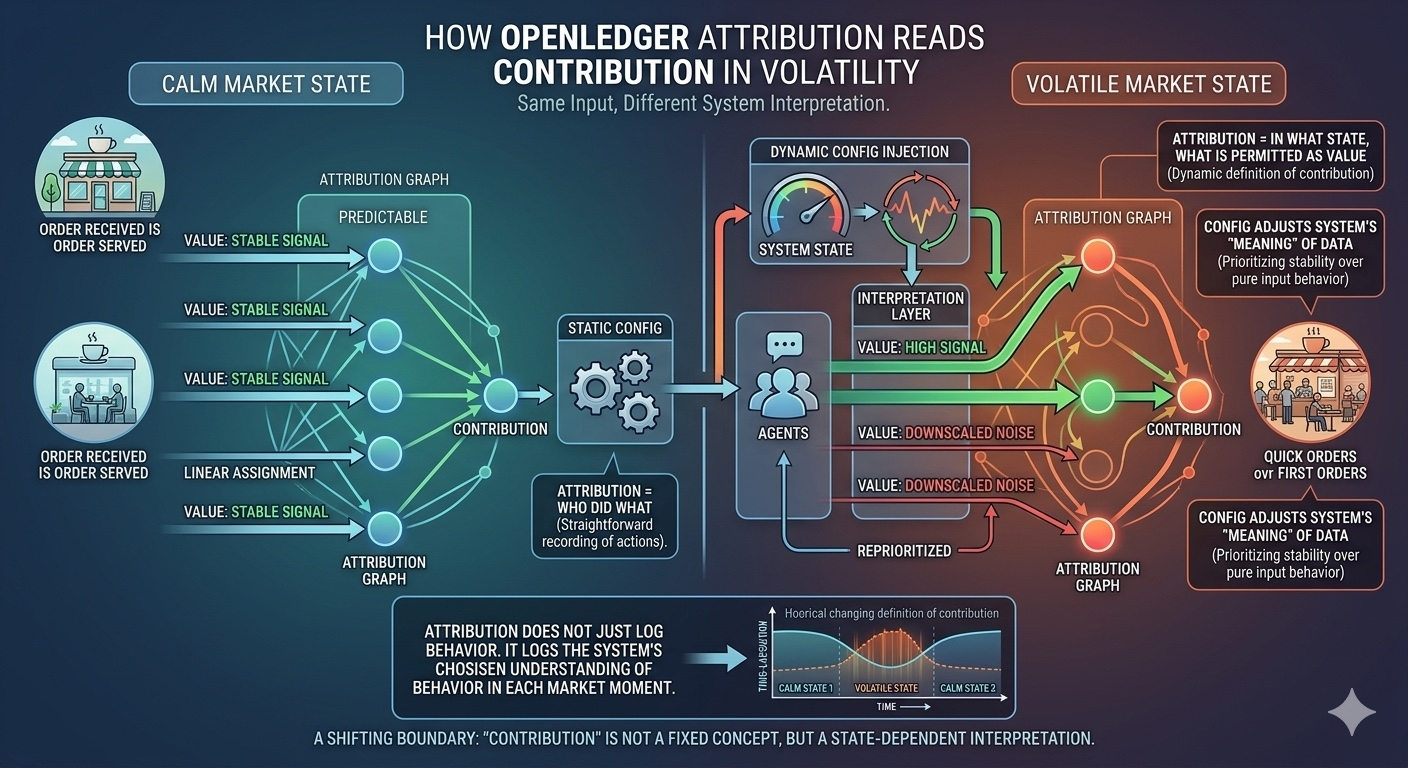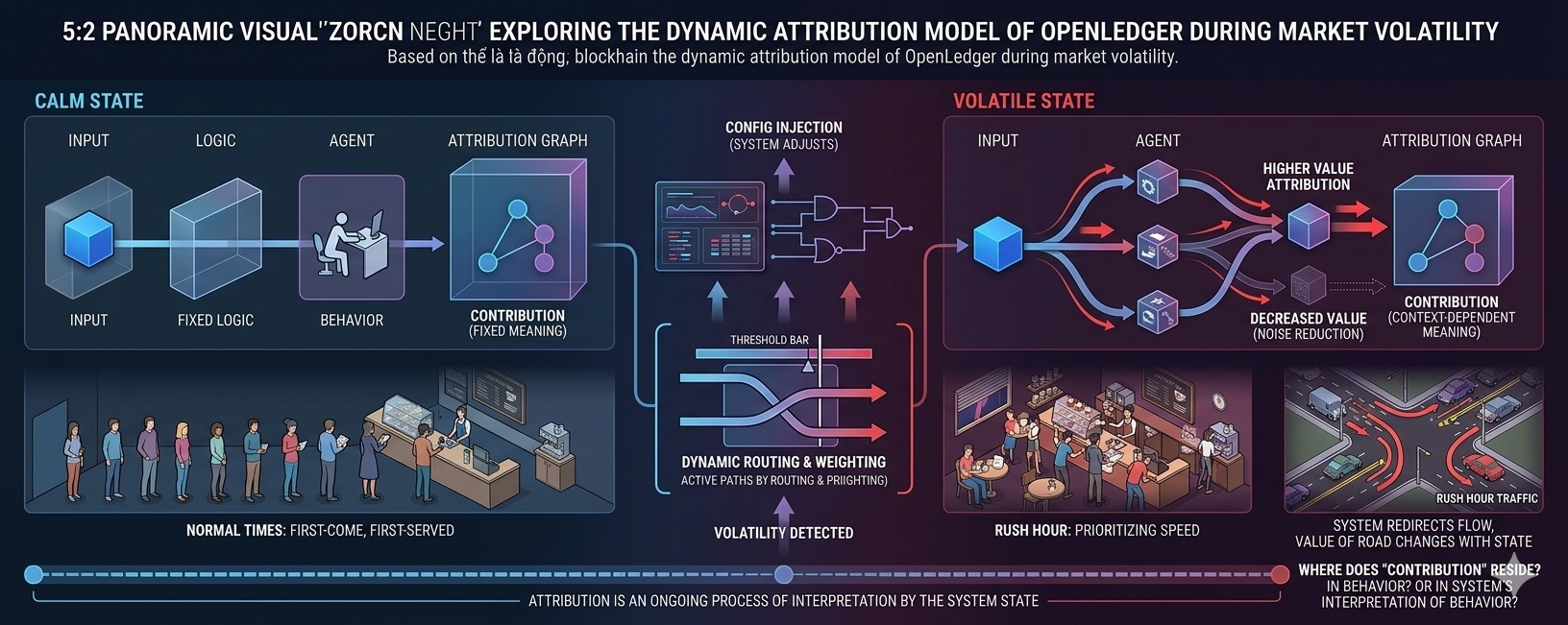
There's one thing I really started to see clearly after going through enough cycles in @OpenLedger especially during times when the market begins to run unstable. It's not that the system is broken. It's not that the logic is wrong. It's the same thing, but it feels like it's being 'read' in a different way.
In OpenLedger, the initial attribution seems pretty straightforward. Which input generates what contribution, which agent does what, and which flow leads to which output. Everything feels like it can be logged in a clear manner. But the longer I look, the more I realize the issue isn't with 'what happens', but with 'the system deciding what to call a contribution'.
At first, I thought the config was just some technical stuff. Thresholds, routing, weighting, just tweaks to make the system run smoother. But during times of volatility, it feels less like tuning and more like the system is changing its understanding of everything in real-time.
It's like a familiar café in town. On regular days, orders are filled in the order they come in, pretty straightforward and no one thinks too much about it. But when the café gets too busy, staff start prioritizing quicker items to keep up with orders, even if you ordered first.
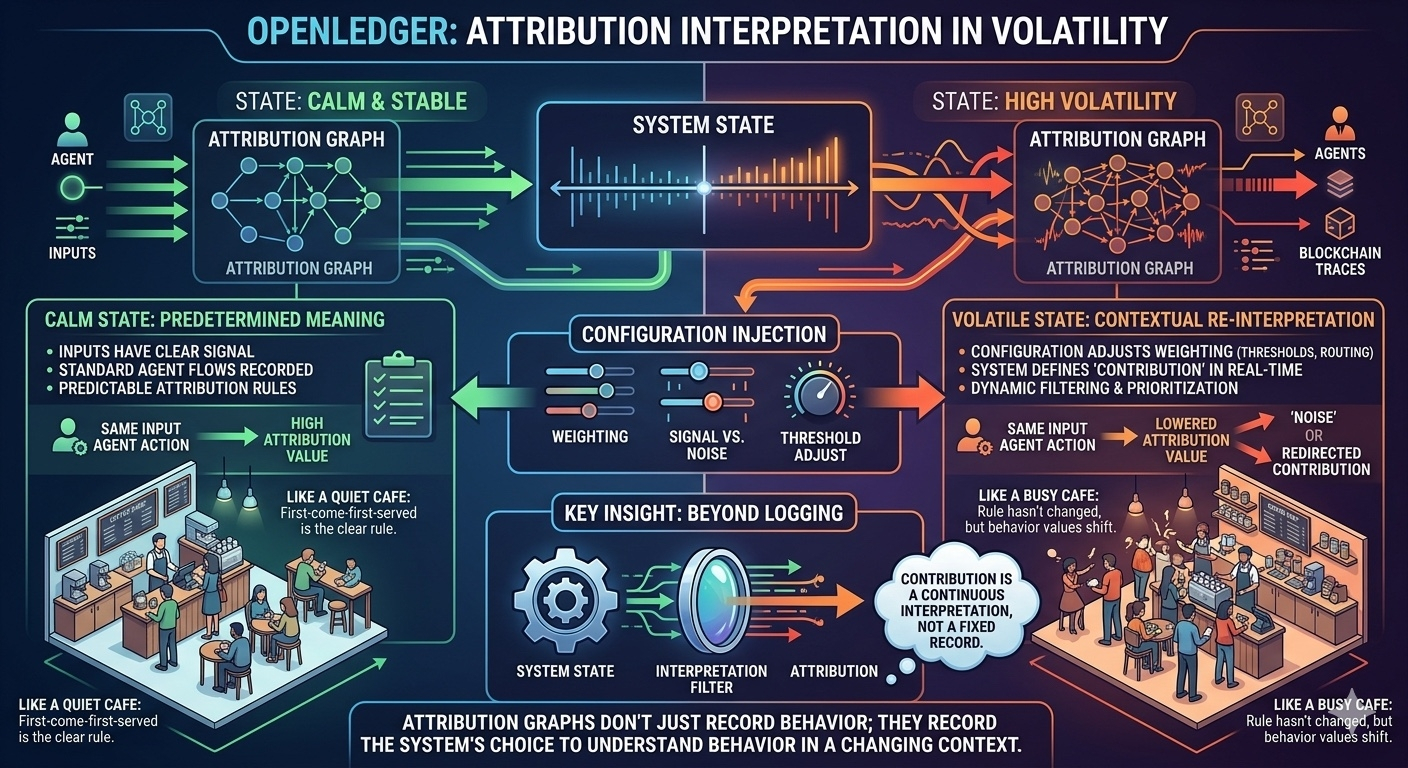
No one changes the rules. No one announces new laws. But the same 'order' no longer holds the same value in the operational system as it did before.
In OpenLedger, config in volatility also works similarly, but with another layer of depth.
An input no longer carries a fixed meaning. Its value depends on the state of the system at the moment it's read. In a calm state, the same input could be a very clear signal, recorded in the attribution graph as a normal contribution. But in a volatile state, that very input might be downweighted or considered noise to keep the system stable. It's not the behavior that changes; it's how the system decides to interpret that behavior that shifts.
The key point here is: the config doesn't just adjust how data is processed. It also adjusts how the system assigns 'meaning' to the data.
To put it simply, the same behavior from an agent, in a normal state, might be seen as a clear contribution. But in a choppy market state, that same behavior might be viewed as too unstable to include in the graph. This makes attribution less about 'who did what' and more about 'in what state does the system allow something to be counted as valuable'.
From a technical standpoint, this makes sense. No system can maintain the same way of reading data under all market conditions. Otherwise, it's either too sensitive in volatility or too rigid in a calm state. Config injection exists for the system to self-balance between those two states.
But in OpenLedger, where attribution isn't just logs but a way to recognize contributions across the entire ecosystem, this creates a different layer of meaning. It doesn't just affect output; it directly impacts how the system defines 'contribution'.
I've got another everyday example to help you feel it clearer: Like a city in normal times, all roads operate as designed. Cars follow the rules, traffic flows steadily, everything can be predicted. But when rush hour hits, the city has to regulate again. Some roads get prioritized, some slow down, some flows get redirected.
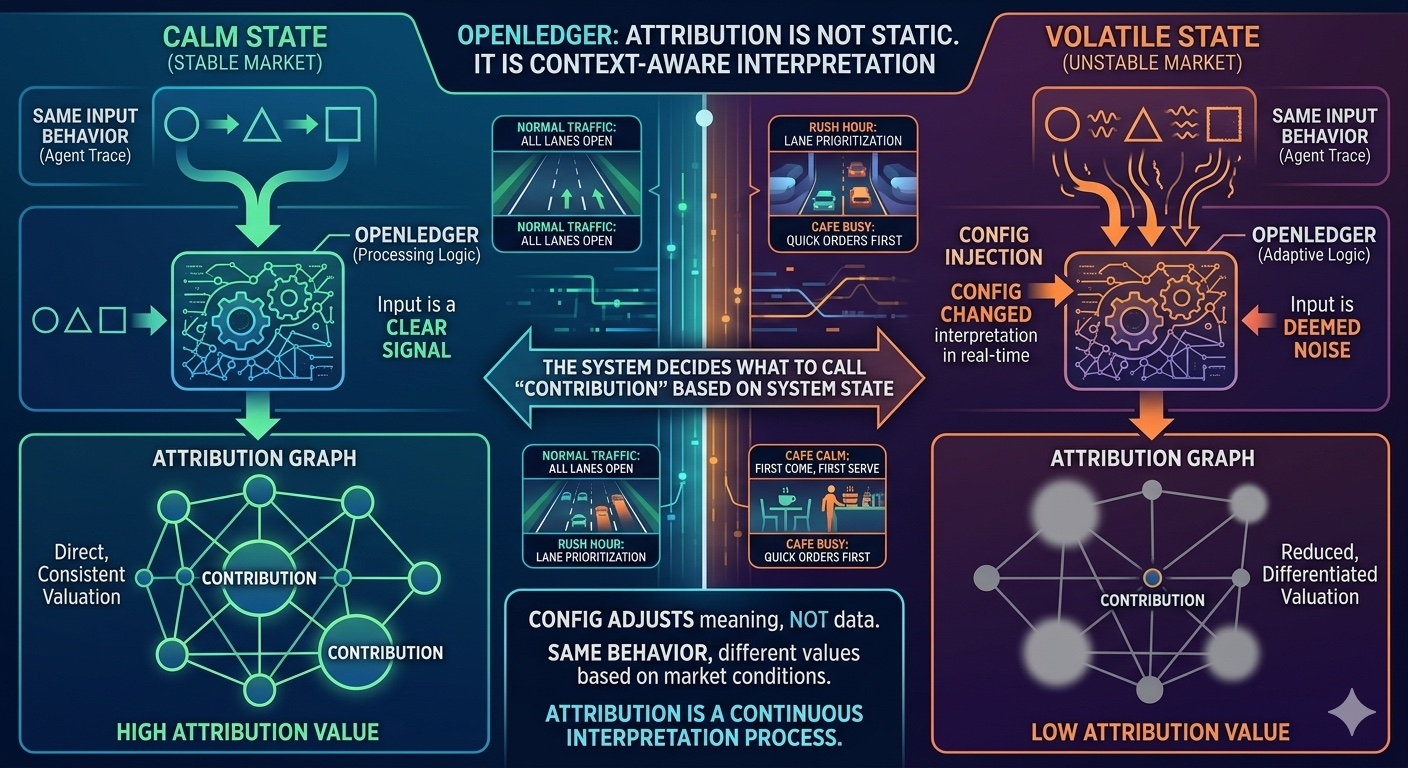
No path ever disappears. But traveling down a path no longer holds the same value as before. And the important thing is that the path doesn't change; only the state of the system does. In OpenLedger, config in volatility works the same way. It doesn't alter data, delete contributions, or rewrite history. It merely changes how the system reads the same trace in different states.
And so, with the same input, the same agent flow, the attribution graph can be completely different just because the system is in a different state. This isn't a fault; it's how the system exists in an environment that never stands still.
But the longer I look, the more I see a question that's hard to overlook. If the same behavior can carry two different values depending on the state of the system, where does 'contribution' truly lie? Is it in the behavior, or in how the system chooses to interpret that behavior?
There's no fixed answer. But it changes how I view attribution. It's no longer a linear record of the past. It's the result of a continuous interpretive process based on the state of the system.
There's a bit of a counterintuitive point here. When attribution depends on state, it becomes harder to read just by looking at snapshots. It's not because the data is opaque, but because snapshots lack the context of the state at that moment. This creates a gap between what happens and what is understood.
But looking on the bright side, this is also how the system avoids being frozen in a fixed understanding of the world. It accepts that the market is in constant flux, and the understanding of 'contribution' must change accordingly.
And perhaps the most important point isn't whether the config changes attribution. It's that there's no fixed definition of 'contribution' that can hold steady in a system living in volatility.
With each market cycle that passes, that boundary shifts a little. It's not easy to see right away. But if you look long enough, you'll start to realize one thing: attribution doesn't just record behavior; it captures how the system chooses to interpret that behavior in each market moment that's constantly changing itself.