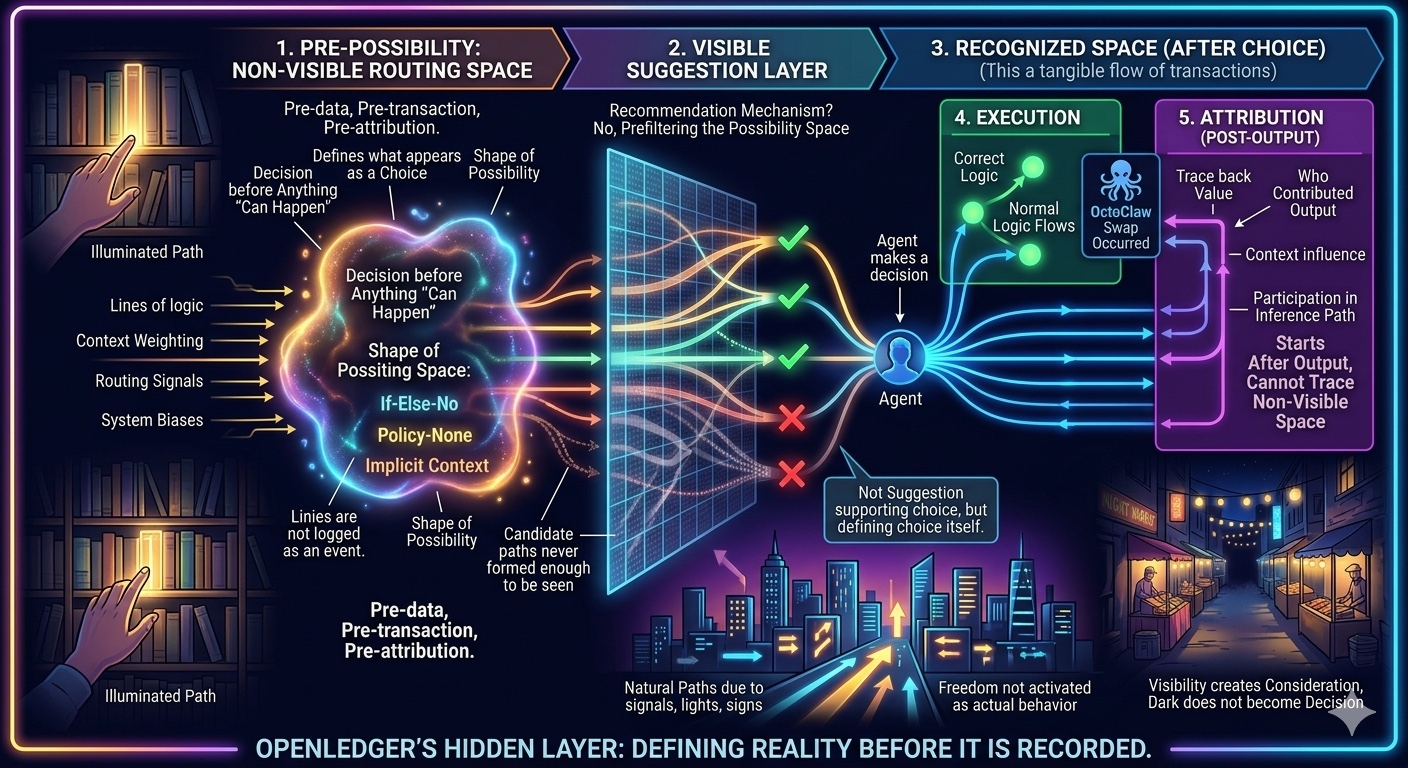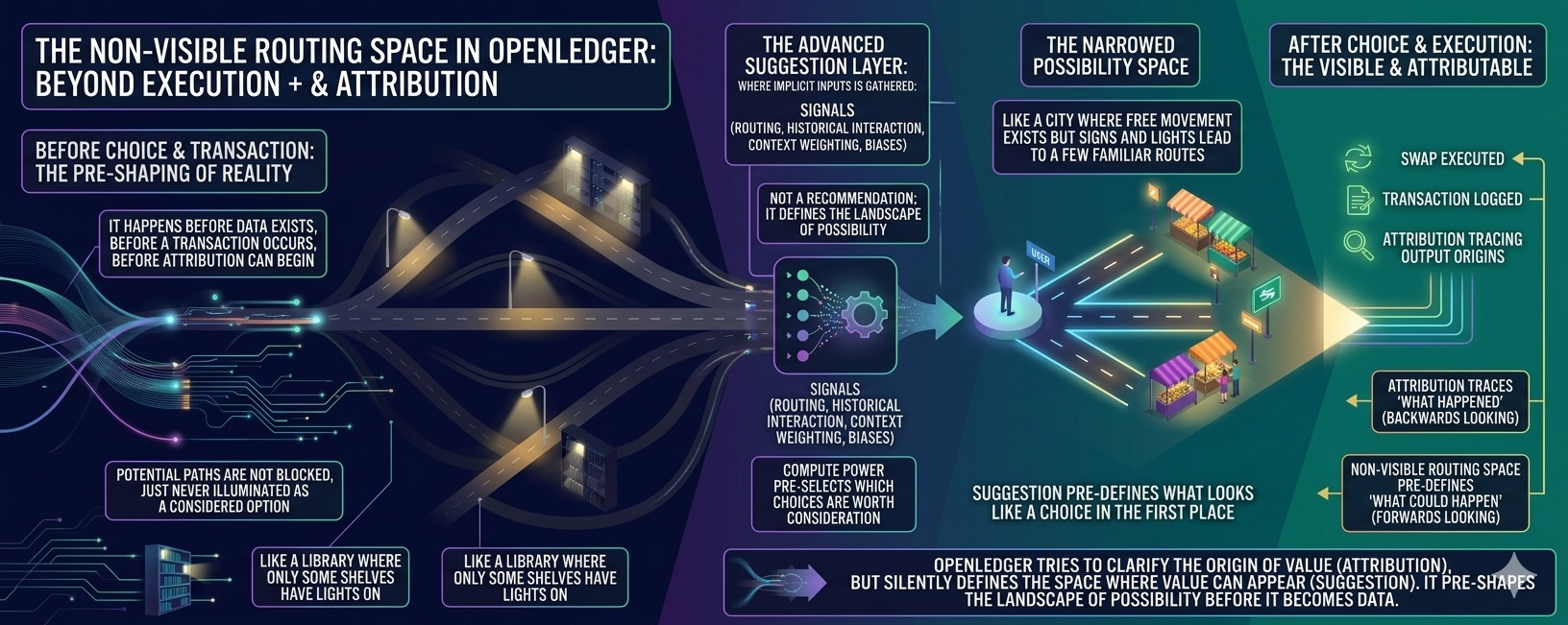
Today, I was sipping coffee and reflecting on the issues I've explored in @OpenLedger , and I suddenly realized there's a unique point I've overlooked for a while. It’s not about execution or attribution; it’s about the phase before anything becomes 'on the table.'
No one calls it by its clear name. It doesn’t show up on the dashboard, nor does it exist in the whitepaper as a standalone module. But when you look at enough routing flows, you’ll notice a strange area that always exists before a transaction. An area where the system has 'lightly decided' what options are allowed to surface.
At first, I thought it was just a suggestion layer. A layer that helps agents or users avoid looking at too many possibilities. Like filtering noise, reducing the search space, or optimizing the experience.
But as I dive deeper into OpenLedger, I see that understanding is too simplistic. Suggestion isn’t just behind the choices to support them. It’s ahead of the choices to define them. It’s not about what to pick. It’s about what gets to look like a choice from the get-go.
I remember once reviewing a routing path in OctoClaw. The final result was nothing unusual. Swaps still occurred, execution was still logically correct, attribution could still be traced back normally.
But what made me pause was the very clear feeling that there are many 'reasonable' paths that never had the chance to become part of the consideration space. Not rejected. Not failed. Just simply never allowed to appear long enough to become a real branch.
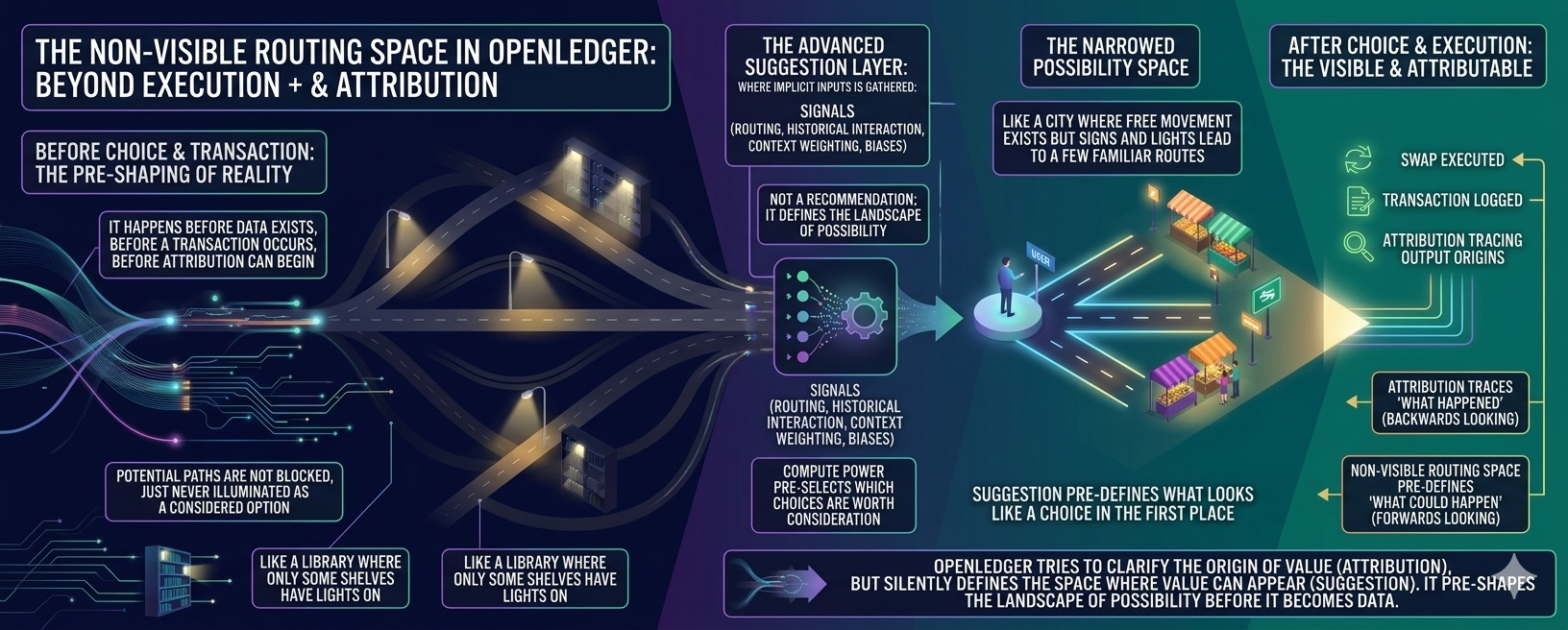
It’s like standing in a library where only a small part of the bookshelves is lit. The rest isn’t erased; it’s just never seen clearly enough for you to know it exists.
In OpenLedger, attribution is designed to trace back value. Who contributed to the output, who influenced the context, who participated in the inference path. It’s very clear in the 'has happened' part. But issues start to arise in the 'could have happened but didn’t happen' part.
Attribution doesn’t have room for that part. It starts after something has become output. While suggestion stands one step before that, where the system decides which output has the right to be born as a possibility.
This made me start to look at the suggestion layer differently. It’s no longer just a recommendation. It resembles a mechanism shaping the space of possibilities before that space is even seen. A sort of 'filtering before the data exists.'
And the annoying thing is it doesn’t operate like a clear rule. No if-else, no fixed policy. It’s a synthesis of routing signals, interaction history, context weighting, and biases that accumulate over time in the system. No one specifically designed it to do that. But it still happens.
I have an example I often think of to grasp this feeling. It’s like a city that doesn’t stop you from going down any road, but the lighting, signs, and flow of people always naturally lead you into a few familiar routes. You still have freedom. But most of that freedom has never been activated into real behavior.
The OpenLedger suggestion layer works like that. It doesn’t block paths. It just makes some paths feel 'more natural' to the point where you stop thinking about other routes.
There’s a data point I’ve noticed in the flow agents. When the system has more compute, it doesn’t really expand the number of choices considered. It just gets better at picking what deserves to be considered first.
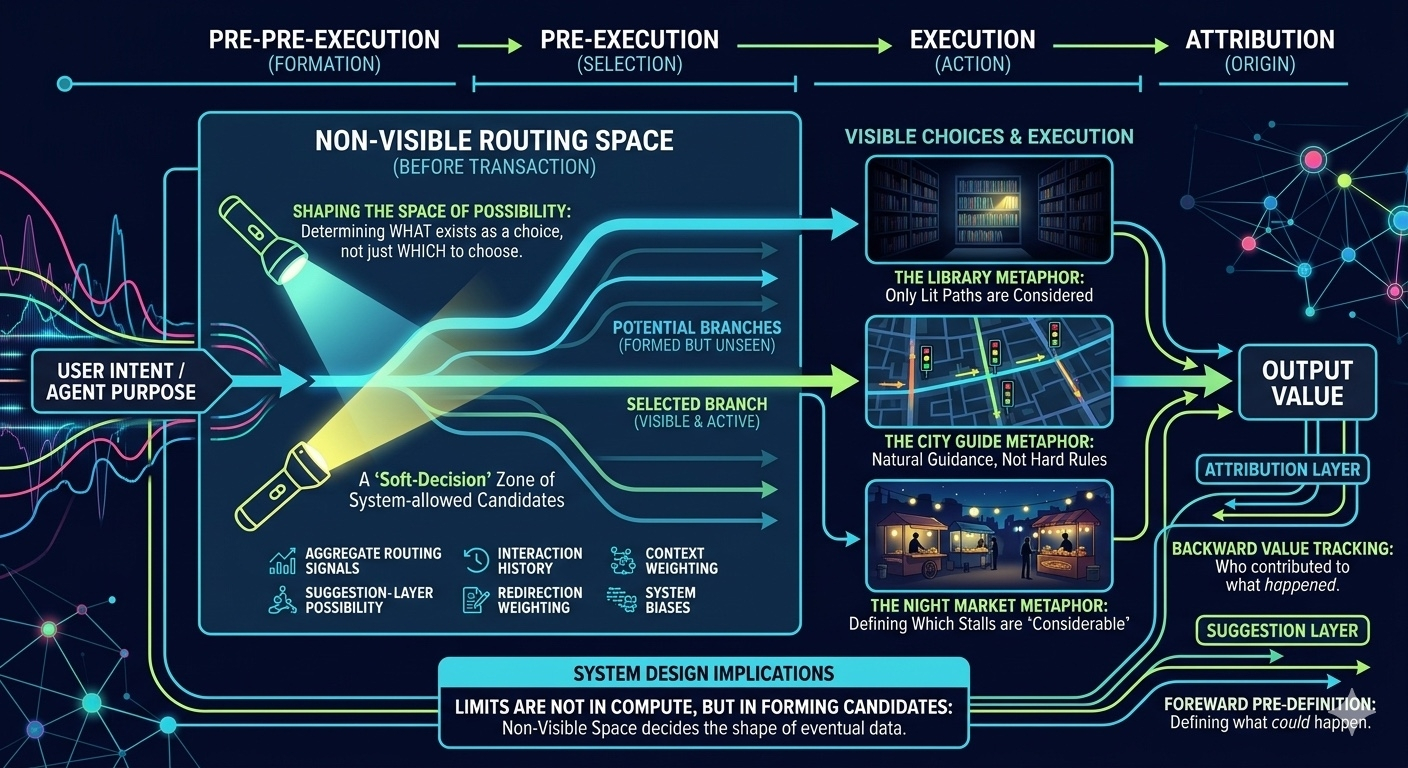
This sounds very small, but it changes the entire structure of the system. Because the limits are no longer in computing power, but in what the system decides the initial set of possibilities is. And that’s when I started calling it the non-visible routing space.
A zone before data is born. Before transactions exist. Before attribution can start working. No one logs it as an event. There's no event like 'candidate path was never formed.' But that very area decides the entire shape of what later becomes data.
I once tried to imagine it simpler to understand. If you remove the suggestion layer from OpenLedger, the system won’t crash. Execution still runs, agents still swap, routing still exists. But what changes is the feeling of the choice space. It will be broader, messier, and less 'naturally narrowed down' to a few familiar paths.
It’s like you’re taking off a colored filter you didn’t know you were wearing. But the issue isn’t about having more or fewer choices. The issue is that before a choice appears, the system has already decided what gets to look like a choice.
There’s a metaphor I often think about. It’s like a bustling night market, but the light only falls on a few specific stalls. No one stops you from going into the dark areas. But you’ll rarely step into them because your eyes never get used to seeing them as 'considerable.' The dark doesn’t disappear. It just never becomes part of the decision.
In OpenLedger, attribution is trying to clarify the source of value. But suggestion is quietly doing another thing: defining the space where value can emerge. One side is retrospective. The other is shaping the future. These two aren't directly opposed, but as you dig deeper, they start to diverge at a very subtle point: what gets to be considered 'has happened.'
From a system design perspective, non-visible routing space isn’t a module. It’s like a naturally forming area when the system optimizes for long enough. Something no one intentionally created, but couldn’t avoid either.
It pops up when compute gets cheap, when routing thickens, when context becomes something that can be reused continuously. And at that moment, the most important thing is no longer what to compute. It's about deciding what gets to step into the computable zone.
There’s a question I haven’t found a concise way to express. If every transaction in OpenLedger has to pass through this area before being born, then what is the system really optimizing?
Not speed. Not cost. Not just accuracy. It might be the shape of the possibility space before it becomes data. And if that’s the case, then the suggestion layer is no longer a supporting layer. It’s where the system starts defining reality before that reality gets recorded.