
I feel like I’ve seen this story play out countless times before.
Every market cycle brings a new debate about where the power should lie. It used to be with banks or DeFi, then it shifted to cloud vs blockchain, and now it’s centralized AI vs decentralized AI. There’s talk of freedom, discussions about data ownership, and reclaiming power from tech giants, but after all the pretty slogans, we’re often left with the same old question: who actually creates value and who holds most of that value?
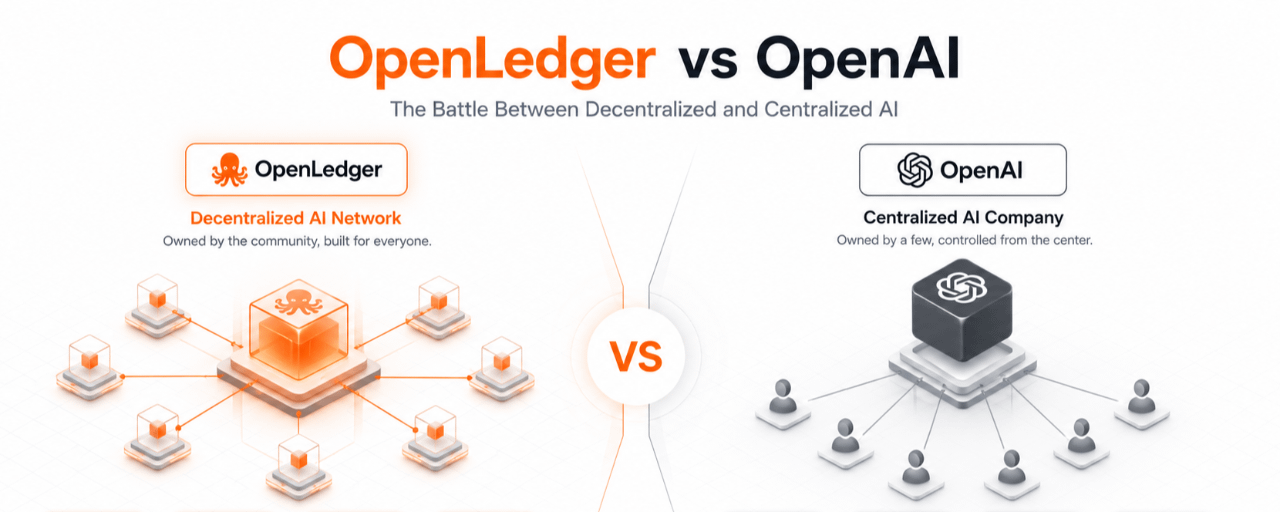
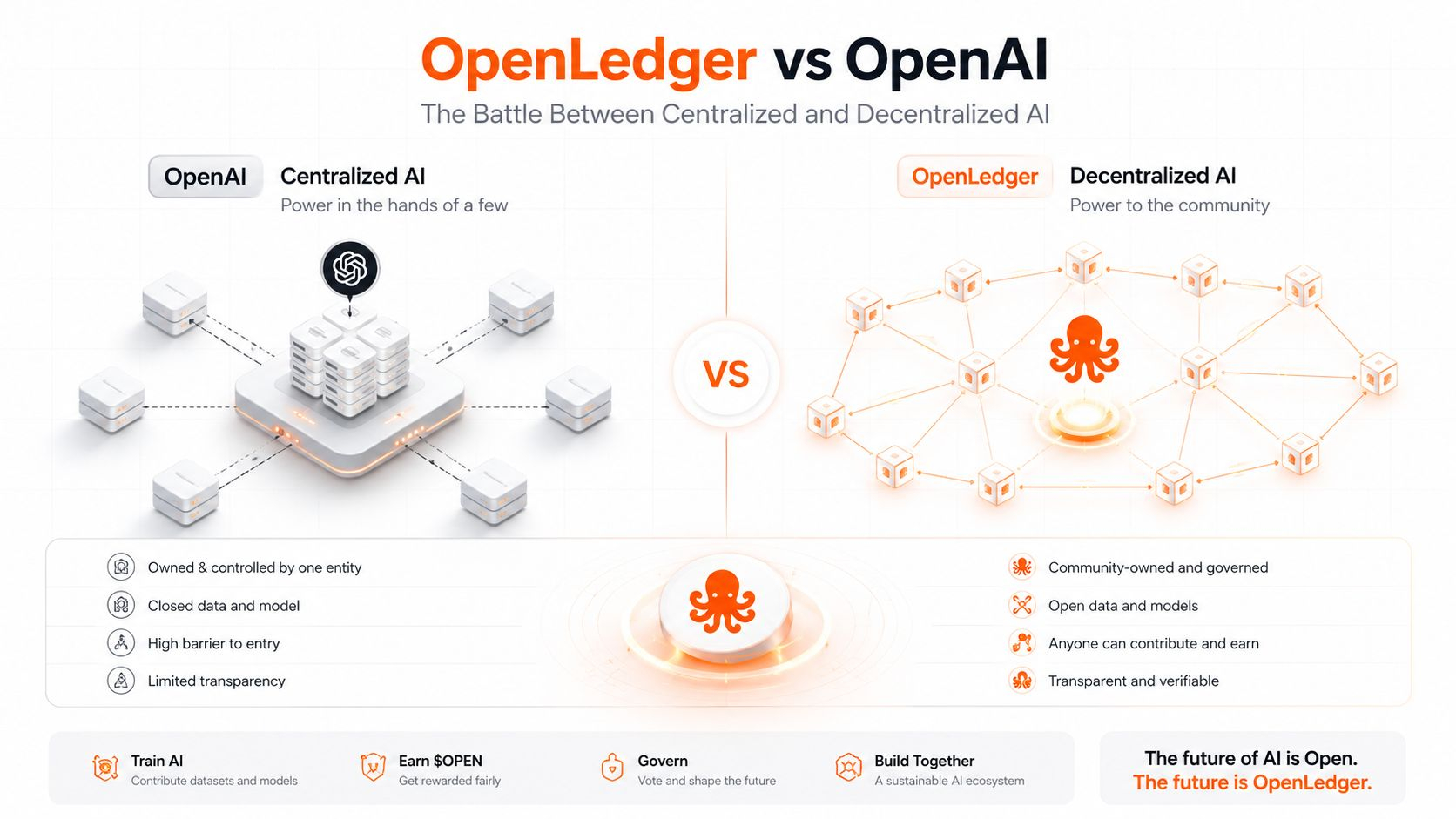
That's also why I find the contrast between OpenAI and OpenLedger quite interesting. Not because this is a battle between two specific entities but because it reflects two completely different views on the future of AI.
If viewed coldly, OpenAI represents a model that the tech world is already familiar with. Data is centralized, infrastructure is centralized, the training process is centralized, and value is also centralized. This isn't necessarily bad; in fact, that centralization has helped AI advance rapidly in recent years. Users don't care where the model is trained or who contributes the data; they just want the product to work well, and OpenAI is proving that a centralized system can provide a superior experience over most competitors.
But here's where a rather boring issue pops up, and because it's so boring, many overlook it.
AI needs data, a ton of data.
However, those who create the data often don't receive commensurate rewards. Contributors of content, expertise, usage behavior, or industry-specific data are almost sidelined in the value chain being created. Models are becoming smarter, revenues are increasing, but the initial raw material is becoming increasingly invisible.
That's something I've always been puzzled about while observing the AI industry.
And that's where OpenLedger comes in.
This project doesn't seem to be directly competing with OpenAI in terms of model quality. At least from my perspective, they're trying to tackle a different question: if data is the fuel for AI, can data contributors be recognized and share value more transparently?
Sounds a lot like a familiar crypto narrative. I know the market has heard about 'returning ownership' hundreds of times, but the point that has brought OpenLedger into the spotlight recently is the idea of turning data into an asset that can be traced back and directly linking rewards to contributors. They call it Proof of Attribution; the name isn't what's important, but the noteworthy effort to tackle a problem that most of the current AI industry seems to want to avoid.
Still, the gap between a reasonable idea and a functioning ecosystem in reality is always vast.
AI isn't short on ideas, and crypto isn't short on ideas either; what both fields lack, in my opinion, are systems that can create genuinely sustainable value loops. Users have to want to use it, businesses have to see economic benefits in participating, and developers need motivation to build. If one link is missing, everything ultimately reverts to the old state—a pretty story on a presentation slide.
That's why I haven't viewed OpenLedger as a rival to OpenAI. It might still be too early to put them on the same scale. One side holds a product used by hundreds of millions, while the other is trying to build a new economic model around data and AI. Two different paths, two different problems.
But the debate they represent is worth keeping an eye on.
Because if AI continues to be the underlying infrastructure of the internet in the next decade, the questions of who owns the data, who gets the rewards, and who controls the created value will become increasingly hard to avoid. OpenAI is showcasing the power of centralization. OpenLedger is experimenting with the opposite hypothesis.
Is there a hypothesis that's more accurate?
I think the market doesn't have the answers yet, and to be honest, the whitepaper doesn't provide those answers; only real usage can do that.
This needs time to answer... I'll keep watching..!