
Crypto Market & Blockchain: The Situation Update as of June 1, 2026
A market under pressure between macroeconomic forces and structural advancements
This Monday, June 1, 2026, marks a turning point for digital assets. As the market opens the sixth month of the year in the red, the data reveals a paradoxical reality: a short-term sell-off pressure from institutional investors is met with a foundational tech adoption that is quietly reshaping global financial infrastructures. Here are the three major dynamics defining this key day.
1. Macro Situation: A Week Start Under Pressure
June begins on a negative note for sector players. By midday, the CoinDesk 20 (CD20) index is down 2%, penalized by a tense geopolitical context and persistently restrictive monetary expectations.
Bitcoin and Ether under negative life support
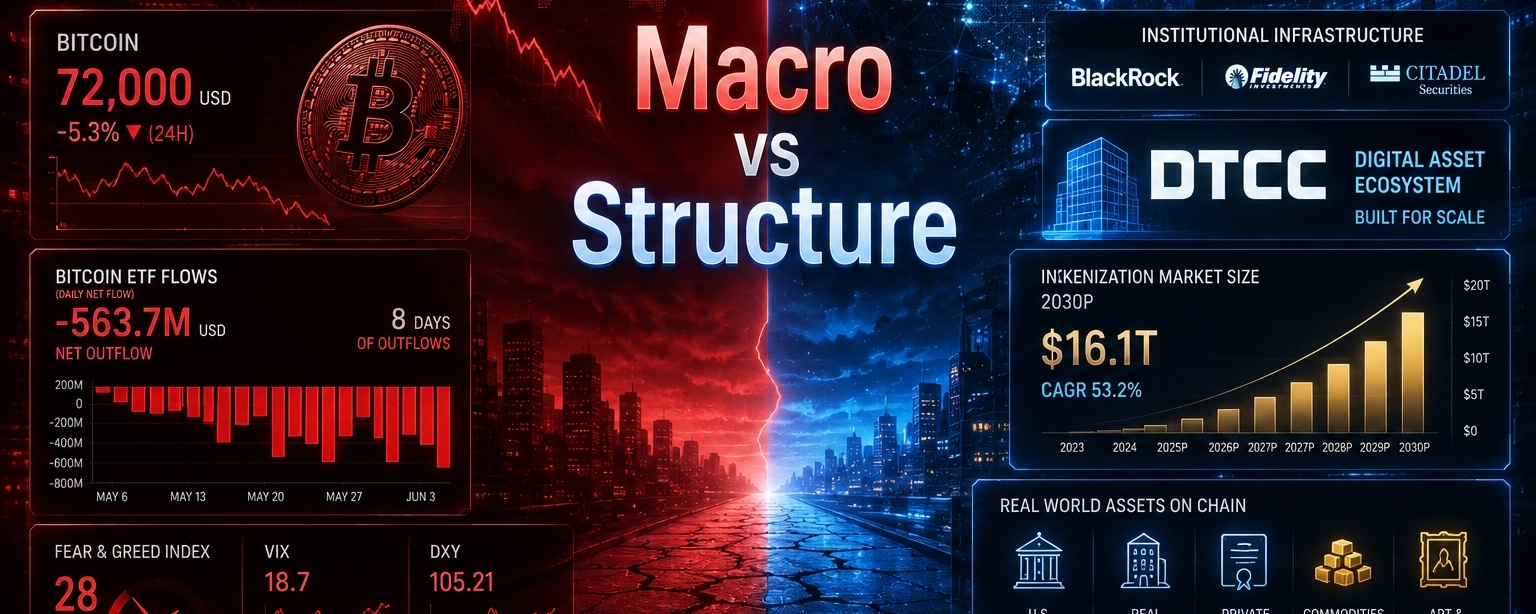
Bitcoin (BTC) is hovering around $72,700, marking its sixth drop in seven days. It is under continuous pressure after a May that historically deviated from its usual bullish trend [citation:5]. Ether (ETH) is even more weakened, dipping below the psychological threshold of $2,000, a level that has served as an anchor for many quantitative trading strategies.
The alarming signal from ETFs
U.S. spot ETFs, true barometers of risk appetite on Wall Street, are experiencing their longest redemption streak since their launch in 2024. Between May 15 and 28, over $2.8 billion left these investment vehicles. Ethereum is facing the same fate with net monthly outflows exceeding $400 million in May, abruptly reversing the positive trend observed in April.
The shadow of the Fed
The prospect of a rapid rate cut is receding. While U.S. inflation (CPI) surged to 3.8% in April, the rhetoric from Federal Reserve officials, like Kashkari and Goolsbee, remains firmly "hawkish." The market is forced to contend with a persistently high rate environment, which mechanically weighs on the valuation of risk assets.
2. Microstructure: Hidden Stabilization Signals
Behind this apparent gloom, derivative market data suggests that professional investors are anticipating a calm, or even a technical rebound.
Bullish positioning of derivatives
Despite the capital outflows from spot products, the futures and options markets show cautious but real optimism. The annualized three-month "basis" (the price difference between futures and spot) has risen to 2.8%, up from 2.2% the previous week. This movement indicates a moderate improvement in risk appetite among institutional investors.
The Put/Call ratio leans towards optimism
Options trading data is clear: over the last 24 hours, 61% of volumes are in "Calls" (betting on upward movement) compared to only 39% for "Puts" (betting on downward movement). The "skew" (a measure of risk aversion) remains moderately bullish, suggesting that the market does not anticipate a dramatic collapse despite the decline in spot prices.
3. Adoption and Innovation: The Institutional Shift is Accelerating
This is probably the most significant counterbalance to the price gloom. Away from trading screens, blockchain technology is firmly establishing itself in the gears of traditional finance.
Tokenization of real-world assets (RWA)
This topic is on everyone's mind in the global finance community for 2026. According to the World Economic Forum, this year is a "decisive moment" for tokenization. The ability to tokenize and trade real-world assets (bonds, stocks, real estate) on the blockchain promises to streamline capital markets. The XLM token (Stellar) perfectly illustrates this dynamic: it surged over 40% after being chosen by the Depository Trust and Clearing Corporation (DTCC), which manages $114 trillion in assets, to build its tokenized securities platform.
The convergence of TradFi/DeFi
Major banks are no longer just "pilots." JPMorgan has issued its deposit token (JPM Coin) on a public blockchain, while Citi has integrated 24/7 USD settlement services. As highlighted in the BPM report, layer 2 infrastructures and Zero Knowledge Proofs are maturing, providing the speed and privacy needed for institutions.
The regulatory framework is becoming clearer
For analysts, the number one catalyst for 2026 is regulatory clarity. In the U.S., the "CLARITY Act" and the SEC's crypto task force are gradually replacing the era of "regulation by enforcement." In Europe, the MiCA framework continues to set the global standard.
Today's Verdict
June 1, 2026 perfectly illustrates a transitional phase. In the short term, the market remains hostage to restrictive monetary policies and the war in Iran, generating negative volatility and capital outflows from ETFs.
However, in the medium to long term, the fundamentals are strengthening. The outflow of speculative capital is being offset by the silent but massive arrival of traditional market infrastructures (DTCC, major banks) choosing public networks to build the finance of tomorrow. The market is bearish, but the industry has never been stronger.
Disclaimer: This article is a market analysis as of June 1, 2026, and does not constitute investment advice. Digital asset markets are extremely volatile.