
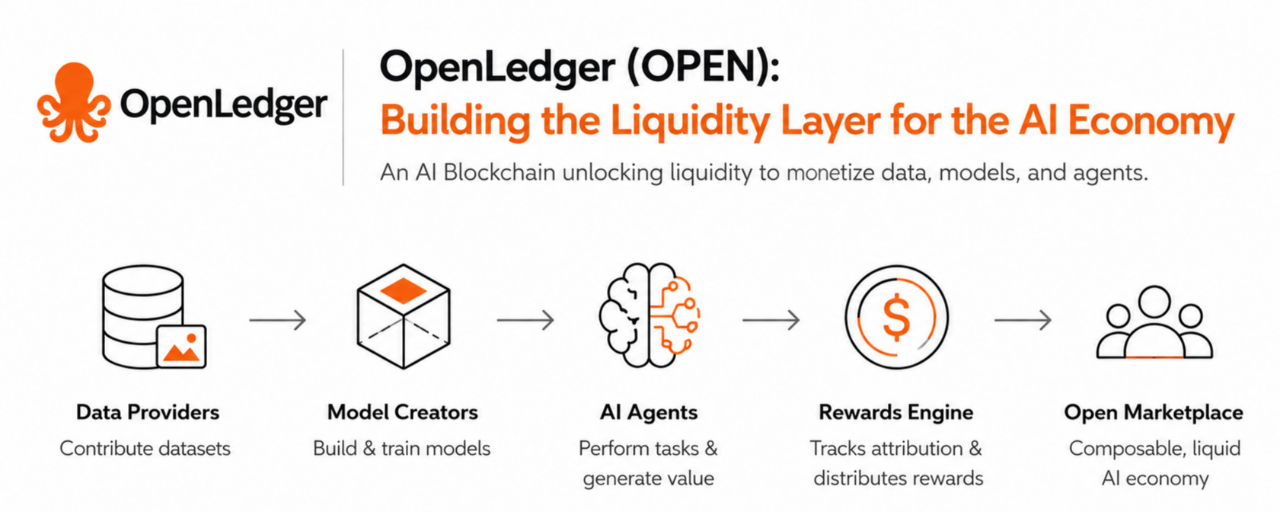
Every so often, a project appears in the blockchain world that feels like it is chasing something bigger than the usual promises of faster transactions, lower fees, or another decentralized application ecosystem. When I first came across OpenLedger (OPEN), that was the impression it left on me. At a time when artificial intelligence is rapidly becoming one of the most valuable technologies on the planet, OpenLedger is asking a simple but powerful question: if data, models, and AI agents create value, who should own that value?
The question may sound obvious, but the reality is surprisingly complicated. Today, much of the AI industry is dominated by a handful of large companies. Millions of people generate data every day through their work, online activity, research, and interactions, yet very few of them directly benefit when that data helps train valuable AI systems. OpenLedger is trying to challenge that model by creating what it describes as an AI blockchain designed to unlock liquidity and monetize data, models, and agents.
What attracted me to the idea is that it goes beyond treating AI as just another buzzword attached to a crypto project. Instead, the project seems focused on creating an economic layer where contributors can participate in the value generated by artificial intelligence. In theory, if someone provides useful data, develops an AI model, or creates an autonomous AI agent that performs valuable tasks, they should have a way to earn rewards from that contribution.
Imagine a small medical research group that gathers specialized healthcare data. Under traditional systems, that data might eventually become valuable to large AI companies while the original contributors receive little recognition or compensation. OpenLedger's vision suggests a different future where that data can be tokenized, monetized, and integrated into an ecosystem that rewards the people who made it valuable in the first place.
The same concept extends to AI models. Training sophisticated AI systems is expensive, and many developers struggle to find sustainable ways to monetize their work. OpenLedger aims to create an environment where these models can become assets within a broader decentralized economy. Rather than relying entirely on centralized platforms, developers could potentially earn from the usage and performance of their creations.
Then there is the idea of AI agents, which may be one of the most interesting parts of the story. AI agents are increasingly being designed to perform tasks autonomously, whether that means analyzing information, executing transactions, managing workflows, or interacting with users. OpenLedger appears to envision a future where these agents are not simply tools but active participants in a digital economy. In that scenario, an AI agent could generate value, interact with blockchain infrastructure, and create economic opportunities for its creators and stakeholders.
Of course, ambitious visions are common in both crypto and artificial intelligence. The challenge is turning those visions into something practical. This is where every investor and observer should pause and think critically.
One reality is that both AI and blockchain are highly competitive industries. There are already numerous projects attempting to combine the two technologies. Some focus on decentralized computing, others on data marketplaces, and others on AI-powered applications. OpenLedger is entering a crowded field where attention is limited and competition is intense.
Another challenge is adoption. Building technology is difficult enough, but convincing users, developers, and businesses to embrace a new ecosystem is often even harder. A platform can have excellent technology and still struggle if it fails to attract a critical mass of participants. For OpenLedger's vision to succeed, it will likely need a healthy network of data providers, model creators, developers, and users who all see enough value to remain active.
There is also the issue of data quality. In artificial intelligence, not all data is equally useful. A decentralized marketplace can create opportunities, but it can also introduce questions about verification, reliability, and incentives. If rewards are tied to contributions, the system must ensure that contributors are providing meaningful value rather than simply generating volume for the sake of rewards.
Market conditions present another layer of uncertainty. Crypto investors have seen many promising narratives rise and fall over the years. A strong concept does not automatically translate into long-term success. Sentiment shifts, funding cycles change, and technological trends evolve. OpenLedger will need to prove that its model remains relevant even when market excitement moves elsewhere.
Despite those challenges, I find the broader idea behind OpenLedger genuinely interesting. It reflects a growing recognition that artificial intelligence is becoming an economic force in its own right. As AI systems become more capable, questions about ownership, compensation, and value distribution will only become more important.
What makes OpenLedger worth watching is not simply the blockchain itself but the possibility that it is attempting to build infrastructure for an entirely new type of economy. Instead of viewing AI as something controlled exclusively by large organizations, the project imagines a world where data contributors, model developers, and AI creators can all participate in the value they help generate.
Whether OpenLedger ultimately becomes a major player or remains one of many experiments in the AI-blockchain space is impossible to know today. The road ahead will be filled with technical challenges, competitive pressures, and market tests. Yet the underlying question it raises feels increasingly relevant. As artificial intelligence reshapes industries and creates enormous amounts of value, who gets to benefit from that value?
OpenLedger is betting that the answer should be more people, not fewer. In a world where AI is becoming one of the defining technologies of our time, that may be one of the most important bets a blockchain project can make.
