
 There's a thread on X saying that OpenLedger is building a 'fully autonomous AI execution layer', where agents can make financial decisions without any underlying control layers. Initially, I skimmed through and found it reasonable, since that's how people generally understand AI systems: high autonomy equates to a smarter system.
Most people think that an AI system just needs to optimize well enough, with the model understanding the state, choosing actions, and optimizing rewards, similar to what I see in many trading bots or AI crypto systems.
But when I opened OpenLedger and looked back at a very small execution path, where an agent adjusts its behavior after a cost constraint changes, what made me pause wasn't the action, but how the system 'reinterprets the financial meaning' of that very behavior.
Here, I see a counterintuitive issue. Systems with high autonomy at the execution layer tend to create gaps at the financial consequence layer. It knows what to do, but doesn't really understand the financial structure it's creating behind the scenes.
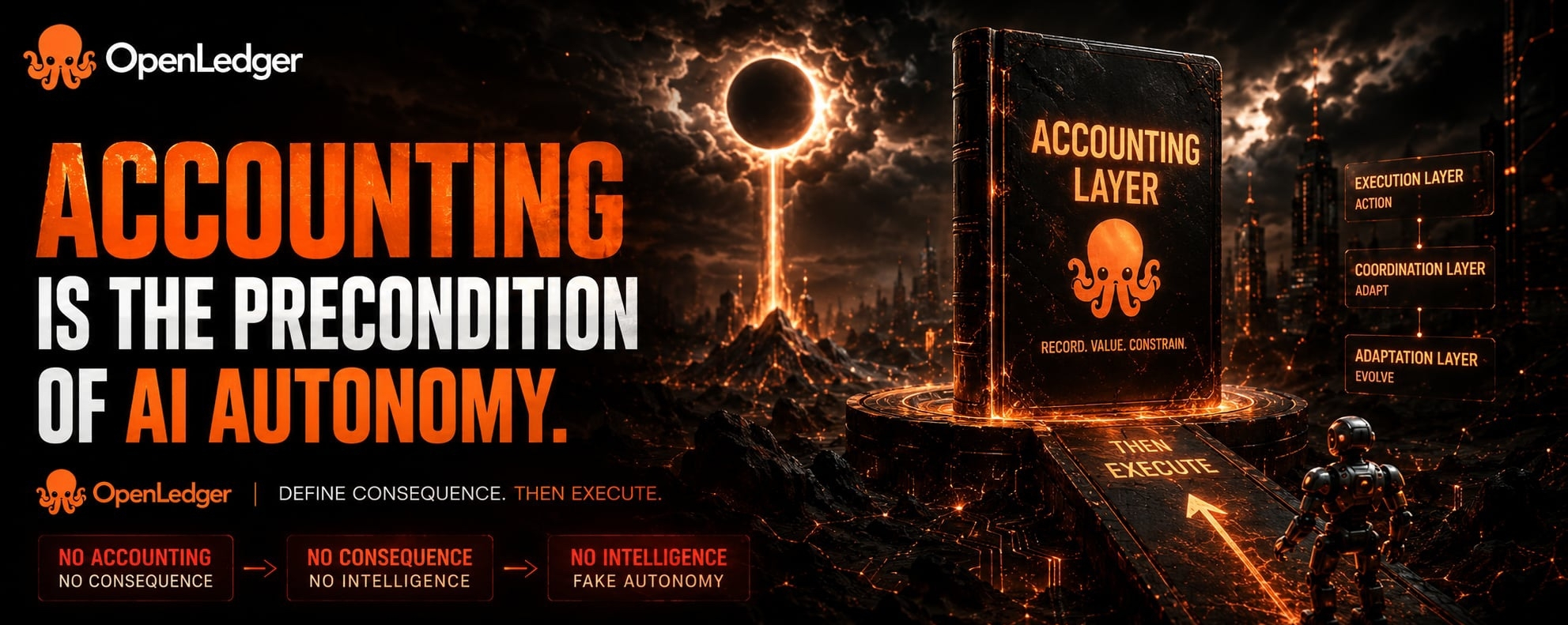
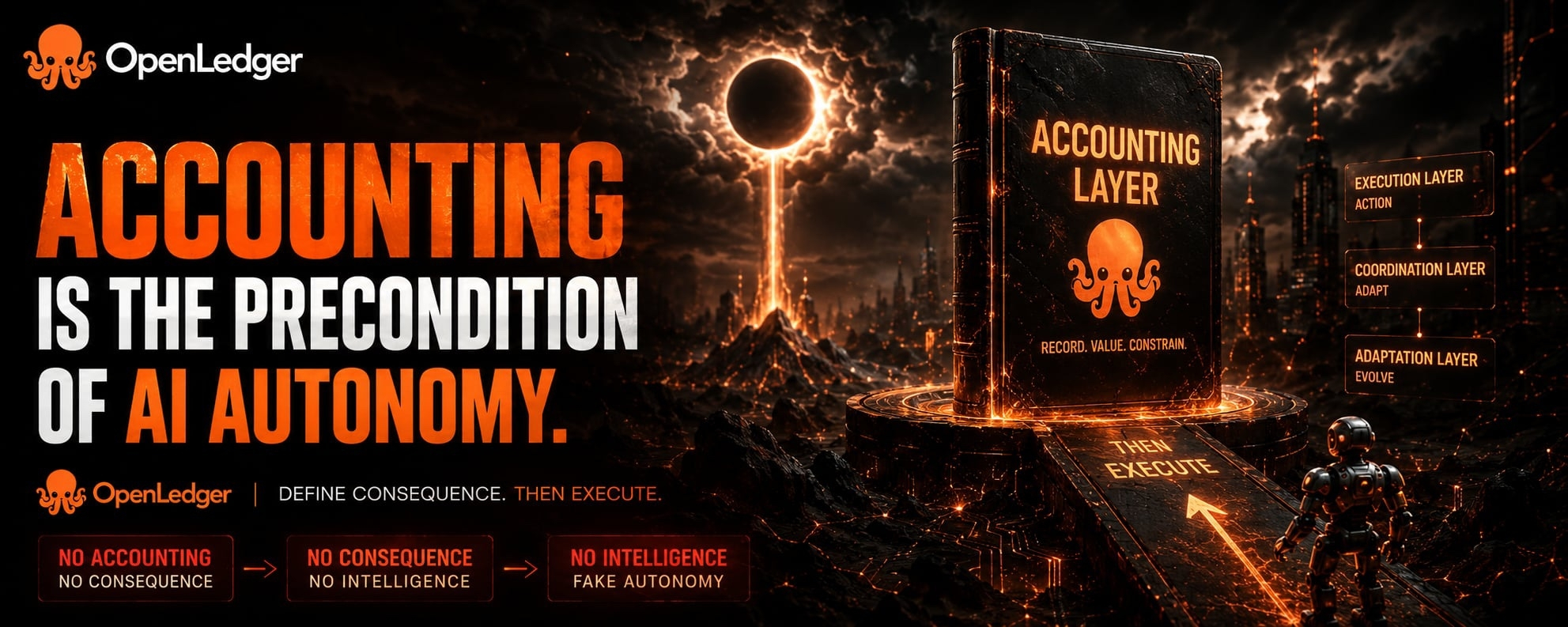
This reminds me of something that seems very simple: every financial behavior has an 'accounting shadow'. But in most AI systems, that shadow doesn't exist as a structure, just as a scattered log. OpenLedger is different. Instead of viewing accounting as a final recording step, this system starts from the accounting layer as a foundational definition of behavior. Data isn't just input; it's a form recorded according to financial value. Each state doesn't just describe what's happening; it carries a structure that affects the balance, risk, and exposure of the entire system.
Only after that layer exists does the execution layer begin to operate. This creates an important reversal. AI no longer starts from action and then calculates consequences. It starts from understanding the financial consequences before action is allowed to exist.
I've observed a weaker version of this logic in trading systems, where the risk engine stands before execution. But the difference is in OpenLedger; accounting is not just a constraint check. It's the way the system represents its entire state from a financial perspective.
If you pay close attention, you might notice a counterintuitive fact about current AI. Autonomy is no longer the starting point; it's the end result. A system can only be truly autonomous if it understands the financial cost of each action before that action occurs. Otherwise, autonomy is just speed, not intelligence. Interestingly, OpenLedger isn't trying to make the model 'smarter' in terms of better reasoning or better predictions. It pushes intelligence down to a lower layer, where everything is accurately recorded financially before it becomes action.
From that accounting layer, the entire system above it is formed. Execution, coordination, and adaptation are no longer separate layers, but extensions of a system that has already understood the financial consequences of its actions. Viewed this way, OpenLedger isn't just an execution layer for AI. It's like a system trying to answer the reverse question: if we want AI to truly be autonomous in finance, it must start by knowing how to record accurately before it knows how to act.
For me personally, the biggest insight isn't about AI autonomy. It's about how OpenLedger is forcing me to revisit a very basic yet often overlooked point: intelligence doesn't start with the ability to act, but with how the system records and reinterprets that behavior from a financial perspective. And OpenLedger is rebuilding the entire intelligence from something that seems very classic: accounting.
#OpenLedger @OpenLedger $OPEN $LAB
