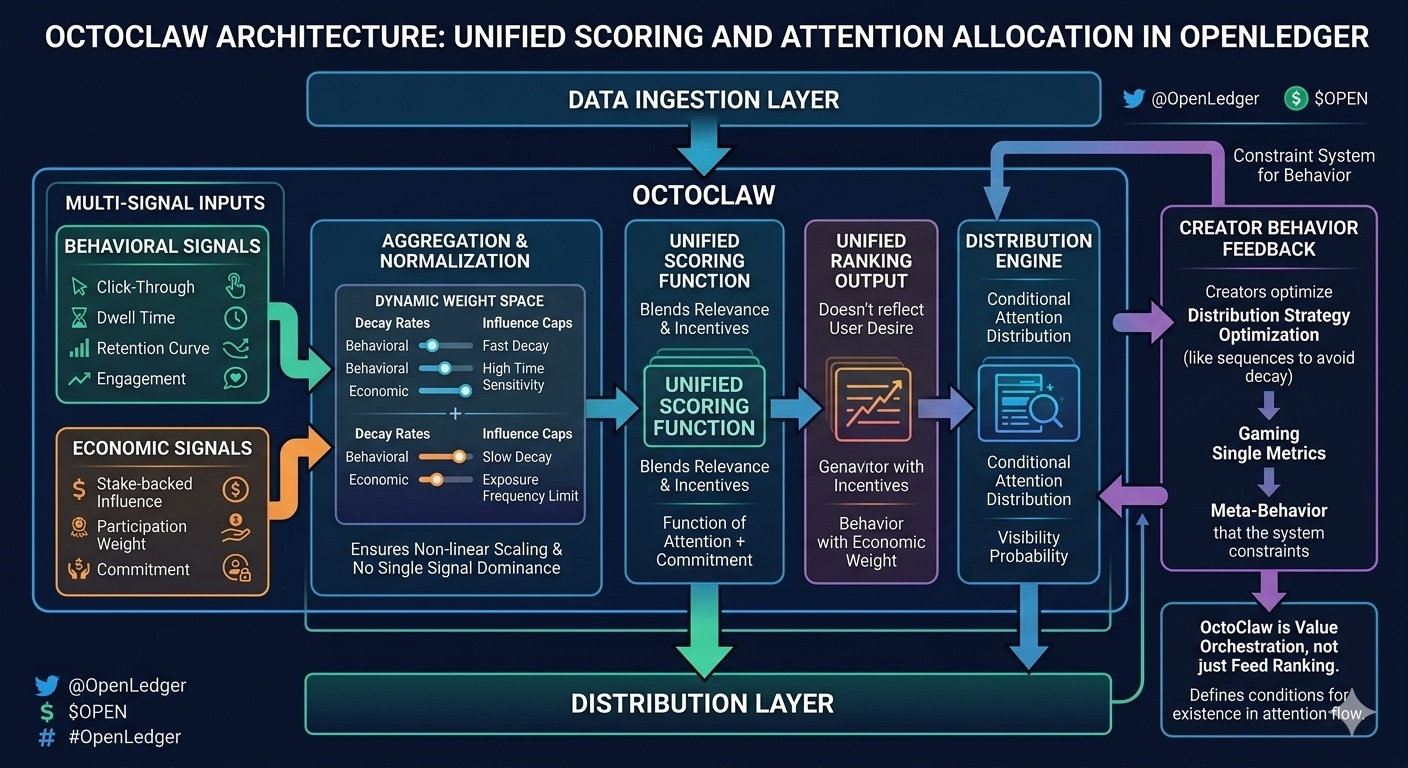
There's a detail in the architecture of OpenLedger that I have to revisit multiple times. OctoClaw doesn't stand alone as an independent recommendation module. It sits right at the intersection of data ingestion and distribution layer, where the system has to decide not only 'which data is valuable', but also 'how that value is amplified by the mechanism'.
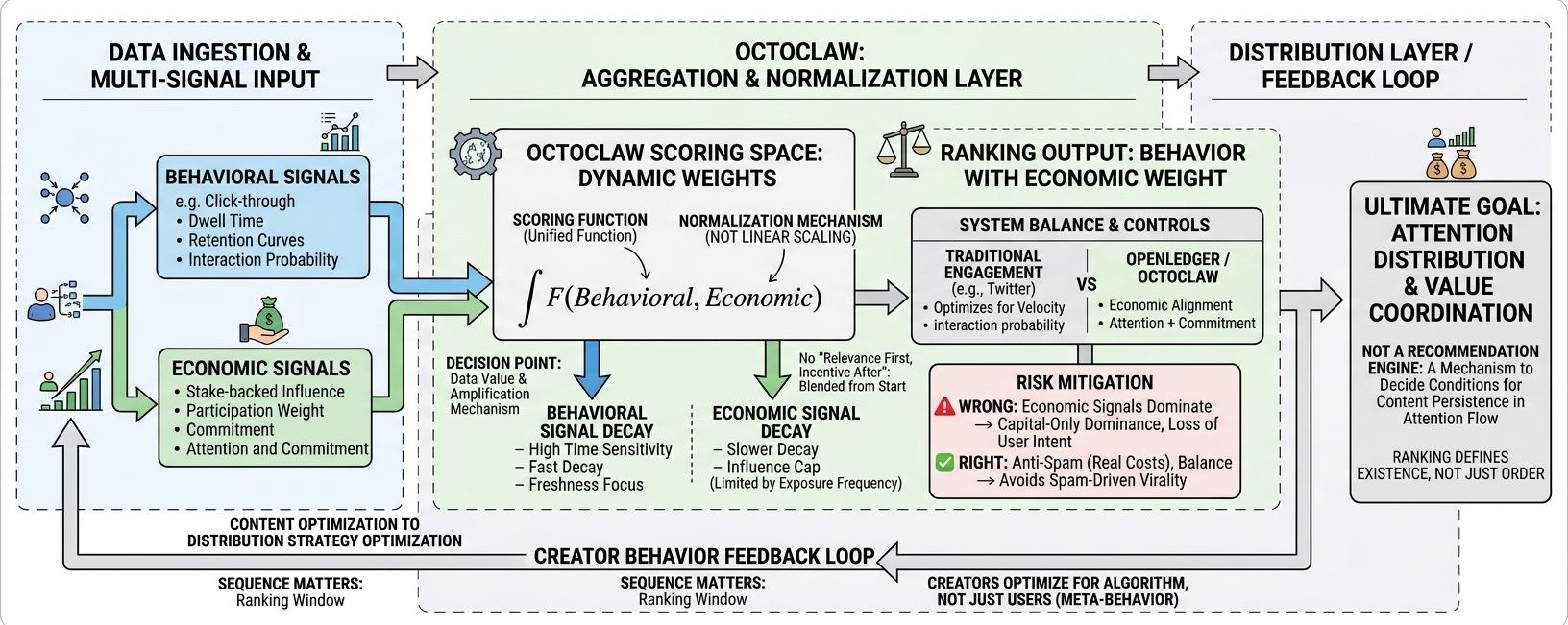
In this design, scoring doesn't separate user behavior from economic signals. They get fed into a single unified function, then break down into the ranking output. This sounds like technical optimization, but it actually shifts the essence of the ranking: from reflecting behavior to reflecting behavior weighted by economic factors.
No longer 'relevance first, incentives later.' It's both mixed from the start. OctoClaw, when interpreted correctly in the context of OpenLedger, is the aggregation layer responsible for normalizing multi-signal input before feeding it into the distribution engine. Input includes not just engagement metrics like click-through, dwell time, or retention curve, but also economic signals like stake-backed influence or participation weight within the system.
The key point lies in how the system handles normalization. Signals aren't scaled linearly and then summed up. They're placed into a dynamic weighted space, where each signal type has different decay rates and influence caps. Behavioral signals have high sensitivity to time, while economic signals tend to decay slower but are limited by exposure frequency.
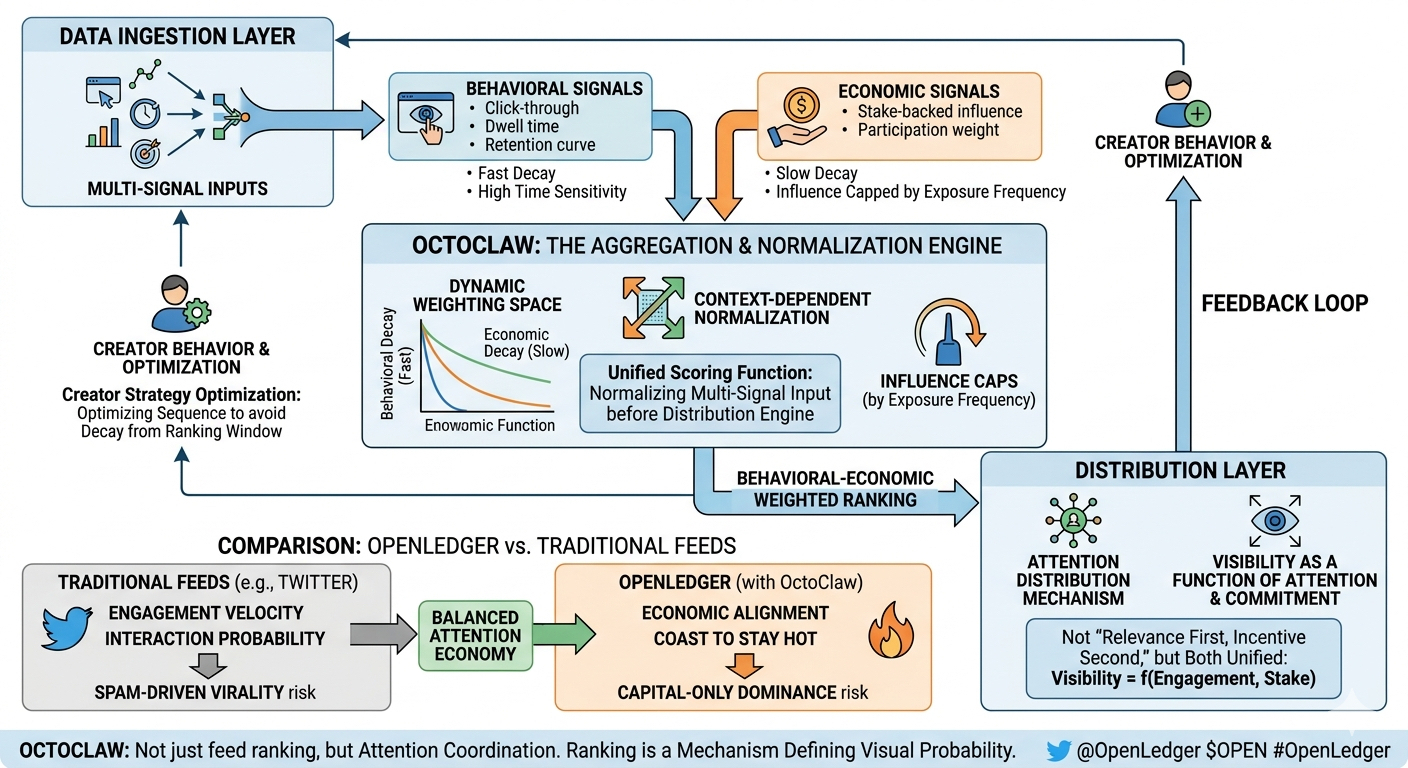
This creates a very clear structure. No signal wins outright. Only signals that fit the context distribution at that moment matter. If this design is wrong, the system will drift in a very specific direction: economic signals will start to dominate behavioral signals. At that point, ranking will no longer reflect what users want, but rather who can maintain economic power within the system. If right, it solves an inherent issue of recommendation systems: manipulation through a single metric.
You can compare it to Twitter to see the differences clearly. Twitter optimizes ranking mainly around engagement velocity and interaction probability. OpenLedger with OctoClaw is trying to incorporate economic alignment into the same scoring space, making ranking a function of both attention and commitment.
It's not just about 'what's hot.' It's about 'what's the cost to keep it hot.' Another crucial technical point is the decay function. In OctoClaw, signals don't decay uniformly. Behavioral signals decay quickly to reflect freshness, while economic signals decay more slowly but lose influence if there’s no accompanying interaction.
This creates a pretty delicate balance. If there's only stake without engagement, influence isn't sustainable. If there's only engagement without economic backing, influence isn't stable in the long run.
This is where the system tries to avoid two extremes: spam-driven virality and capital-only dominance. Another layer exists in the feedback loop between creator behavior and ranking output. As distribution continuously feeds back into how content is created, creators start optimizing not just content but also the patterns of appearance in the system. This is no longer content optimization; it's distribution strategy optimization.
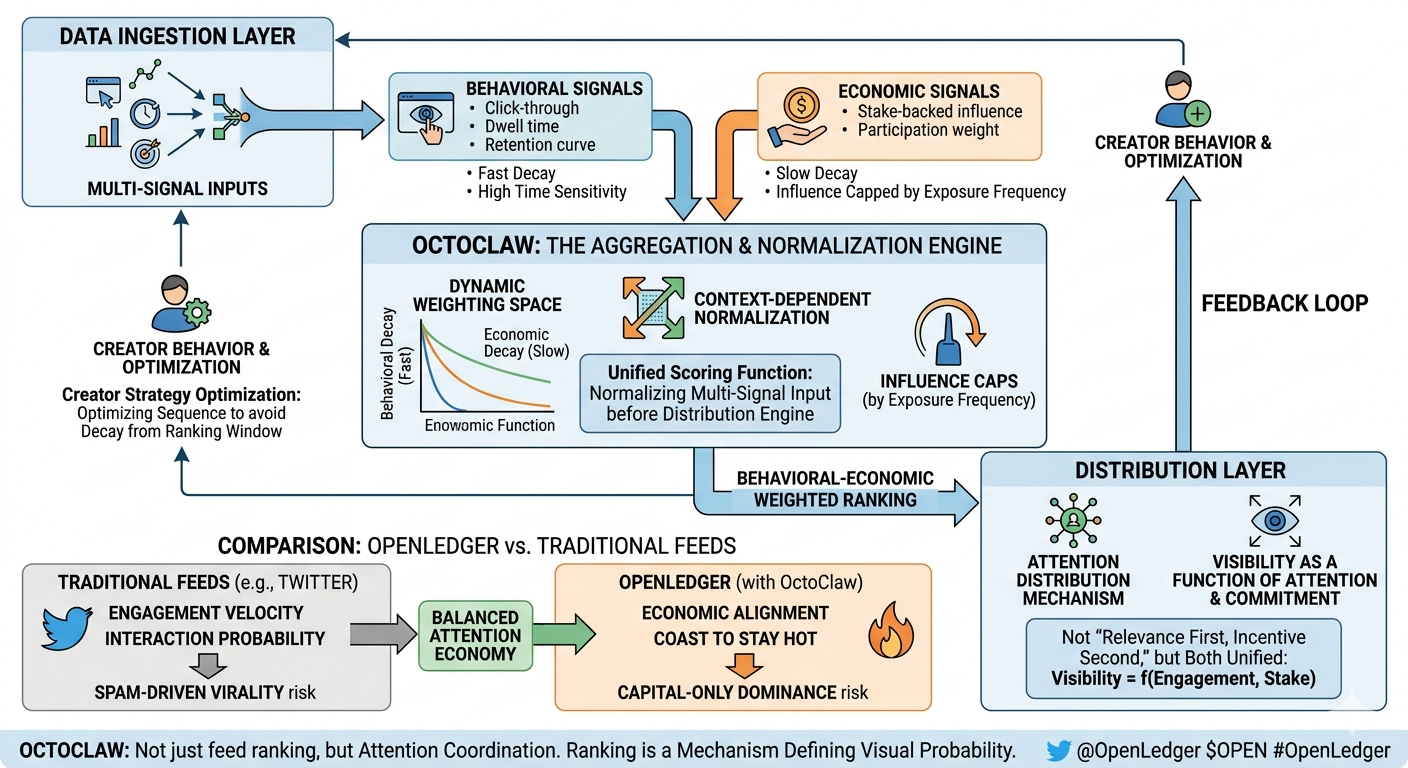
It's not about 'is this post good?' It's about 'which sequence helps the signal not decay from the ranking window.' If the system operates correctly, it reduces dependence on single-metric gaming. If it skews, it creates meta-behavior, where creators write for the algorithm instead of the users.
There's a point that not many notice in this kind of design: ranking is no longer a pure technical output; it becomes a constraint system for behavior within the network. That means it doesn't just reflect the world. It starts to shape how the world self-adjusts to fit that system.
A simpler way to look at it: OctoClaw is not a feed ranking. It's a conditional attention distribution mechanism, where visibility becomes a function of both behavior and economic commitment within the same measurement framework.
If wrong, the system will be captured by actors who can optimize economic signals better than behavioral signals, leading to distribution imbalance. If right, it creates a natural anti-spam layer based on real costs instead of heuristic filters. Last but not least: OpenLedger isn't building a recommendation engine.
OctoClaw is just a slice of a bigger pie, where data, incentives, and distribution come together into a value coordination system. It's not a content selection system. It's a system that determines the conditions for content to stick around long enough in the attention flow.
And the difference lies here: ranking is no longer a leaderboard. It's a mechanism that defines the potential for visibility.