
Introduction: The Undervalued Century-Old Giant and the Second Half of AI
When we mention Nokia, most folks probably still think back to those indestructible feature phones, or maybe the company's recent retreat into the background of the 5G telecom equipment game. But history is always full of twists. As the AI wave sweeps across the globe, this tech titan with over a century of history is quietly undergoing a more critical and disruptive transformation than its past shifts from a paper mill to a mobile empire, or from phones to telecom equipment.
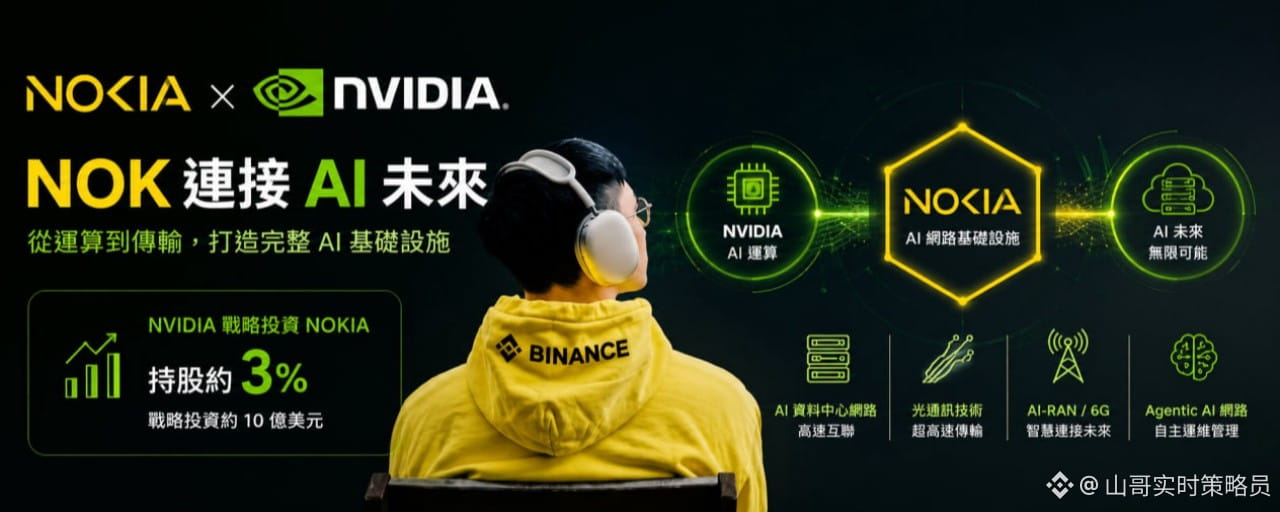
Today, Nokia is no longer just a traditional telecom equipment supplier. It is rapidly transforming itself into an indispensable participant in the underlying infrastructure of the AI ecosystem at an astonishing speed. From the network architecture of super-large AI data centers, ultra-fast optical communication technology, to revolutionary AI-RAN (Artificial Intelligence Radio Access Network) and Agentic AI autonomous network management systems, Nokia is attempting to redefine its ecological position in the AI era.
What truly pushed this 'giant transformation' into the spotlight is NVIDIA's epic strategic investment in Nokia.
🚀 1. NVIDIA holds nearly 3%: The top strategic signal behind the $1 billion investment
At the end of 2025, NVIDIA announced a decision that shocked both the tech and financial circles: a strategic investment of about $1 billion in Nokia, holding nearly 3% of its shares (approximately 2.9%).
For a chip empire with a market cap running into trillions of dollars, a $1 billion investment or 3% stake might seem negligible; but for the market, the buzz isn't about the absolute share size, but the strong signal it sends about global tech trends.
Wall Street's clear signal: NVIDIA has never been a company focused primarily on financial investments.
Looking back at Jensen Huang's past investment landscape, NVIDIA's capital moves have always been highly focused on expanding its own ecosystem (like CUDA) and strategically positioning future core technologies. Thus, when NVIDIA is willing to invest real money to become a core shareholder of Nokia, global high-net-worth capital and institutions reach a consensus: this is by no means a simple short-term capital appreciation investment, but a long-term fate binding aimed at the development direction of AI infrastructure over the next decade.
The bottleneck in the computing power race: from 'brain computation' to 'neural transmission'
This strategic investment brutally exposes the new underlying phase confronting the AI industry.
In the past two years (Phase One): All the market's attention and hot money were focused on the 'GPU computing race,' with tech giants (Meta, Microsoft, Google, etc.) frantically buying and stacking AI chips.
Now and in the future (Phase Two): As individual AI data centers scale from thousands of GPUs to tens of thousands, the strongest pain points in the tech world have shifted.
What truly limits the iteration speed of large models and the evolution of AI is no longer just the computing power of a single chip; it is how massive data can achieve zero latency, ultra-high speed, and absolutely stable throughput and transmission (Networking) across hundreds of thousands of GPUs.
If NVIDIA's GPUs are likened to the 'strongest brain' providing human intelligence; then Nokia is using its century-long communication technology accumulation to build an impeccable 'high-frequency nervous system' for this brain. The ceiling limiting AI development has officially upgraded from the chip battle to an overall communication architecture battle.
🛠️ 2. The New Battlefield of the AI Era: Dissecting Nokia's Three-Phase Comeback Path
How terrifying is a modern large-scale AI training cluster? In an extreme environment with hundreds of thousands of GPUs working in coordination, the amount of data exchanged every second is astronomical. On this highway, even the slightest network latency (Latency), insufficient bandwidth, or decreased transmission efficiency can cause a cliff-like drop in the overall performance of a GPU system worth hundreds of millions of dollars (stuttering, waiting).
To this end, Nokia's development focus has already completed a hardcore pivot to the right, fully laying out its underlying moat in AI Data Center Networking, high-speed Ethernet, optical communication systems, AI Cluster Interconnect, AI-RAN, and Agentic AI autonomous network management platform.
We can clearly divide Nokia's ongoing transformation into three progressively strategic phases:
📌 Phase One: Fully capturing the network cake of super-large AI data centers
As OpenAI (and the Microsoft backing it), xAI, Meta, Google, and other tech giants continue to pour hundreds of billions of dollars in capital expenditure (CapEx) into AI, global demand for super-large data centers is experiencing explosive growth.
The future data center won't just blindly stack chips but will undergo a thorough systematic restructuring of the network architecture. Nokia is actively laying out its cards in this field:
High-speed switches (Data Center Switching): Its advanced SR Linux software system is deeply adapting to NVIDIA Spectrum-X™ Ethernet platform, directly resolving internal data congestion in data centers.
Optical transmission devices and interconnection architecture: With its heavy acquisition of Infinera expected to complete in 2025, Nokia's optical communication technology (Optical Networking) is providing lossless, near-light-speed transmission guarantees for massive multi-data-center interconnection (AI Fabric Networking).
📌 Phase Two: AI-RAN and the Absolute Monopoly in the 6G Era
If data centers are the AI rear guard, then communication networks are the front line that reaches households. The AI-RAN (AI Radio Access Network) concept being aggressively pushed by Nokia is a core killer app that could disrupt mobile communications.
By integrating AI inference and edge computing capabilities directly into wireless base stations, future base stations will evolve from mere 'signal transmission towers' to 'distributed edge AI computing stations.'
Instant resource scheduling and autonomous optimization: Base stations can autonomously allocate bandwidth and energy based on real-time traffic from surrounding connected vehicles and robots.
6G native foundation: In 2026, Nokia, in conjunction with NVIDIA (based on its AI Aerial platform) and American telecom giant T-Mobile, has officially begun on-site evaluations and field tests. This technology is recognized as the underlying cornerstone for future 6G wireless networks.
📌 Phase Three: Agentic AI Autonomous Network—Granting Networks 'Autopilot' Capabilities
As AI Agents become a global tech consensus today, Nokia's ambition is further advanced—laying out the Agentic AI Network (autonomous intelligent network).
Traditional telecom and major network maintenance heavily rely on cumbersome manual monitoring and troubleshooting. Nokia's self-driving network aims for perfect self-awareness, self-judgment, and self-execution:
Automatically perform network fault diagnosis and traffic optimization.
Real-time, autonomously identify security threats and conduct fully automated resource allocation.
For global telecom operators and super-large enterprises, this is not only an extremely exaggerated cost-cutting and efficiency-boosting move but also transforms future communication networks into a 'never downtime, self-evolving' entity.
🤝 3. Strong Partnership: The Perfect Match Between NVIDIA and Nokia
Why have Wall Street and the global tech community placed such a high valuation premium on the cooperation between the two? Because they have perfectly locked in the two most critical and complementary choke points in the AI industry chain.
Core empowerment and moat of the giant camp's role in the AI industry chain: NVIDIA's (NVIDIA) powerful GPU computing, CUDA software ecosystem, and full-stack AI platform provide the unbeatable engine and brain for the AI era. Nokia's advanced optical communication technology, high-speed network switching devices, and telecom-grade lossless transmission architecture build the highway and neurons connecting the AI world.
We can understand this cross-industry alliance with a straightforward metaphor:
If NVIDIA is responsible for creating the most powerful and destructive 'super gold mining machine' in this AI golden age; then Nokia is fully responsible for building the 'broad roads, stable power grids, and lossless transport systems' necessary for the entire mining site to survive.
In this AI gold rush, without mining rigs, you can’t dig out gold (no computing power); but if the mining site has no power, and the roads are muddy (network delays and congestion), even if you have thousands of machines, you can only be paralyzed in place. The combination of the two is the only full-stack solution from computation to transmission.
📈 4. Valuation Reconstruction: Why is the market reevaluating Nokia?
In recent years, due to retail investors and even some traditional institutions' stubborn perception of Nokia, which remains rooted in the 'saturated market and slowing growth of traditional telecom equipment business,' its valuation in the financial market has long been severely suppressed.
However, as the global demand for AI infrastructure explodes at a pace akin to 'nuclear fission,' the immense scarcity assets represented by Nokia are being excavated anew by capital.
The long-term surge in demand for AI data centers for high-speed and optical communication networks;
AI-RAN successfully went viral, shining at MWC (Mobile World Congress), explicitly binding to long-term 6G themes;
Agentic AI autonomous network systems directly penetrate the software maintenance market with the highest profit margins for global telecom operators;
Most crucially—NVIDIA's $1 billion and nearly 3% stake brings a top-tier strategic endorsement from the titans of the tech industry!
These hardcore fundamental restructurings form Nokia's explosive long-term growth narrative for the coming years. This perfectly mirrors the underlying trend we've been emphasizing in the crypto market: In the AI race, funds and established giants are rushing toward 'hard tech' targets that truly master core underlying technologies and hold high-barrier infrastructures.
This is why flagship tokens (like $RENDER) with hardcore infrastructure narratives, such as underlying AI computing power and decentralized rendering, can show significant resilience against market downturns during extreme volatility and shakeouts. Because the smartest money globally has a highly resonant asset allocation logic underneath.
🎯 Summary: The ultimate competition in AI is a competition of infrastructure completeness.
The AI revolution has never been just a solitary chip revolution.
While short-sighted retail investors are still crazily chasing and blindly going long on those airy concepts, or panicking and cutting losses in the market's turbulent downturn, Wall Street's tech giants have long been using the tide's retreat to quietly accumulate and form strategic alliances in both the physical and crypto realms.
NVIDIA's strategic investment of nearly 3% in shares is like a scalpel, thoroughly cutting open the truth of the second half of AI: the ultimate battle in the AI field will not only be about whose GPU computing power is stronger, but about who can first construct the most complete, stable, efficient, and unshakable underlying infrastructure network.
Only by understanding the clear layouts of international tech giants and the direction of global macro capital can you maintain absolute calm and patience in the long river of investment. Gold always shines; grasp the core chips that truly hold the underlying tech moat, and don't let go of the potential multibagger on the eve of a dawn explosion!