
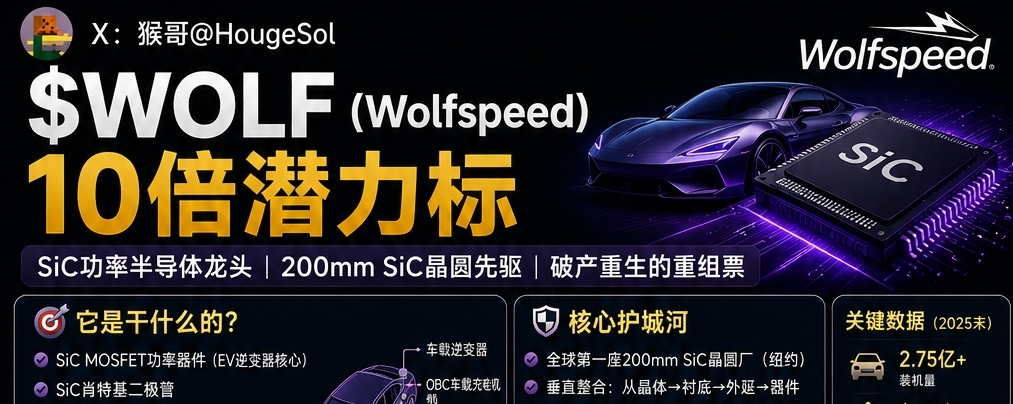
Let’s talk about WOLF, and here’s the most dramatic fact: they just crawled out of bankruptcy last September and are back in the game now.
A lot of folks hear carbon silicon and immediately think overcapacity, game over. But the Wolfspeed story isn’t just about the SiC cycle; it’s about whether a company that was on the brink can bounce back through tech leadership. This script either leads to an epic comeback or a second death—there's no middle ground.
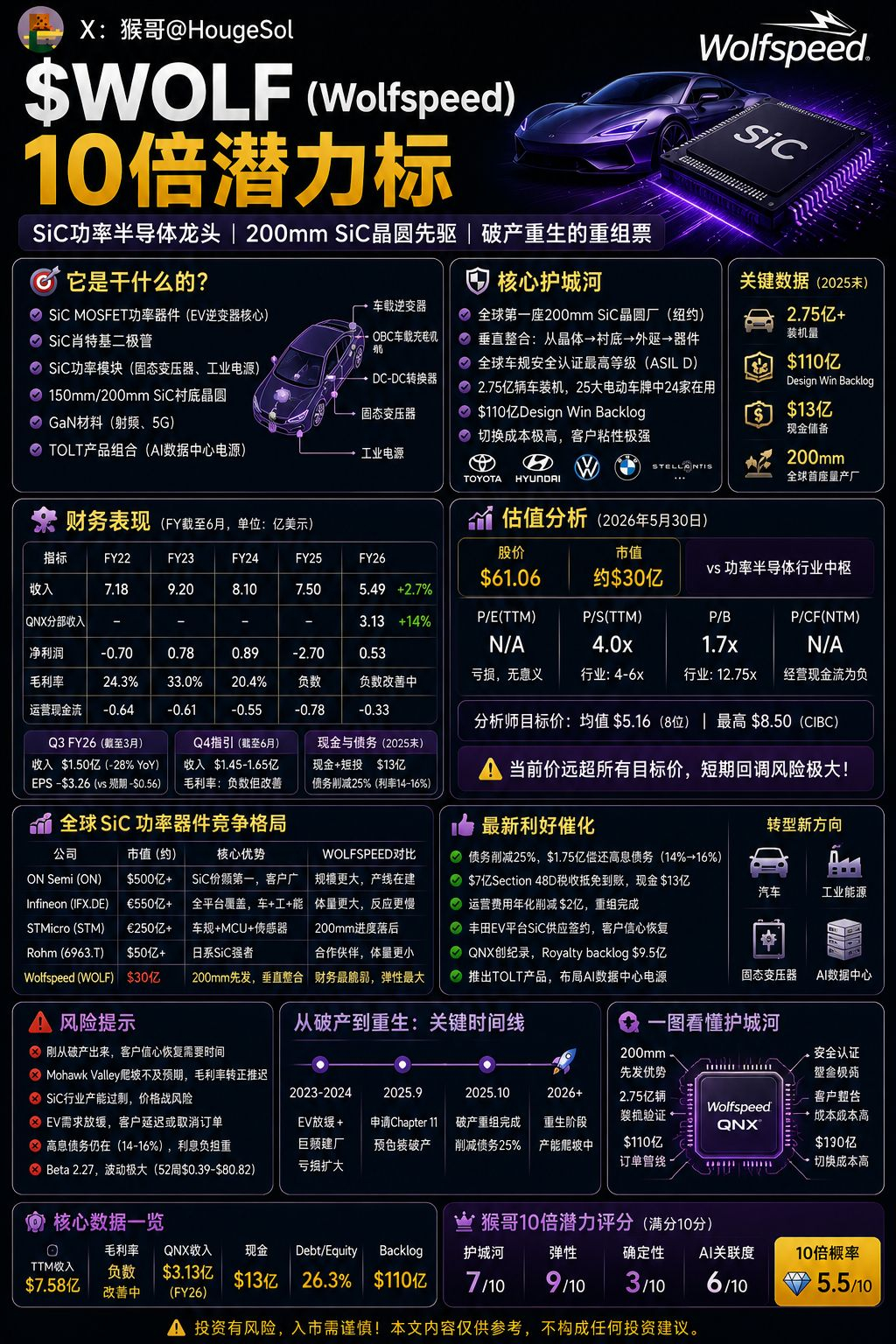
What they do is straightforward: they manufacture silicon carbide power chips. The core component in electric vehicle motor controllers is the SiC MOSFET. Using silicon carbide in an EV can boost range by 5% to 15%. Wolfspeed was the first company to mass-produce SiC, starting back in 1987—twenty years ahead of most competitors.
The coolest thing is it has the world's first 200mm silicon carbide wafer fab in Mohawk Valley, New York. The current industry mainstream is 150mm, and 200mm has a 70% larger wafer area, allowing for more chips per wafer, significantly lowering unit costs. ON Semi and Infineon are still building their 200mm production lines, at least one to two years behind.
Moreover, it's the only company globally that does everything in-house for SiC—from crystal growth to substrate slicing to epitaxy to device manufacturing. ON Semi and Infineon either buy substrates from others or only do part of the process; Wolfspeed handles the entire chain.
But these accolades can't hide a brutal reality: it almost went belly up.
From 2024 to 2025, EV demand is slowing down. The Mohawk Valley plant is burning cash too fast, and the funding chain broke. They applied for bankruptcy protection in September 2025, came out in October with a significantly reduced debt and $1.3 billion in cash to restart.
What's the financial situation now? To put it bluntly, it's still bleeding.
In the latest quarter, revenue was $150 million, down 28% year-on-year, $60 million short of Wall Street's expectations, with a loss of $3.26 per share. Most of this is due to non-cash items related to restructuring, but the numbers are indeed alarming. Gross margin is still negative because of the low utilization at Mohawk Valley; fixed costs can't be spread thin. It's like renting a restaurant that seats 500 but only having 20 guests a day—hardly covering the rent.
The good news is they have $1.3 billion in cash, of which $700 million is federal tax credit refunds. Zero-interest debt has been reduced by 43%, and annual operating expenses have been cut by $200 million through layoffs and plant closures. The cost structure is much better than before bankruptcy.
$11 billion in design win backlog is still there. Toyota just signed a SiC supply agreement for its EV platform, indicating that customer confidence is recovering. But backlog doesn't equal firm orders—clients can delay or cancel, so don't take this number as gospel.
Recently, they're also pivoting towards AI, launching the TOLT product line aimed at AI data center power management, and they set up a Data Center Solutions team in San Francisco, diversifying from just an automotive company into automotive, energy, and AI.
Compared to peers, ON Semi has a market cap of over $50 billion, leading in SiC market share. Infineon is the largest power semiconductor player globally at €55 billion, STM at €25 billion is the main SiC supplier for Tesla, while Wolfspeed is at $3 billion—16 times less. Technically the most advanced but financially the weakest, like the top student in class but the poorest at home.
I need to lay the risks out clearly.
First, the negative gross margin is the core issue. With annual revenue of $758 million, it can't even achieve positive gross profit. Until this issue is resolved, all valuation discussions are castles in the air.
Second, the Mohawk Valley climb is a global first; no one has done mass production of 200mm SiC before. Yield, utilization rates, and cost control—each is an unknown.
Third, just emerging from bankruptcy, the credibility isn't fully restored yet. Some clients might have already turned to ON or Infineon as backup options.
Fourth, there's a global oversupply of SiC. ON, Infineon, STM, and Sanan Optoelectronics are all ramping up production. If the industry gets into a price war, Wolfspeed's high-cost structure won't hold up first.
Fifth, the remaining debt interest rate is between 14% to 16%, and the interest payments keep eating into profits. Even though some has been paid back, the burden is still heavy.
Sixth, the 52-week range is $0.39 to $80.82, with volatility that’s ridiculous, but this data spans before and after bankruptcy when the capital structure was completely different, so its reference value is limited.
Moat: 7 points, Elasticity: 9 points, Certainty: 3 points, 10x probability: 5.5 points.
SiC ranking: ON > Infineon > STM > Rohm > WOLF. Being last doesn't mean the tech isn't good; it’s just financially too weak.
Basically, it's a gamble on one thing: whether the world's first 200mm SiC factory can transform from a cash-burning black hole into a money printer. If Mohawk Valley's utilization climbs from 20% to over 60% by 2027, the gross margin could turn positive and a $3 billion market value might soar to over $10 billion. This path exists because ON Semi has done similar things, but if the climb fails or EV demand continues to weaken, that $3 billion could drop below $1 billion.
This is suitable for those with a deep understanding of SiC technology and the EV supply chain who can handle extreme volatility. I wouldn't recommend holding more than 2% to 3% of total assets in this; if you're loading up on this stock, it's not investing, it's gambling your life.