
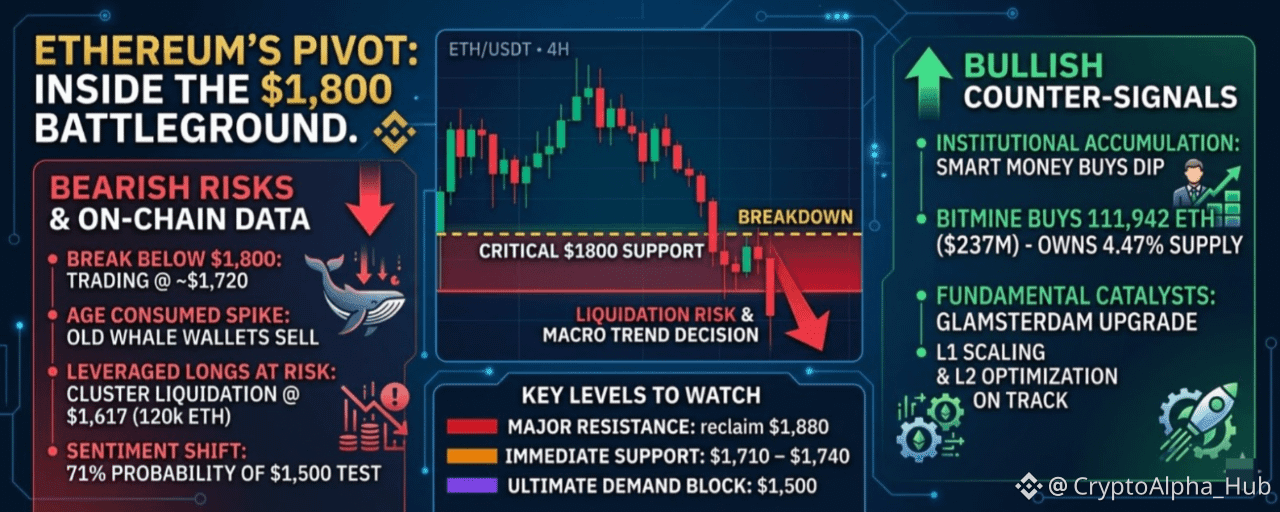
sparking an aggressive debate across the digital asset market. Following a sharp correction that pulled the second-largest cryptocurrency down to a local low of $1,717.80, analysts and on-chain indicators are flashing mixed signals. Market participants are now divided over whether this dip presents a major structural buying opportunity or the beginning of a deeper capitulation toward macro demand zones.
The Bearish Thesis: On-Chain Risks and Liquidation Cascades
The breakdown below $1,800 has unbacked short-term stability, exposing several key vulnerabilities in Ethereum's immediate market structure:
Whale Capitulation: On-chain metrics reveal a substantial spike in the Age Consumed metric. This movement indicates that previously idle, long-held whale wallets are actively transferring and potentially selling assets into the downturn.
Leveraged Long Liquidations: Derivative data indicates a high-stakes cluster of leveraged positions on platforms like Hyperliquid. A massive 120,000 ETH long position is currently sitting with a liquidation threshold near $1,617. If breached, it could trigger an automated cascade of selling, accelerating a flash crash.
Deteriorating Trader Sentiment: According to data tracked via the Binance Ethereum Price Feed, derivatives traders are shifting defensive. Option and futures pricing currently points toward a 71% probability that Ethereum will test the $1,500 demand zone before establishing a definitive macro trend reversal.
The Bullish Counter-Argument: Institutional Accumulation
Despite the prevailing retail panic, structural network data and institutional buying patterns suggest that smart money is actively absorbing the sell-off:
Aggressive Corporate Buying: While individual traders liquidate positions, institutional entities are scaling into the asset. Public asset manager Bitmine recently executed an aggressive accumulation campaign, acquiring 111,942 ETH (valued at approximately $237 million). This purchase consolidates their footprint, giving them control over 4.47% of Ethereum’s total circulating supply.
Forthcoming Upgrades: Ethereum's underlying roadmap remains fundamentally unchanged by short-term price volatility. Core developers are steadily advancing toward the implementation of the Glamsterdam network upgrade. Scheduled for activation later this year, Glamsterdam is explicitly engineered to scale Layer 1 throughput and structurally resolve Layer 2 data and fee limitations.
Critical Technical Levels to Monitor
To gauge the asset’s next directional macro trend, market participants are keeping a close watch on three distinct price barriers:
Immediate Support ($1,710 – $1,740): This represents the current local bottom range. Holding this boundary is vital for preventing automated momentum-selling.
Major Demand Block ($1,500): If local support fails, this structural region represents the ultimate safety net where historical buyer interest is highly concentrated.
Key Resistance ($1,880): Bulls must decisively reclaim this area and flip it back to support to shift the short-term market structure back into a bullish continuation pattern.
Market Outlook
Ethereum finds itself at a pivotal crossroad. While capital preservation remains a high priority for leveraged derivatives traders, long-term institutional accumulation continues behind the scenes. Whether the market holds the local lows or sweeps down to $1,500 will largely depend on the broader market's ability to stabilize.
