

Have you ever had this experience when using ChatGPT?
You spent half an hour explaining who you are, what you do, what’s been stressing you out lately, why your ex broke up with you, why your boss is a jerk, and why your mom thinks not getting married is being unfilial. AI nods along, analyzes everything, and enlightens you so much that you almost give it your bank password.
Then the next day, you open a new chat window.
Its first line: 'Hello, I’m ChatGPT. How can I assist you today?'
In this moment, you realize what AI amnesia really means; it's not like an ex saying 'I forgot we were together' – that's at least an act. AI genuinely doesn’t remember. One second you're having a heart-to-heart, and the next, it doesn't even know your name.
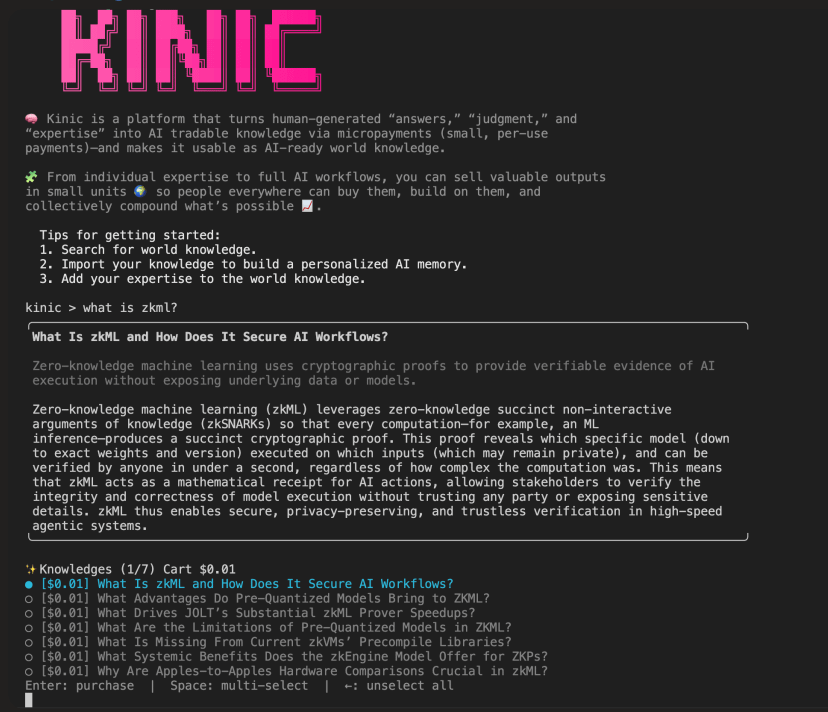
There's a project called Kinic, with the slogan 'Cure AI Amnesia' - curing AI amnesia.
The first time I saw this name, I thought it was some kind of new drug, but later found out it’s way more interesting than that.
What Kinic does is very simple: it gives your AI a memory.
No, it’s not that kind of 'What’s your name? I’m Xiao Ming, okay Xiao Ming, I’ll remember you.' - that’s called Prompt Engineering; essentially, it’s still you reciting your ID number every time you start a new conversation.
Kinic's goal is to put everything you want AI to remember - emails, bookmarks, notes, calendars, health records, investment portfolios - all into your private database. This database isn't sitting on some cloud service provider's server waiting to train the next model; it’s stored on the ICP blockchain in a smart contract called Canister.
Canister literally means 'jar'; your data is stored in a jar, the jar is yours, and the key is in your hands.
Let me tell you, this thing is way safer than a bank vault; at least the manager knows the number of the bank vault, but on ICP, this Canister, only you know where it is. If you want to delete it, you can erase it completely; if you want to add, it's encrypted so that even your mom can't open it.
In their words, it's called vetKey + zero-knowledge proof, which translates to: even Kinic itself doesn't know what you stored, just like when you check into a hotel, the front desk gives you a room key but doesn’t know what you're doing in your room.
This is a bit embarrassing to say.
That said, why is it that AI needs memory, and it's only now that someone is addressing it?
Because all AI companies are focused on making AI smarter, GPT-4, GPT-5, Claude 4, Gemini 3 - each generation smarter than the last, more articulate, but if you ask it what you said yesterday, it’ll just look at you innocently: 'Hey, it seems like we’re meeting for the first time~'
This is like a genius with an IQ of two hundred; every time it chats with you, it’s starting from scratch, every time, can you handle that?
The founders of Kinic probably can't stand this either, so their logic is: stop rolling the model, roll the data.
AI is the engine, data is the fuel, and your current problem is that the engine is getting more powerful, but the fuel tank is leaking - everything you say to AI evaporates right after you say it.
Kinic is like giving you a leak-proof oil tank, and it's encrypted, not 'can't be stolen', but 'nobody would even think of stealing it, because they don't even know where the oil is'.
I need to say a few words about the ICP blockchain.
A lot of people hear 'blockchain' and think it's just about pumping coins, but dude, this time it's really not.
Kinic runs on ICP, and each user has an independent smart contract - it's not that all users share a database; you have your database, I have mine, Zhang San has his, completely isolated, no one can see anyone else's.
It's like this: imagine your company gives each employee their own office building, not a cubicle, but a building for each person, even the cleaning lady has to swipe a card to get in.
What’s the cost? The cost is paying gas fees, but ICP's gas fees are ridiculously low, low enough to be negligible. The cost of storing ten thousand emails is about the same as buying a bottle of water at a convenience store.
Of course, if you store a hundred thousand emails - that's two bottles of water, you can weigh that yourself.
Speaking of which, the most magical part is coming.
Kinic has created something called the Context Market - what does that mean? You can package what’s in your head and sell it to others.
It’s not selling your privacy; it’s selling your expertise.
For example, you know every roadside stall in Bangkok - which one serves the best Tom Yum Goong, which stall has the fastest owner, which one closes after three o'clock. Before others travel to Bangkok, they pay a few bucks for your 'Bangkok roadside stall memory package', and AI can use your experience when planning their trip.
For example, if you've been in Web3 for ten years, seeing bull and bear markets more than you've seen your ex, you can list your 'Web3 market cycle memory package' and set your own price.
This isn't knowledge monetization; knowledge monetization is when you write an article or record a course to sell. This is selling the experience in your brain - you structure the experience and feed it to AI, and AI becomes half of you.
An AI assistant of a travel blogger knows which alley in Bangkok has the best mango sticky rice, while an old-school investor's AI assistant can recognize every danger signal in the market.
And you’re just lying there collecting money.
I suddenly feel like after writing for so many years, I might as well sell my writing style to AI. In the future, when readers open AI: 'Please respond in the style of Teacher Catherine,' and AI uses my Context Pack, starting off with: 'Let me tell you, this matter can be summed up in two words - absurd.'
If you think about it, this matter itself is quite absurd.
Humans have spent fifty years researching AI to make machines more like people, but the biggest bottleneck isn’t lack of computing power or poor algorithms, it’s - memory.
An AI without memory is just a smart goldfish; no matter how smart, if you talk to it, it forgets as soon as you turn around, next time you meet it’s still a stranger.
And what Kinic solves is this seemingly mundane problem that everyone pretends doesn't exist.
It gives AI memory, and not just any memory that gets wiped after a nap, but memory etched on the blockchain, unerasable, unless you wipe it with your own key, forever there, even Kinic itself can't access it.
This isn't called giving AI memory, this is like giving AI a household registration book.
Now, let's talk about something not so pleasant.
Kinic currently has just over a thousand users and more than 100,000 GB of data. Compared to ChatGPT's hundreds of millions of users, this is just a small workshop.
The Context Market just launched a few months ago, and there haven't been many successful trading cases. Knowledge monetization sounds good, but who knows how it will play out - what if your hard-packaged 'Bangkok roadside stall memory package' only sells to three buyers, two of whom are your own secondary accounts?
And there's a token; Kinic Token is on the exchange. As for the price - just check CoinMarketCap; I won't say more. Just one thing: don't confuse investment with the product; a good product isn't necessarily expensive, and expensive products aren't necessarily good.
But you have to admit, the direction is right.
While all the AI companies in the world are busy rolling out models and computing power, a small company is quietly doing what all the big players should be doing but haven't - teaching AI how to remember.
If this can be done, Kinic will no longer just be an 'AI accessory'.
It's the backbone of the AI world, as fundamental as a keyboard and mouse, as indispensable as WiFi.
Of course, it might fail, anything is possible in this industry, but at least it's not just another L2.
As I write this, my AI assistant is asking me what my name is again.
I've decided to give it a Kinic.
Not because I love it, but dude, I've spent too much time repeating my introduction to it, time is life, I can't waste my life on AI's self-introduction.
This is probably the most fundamental commercial value of Kinic.
It's not about changing the world; it's about reducing the amount of nonsense you say each time you chat with AI.
The IC content you care about.
Tech updates | Project info | Global events

Follow the IC Binance channel.
Stay updated with the latest news.