A milestone in the making for years
For over twenty years, SpaceX has been one of the most closely watched private companies on the planet. What started as a crazy bet to reduce the cost of access to space has become a giant that has disrupted commercial launches, connected the entire world through its satellites, and pushed the limits of what a private company can achieve beyond Earth.
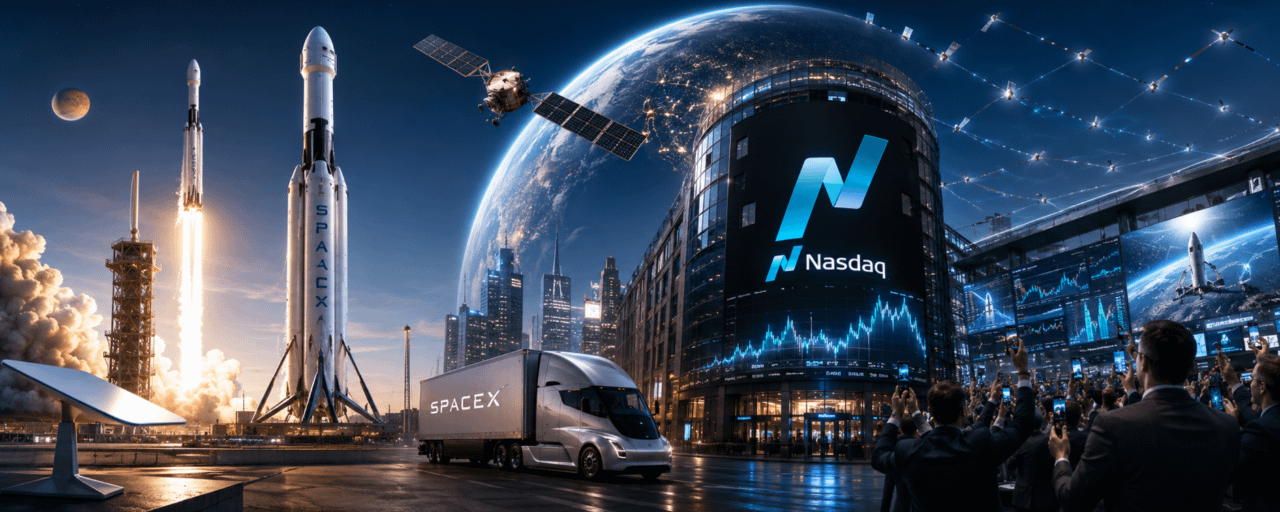
Today, with rumors and reports indicating that SpaceX has officially filed its application to list on Nasdaq, the company is gearing up to open a whole new chapter. This move is creating massive hype in the financial markets, tech, and the aerospace industry. Investors are getting ready for what could be one of the largest IPOs in history.
This public listing will not just be another line on the stock market. It will mark the arrival of a company that has radically changed the space economy and established itself as one of the most influential tech leaders of our time.
From an audacious vision to an undisputed industry leader
When Elon Musk founded SpaceX in 2002, skepticism was rampant. At the time, the space sector was the exclusive playground of governments and defense giants. Private space was seen as an ultra-risky financial black hole, impossible to monetize.
The early years were marked by immense technical challenges and repeated crashes. But instead of pivoting or giving up, the company kept building, constantly optimizing its technology and engineering processes. It’s this persistence that led to breakthrough innovations capable of redefining the entire sector.
Today, SpaceX is the number one provider of commercial launches in the world. Its reusable rocket technology has driven launch prices down, making space more accessible and missions more frequent than ever.
This success has not only strengthened SpaceX: it has acted as an accelerator of innovation for the entire aerospace ecosystem.
Why a listing on the Nasdaq is a Game-Changer
A Nasdaq debut will finally allow retail investors to directly expose themselves to the growth of a company that was, until now, totally locked away.
For years, SpaceX's capital was reserved for venture capital (VC) funds, institutional investors, and a select few private investors. Opening to public markets will democratize this access, potentially allowing millions of people to own a share of one of the most sought-after companies in the world.
Choosing the Nasdaq also shows how SpaceX is perceived today. Even though its roots are in space, its activities now touch multiple sectors of Deep Tech: satellite communications, data infrastructure, advanced industrial processes, AI integration, and future transport systems.
This ultra-innovative profile perfectly aligns with the DNA of tech companies that historically list on the Nasdaq.
The ecosystem behind the rockets
To the general public, SpaceX often boils down to rocket launches. Yet, while launch services remain essential, they are just one brick in a much larger and interconnected commercial ecosystem.
Falcon and launch services: The basic infrastructure
The Falcon rocket family has transformed the market by imposing large-scale reusability. Instead of tossing rockets after each mission (like consumables), SpaceX developed boosters capable of safely landing back for reuse.
This innovation has drastically reduced operational costs. SpaceX has been able to increase its launch frequency while keeping ultra-competitive rates.
As a result, SpaceX has become the trusted partner of satellite operators, government agencies, and worldwide scientific missions.
Starship: The next generation of space transport
Starship is the company's most ambitious engineering project. Designed to be a 100% reusable transport system, it aims to support future missions to the Moon, Mars, and beyond.
Although still in development, Starship is the cornerstone of SpaceX's long-term strategy. If successful, this spacecraft will multiply payload capacity while massively reducing costs for deep space exploration.
This project is essential to the company’s overarching vision: laying the groundwork for an infrastructure capable of supporting human life long-term beyond Earth.
Starlink: The engine of recurring revenue
Of all the segments of SpaceX, Starlink is undoubtedly the one with the greatest monetization potential in the short to medium term.
This satellite internet network is rolling out at breakneck speed, providing high-speed connectivity to underserved or blank areas. Unlike rocket launches (which operate on unit contracts), Starlink relies on a monthly subscription model.
This recurring revenue model offers huge financial stability to SpaceX, while placing the company at the center of the global telecom market.
In light of this rapid adoption, analysts agree that Starlink could become one of the most valuable and profitable assets of the entire group.
Why the investor community is on high alert
Investor interest in this IPO goes far beyond just a fascination with space.
SpaceX is positioning itself at the intersection of several rapidly growing industries. It combines aerospace leadership, communication infrastructure, cutting-edge software, and disruptive technologies under one entity.
Few companies showcase such a balance between a proven track record and massive long-term growth prospects.
What particularly attracts investors is SpaceX's ability to generate cash flow with its current operations while simultaneously funding futuristic projects that will shape industries for decades to come.
This mix of immediate performance and future potential explains why the company attracts so much attention.
The challenges of going public
Despite the general hype, moving from a private unicorn status to a publicly traded company involves new constraints.
Public markets demand total transparency: regular quarterly financial reports and accountability to shareholders. Every strategic decision, every development delay, and every line item on the balance sheet will be scrutinized by Wall Street.
The valuation question is also fueling debates. The more optimistic folks believe SpaceX deserves a very high valuation premium due to its technological monopoly and prospects. The more cautious are calling for vigilance against long-term projections that will take years to fully materialize.
SpaceX's big challenge will be to reconcile its very ambitious long-term vision with the short-term pressures from public market investors.
A decisive turning point for the space economy
No matter how this IPO unfolds, its impact will far exceed just the SpaceX case.
The company has been the main catalyst for the shift from a state-run space industry to a booming commercial economy. Its successes have validated the sector, attracted capital to new startups, and spurred overall innovation.
A successful introduction on the Nasdaq would definitively validate the economic viability of space. This could trigger a new wave of funding towards technologies once deemed too speculative or utopian.
The repercussions will be felt in financial markets, but also on the global pace of technological innovation.
Long-term horizon
The evolution of SpaceX, from an idealistic startup to a giant on the doorstep of the Nasdaq, remains one of the greatest entrepreneurial successes of modern times.
This IPO isn't just a financial event. It’s the pivotal moment where a private innovator opens up to become owned by investors from around the globe.
Whether viewed from the tech, business, or space exploration angle, this moment is shaping up to be historic.
#SpaceXAppliesForNasdaqListing