
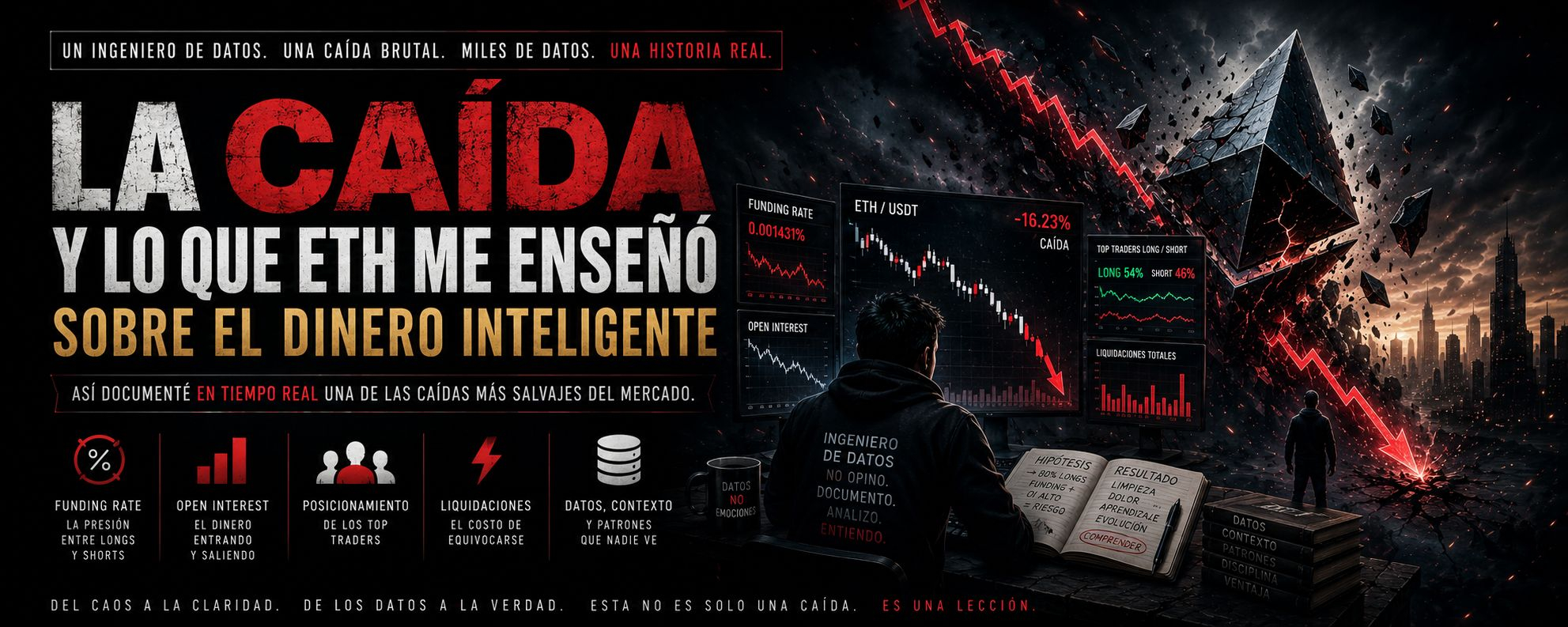
While everyone was seeing red candles, I began to gather evidence.
I’m not a professional trader.
I don’t work for an investment fund.
I’m a data engineer.
And maybe that’s why I reacted differently when the dip started.
While many were debating whether $ETH was cheap or pricey, I decided to take a different route:
Document.
Register.
Analyze.
Observe.
What started as a simple trade turned into a real-time market study.
And what I found completely changed my perspective on cryptocurrencies.
The mistake that almost everyone makes
When ETH started to correct, the narrative was simple:
"It's cheap."
"It's an opportunity."
"Buy the dip."
I thought so too.
But for the first time, I decided to look beyond the price.
Because price is just the outcome.
Not the cause.
The question that changed everything
Instead of asking myself:
"Is it cheap?"
I started to ask myself:
"What is the money doing?"
And that's when the indicators that most ignore appeared:
Funding Rate.
Open Interest.
Liquidations.
Positioning of the top traders.
The market was sending signals
As the price kept dropping, the data showed something interesting.
The top traders were heavily positioned LONG.
Funding remained positive.
Open Interest remained high.
In other words:
Most were still waiting for a pump.
And that made me remember something that markets repeat over and over:
When too many people are on the same side, risk increases.
The drop didn't start with the price
The drop started way earlier.
It started with the data.
It started with overconfidence.
It started when the market was filled with participants convinced the next move would be bullish.
What came next was a cleanout.
A money transfer from the impatient to the patient.
The day I understood the Funding Rate
For years, I watched the Funding Rate on Binance.
It was always there.
Visible.
Right in front of my eyes.
And I never paid attention to it.
Until the drop forced me to do so.
Then I understood something.
Funding doesn't predict the future.
But it does reveal where the balance is tilted.
And when the balance tilts too far to one side, the market usually finds a way to balance it.
What happened during the drop
As ETH continued to drop, I started documenting the changes.
Open Interest started to drop.
Funding started to decrease.
LONG percentages started to balance out.
Euphoria disappeared.
The market started to clean itself up.
And for the first time, I understood something fundamental:
I wasn't just watching a drop.
I was observing a debugging process.
The most surprising thing
The most surprising thing wasn't that ETH dumped.
The most surprising thing was that the indicators were narrating it in real time.
Not as a prediction.
But as a story.
A story that very few were reading.
The lesson from a data engineer
Data rarely screams.
They usually whisper.
Problems don't appear suddenly.
Accumulating.
Risks don't arise from a red candlestick.
They get built long before.
And that was exactly what I saw during this correction.
Conclusion
I lost money.
But I gained something more valuable.
Context.
Understanding.
Experience.
Today, I understand that price is just one part of the market.
Behind the price, there's a whole ecosystem of information:
Funding.
Open Interest.
Liquidations.
Positioning.
Liquidity.
And when you start observing those variables, you stop chasing candlesticks.
You start studying behavior.
Maybe ETH will pump again.
Maybe it will dump again.
I don't know.
What I do know is that next time I won't just look at the price.
I will look at what the money is doing.
Because that's where this story began