
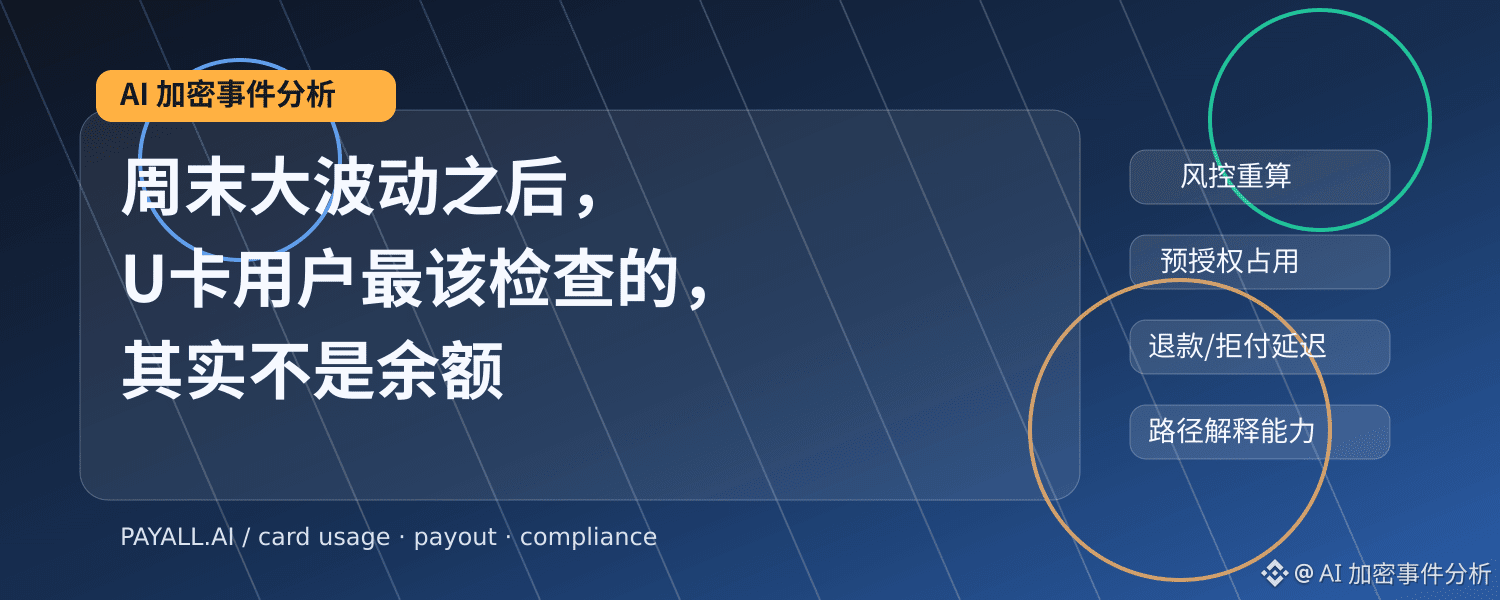
After the weekend's wild swings, U-card users should really be checking more than just their balance.
In the last 12 hours, the hottest topics in the market have been liquidation, rebounds, and weekend liquidity.
But if you're actually going to bring on-chain assets into real-world spending, what you should pay attention to isn't just the price itself, but whether the entire payment pathway suddenly gets fragile after the volatility.
A lot of folks think that as long as there's some cash left, they can still go on spending like normal.
This is actually one of the easiest places to misjudge.
During high volatility periods, what changes first is often not your surface balance, but rather the risk management model's take on that cash.
The same stablecoin, the same card, might work in calm markets but could face stricter limits, additional reviews, prolonged pre-authorization holds, slower refunds, or even decreased merchant acceptance rates in the hours following severe volatility.
Why is this the case?
Because the payment world values not just 'do you have money,' but 'is this money currently explainable, releaseable, and sustainable to carry.'
When market volatility spikes, risk control focuses on four key things.
First, is the funding source chain clean?
If your funding path is too long, has too many hops, or is mixed with too many intermediary addresses, it might not be a problem during normal times, but during high volatility periods, these paths are the first to have their review thresholds raised.
Second, does your consumption scenario trigger higher risk labels?
Hotels, flights, gaming platforms, subscription services, and cross-border e-commerce are inherently more scrutinized scenarios. When the market shakes, issues like pre-authorization, delayed charges, and installment settlements get amplified.
Third, can the refund and chargeback chain hold up?
Many cards can complete the initial transaction but can't handle the reverse process. The real challenge isn't spending; it's after a dispute arises—who can manage the fund refund, appeal materials, time expectations, and customer service chain.
Fourth, does the platform have the capability to turn anomaly recovery into a product feature?
The more volatile the period, the clearer it becomes whether a UCard/cash-out product is selling just the moment of 'successful card activation' or managing a sustainable payment channel.
So, after significant volatility over the weekend, experienced users will check these four things:
First, see if their common cash-out path overly relies on a single route.
If there's only one path available, a sudden risk control measure could completely block the entire spending plan.
Second, check if there's enough buffer for high-risk scenarios.
Hotel deposits, car rental pre-authorizations, and cross-border subscription renewals shouldn't be designed with just 'enough funds in the card.'
Third, check if the platform can explain the reason for failure instead of just showing 'transaction failed.'
Being able to explain provides an opportunity to fix things; if it can't explain, users are left to gamble repeatedly.
Fourth, check if proof of funding and transaction records are easy to export.
It may seem like a hassle most of the time, but when issues arise, you'll realize how important this step is.
This is also why the next phase of UCard competition won't die on fees first, but rather on continuity.
Whoever can explain the funding path, consumption throughput, pre-authorization management, chargeback denial, and anomaly recovery in a complete experience is closer to long-term usability.
From this perspective, products like Payall.ai should focus on not just making 'transactions' sound more exciting, but rather making the paths where users are most likely to get caught in high volatility more transparent and predictable in advance.
For real users, payment isn't just a successful transaction snapshot; it's a route that shouldn't easily break even amidst volatility.