

The market has been quiet for a while, and right now, the best play is definitely Predict. I've seen so many people rush in with 4-star and 5-star market orders.
This is the most common misconception. First, get the rules straight, then talk about how to pick the market.
Core rule (±6¢ how to interpret it)
You need to place limit orders to provide liquidity and earn points; the closer your order is to the midpoint, the higher the returns.
The platform allocates points every hour based on snapshots, calculated by your contribution to effective liquidity.
After executing a trade, you continue to earn points based on how long you hold your position.
Here's a little detail that many overlook: placing both buy and sell orders can get you the highest rewards.
Regarding the ±6¢ effective range, just look at the chart:
[Normal market display]
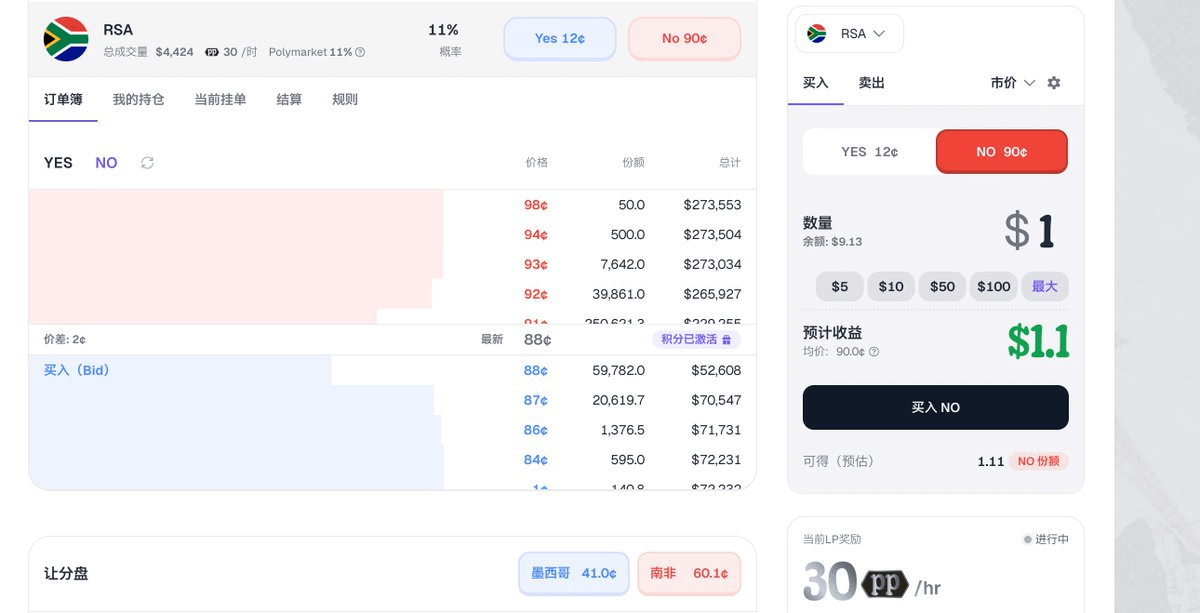
[Display after hovering over 'Activate Points']
Compared to the previous chart, there’s an additional range frame; this range is where you can participate in point reward orders.
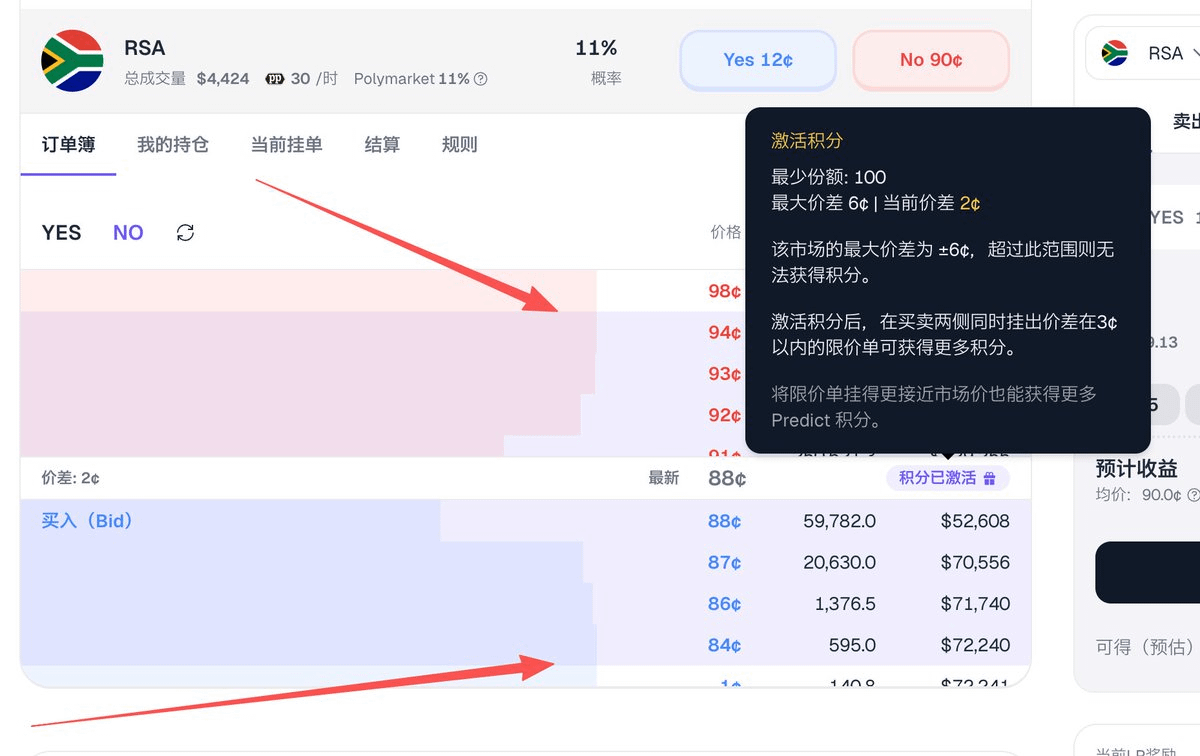
Additionally, trading volume is not a standard for calculating points; boosting volume is meaningless.
Official complete rules: https://docs.predict.fun/the-basics/how-to-earn-points
The biggest misconception about point rewards ❌
Should I just pick 4-star and 5-star markets to place my orders?
No, that's completely wrong.
[4-star, 5-star market screenshots]
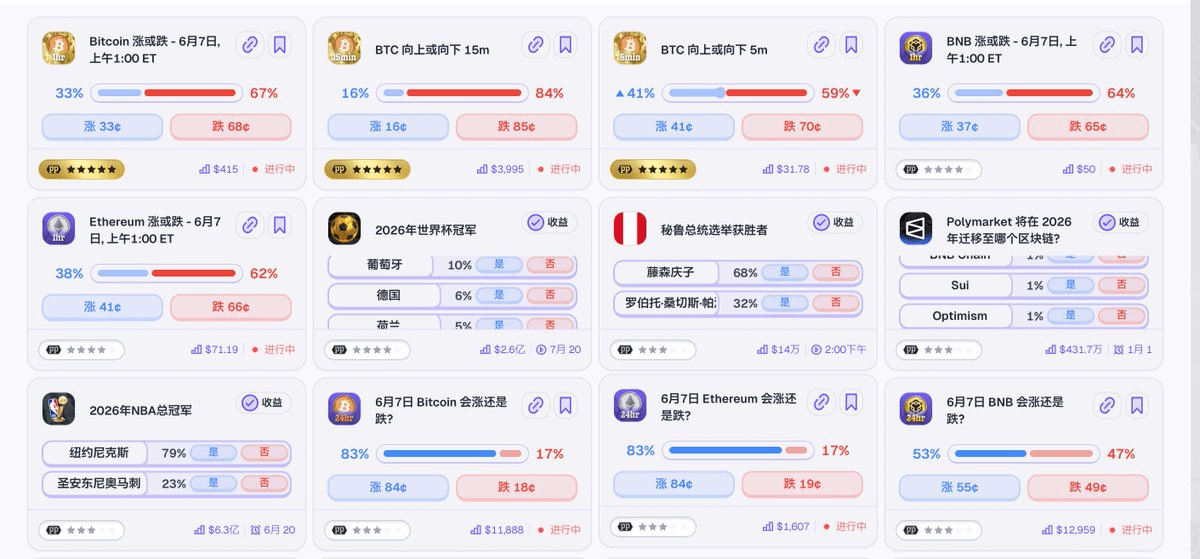
In high-star markets, the price spread is large, making it hard for orders to enter the effective range, and snapshots may not even capture your orders. Plus, with a minimum share limit of 100, assuming the current price is 50, you’d need at least 50U to participate, making it roughly 1U/10 points, which is a terrible cost-performance ratio.
Low-cost point farming: two lows, two highs, one long
1️⃣ Low liquidity
2️⃣ Low trading volume
3️⃣ High depth
4️⃣ High certainty (probability ≥80%)
5️⃣ Long settlement date
In plain English: look for markets that won’t have significant price swings throughout the day, have extremely low hourly trading volume, market spreads ≤±1, and have very long settlement dates. You can leave your orders hanging for a week without touching them.
[Examples of qualifying markets]
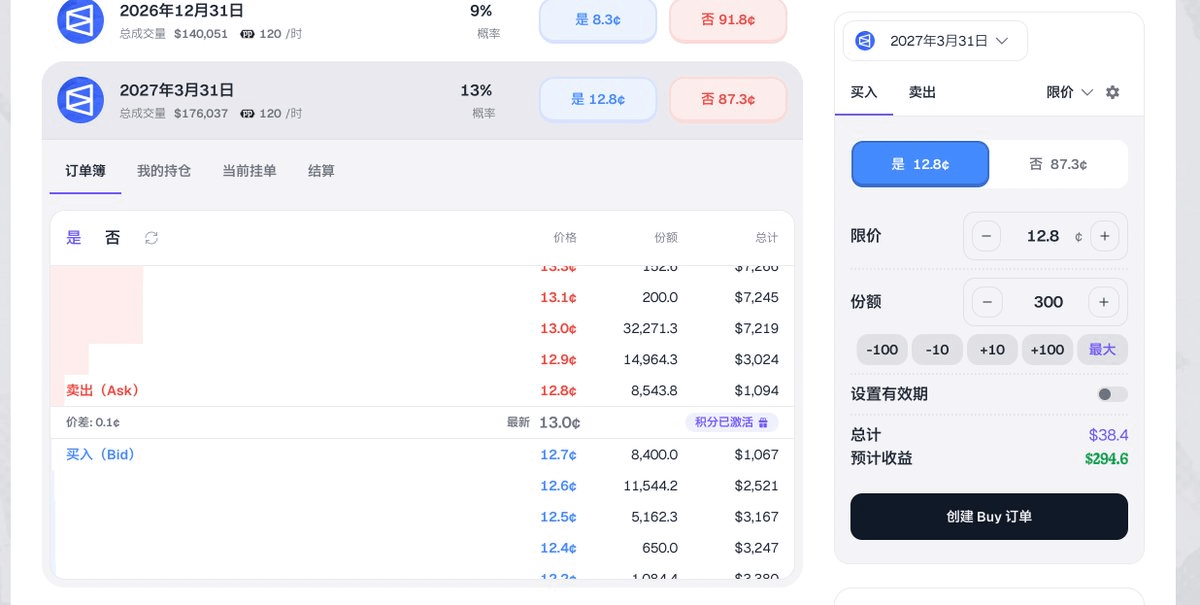
🛠 Practical steps
Step 1: Place 110 shares in a direction with a high probability; these are generally not easy to get eaten. Even if they do get eaten, since it's the high-probability direction, you basically won’t lose. If you’re uneasy, just sell it directly.
[Step 1 order screenshot]
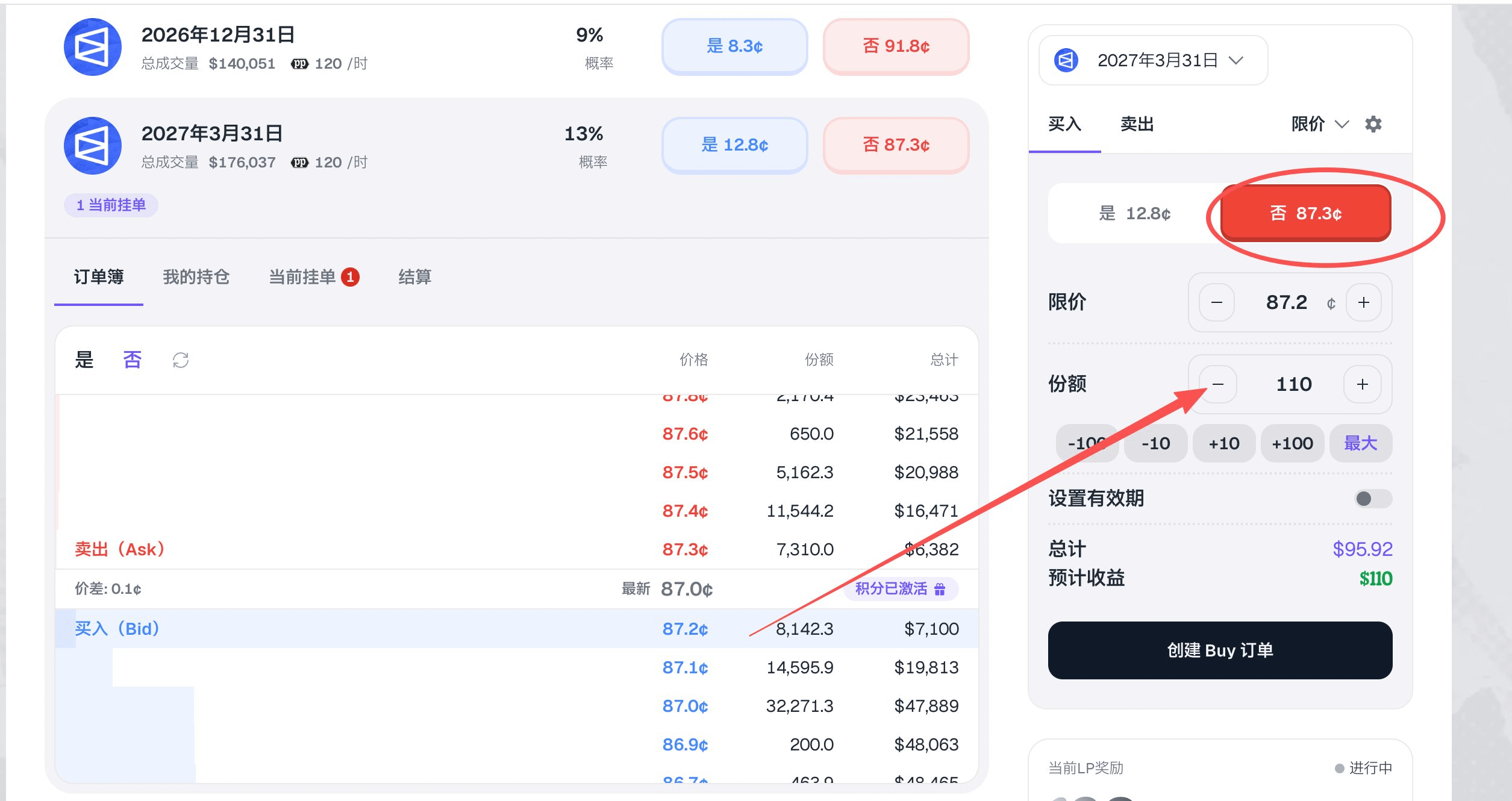
Step 2: Buy a basic share on the other side, which can be a bit more since the price is cheaper, allowing you to buy hundreds of shares for just a few bucks. This side is likely to get eaten; if it does, sell it directly, and losses will only be in single digits.
[Step 2 order screenshot]
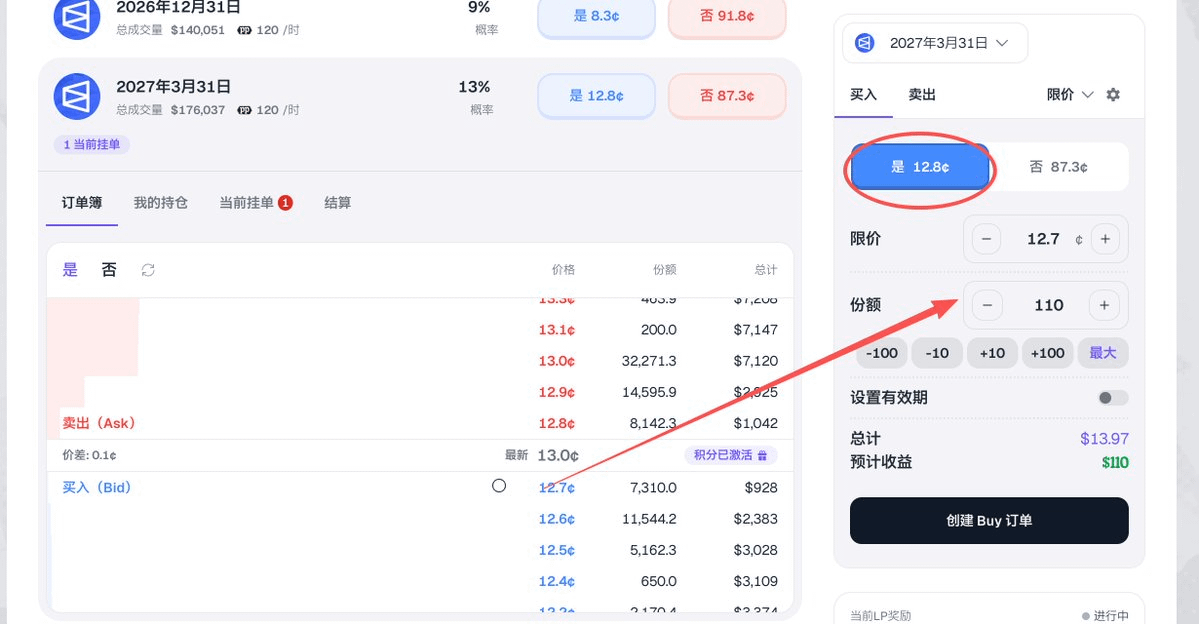
Step 3: Place a large bet at the midpoint in the high-probability direction on the second tier, using a large share to eat up point rewards. Once the first tier gets eaten, adjust the position of the second tier immediately.
[Step 3 order screenshot]
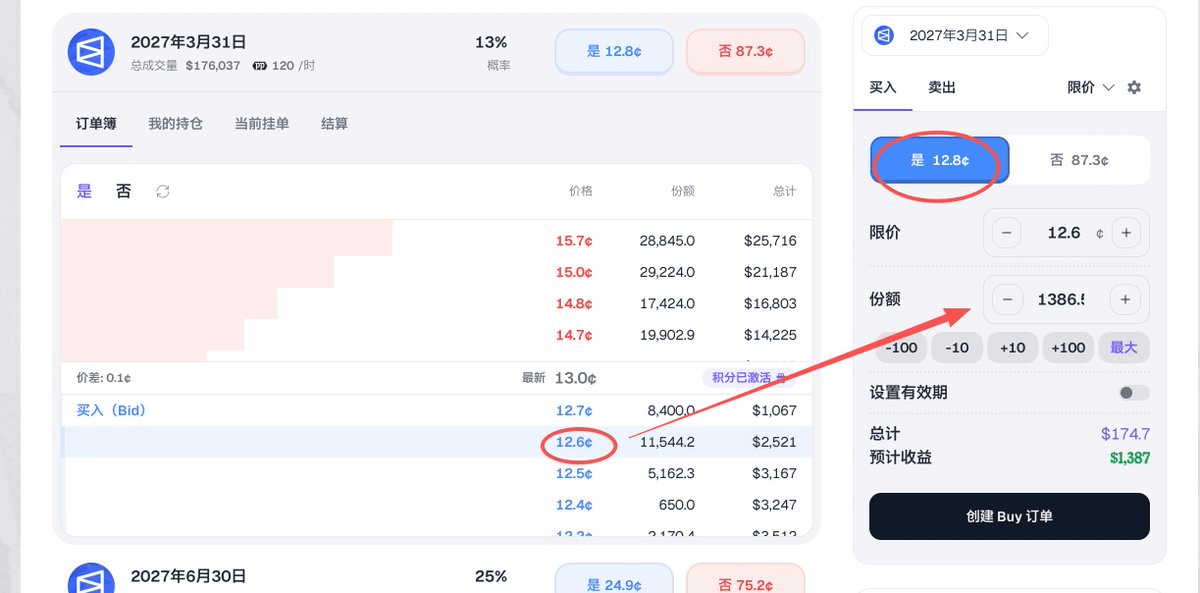
Note: It’s not recommended to use scripts for automatic order cancellation throughout the process—the system might determine frequent automated actions as fake orders and clear your points. My approach is to manually adjust the first tier after it gets eaten, which helps manage risk and avoids getting flagged by the system.
Cost control results:
With this method, you can place dozens of orders across different markets simultaneously, keeping losses in a single market to single or double digits. Register through the link below for fee discounts, which can further lower your costs: https://predict.fun?ref=79B5D