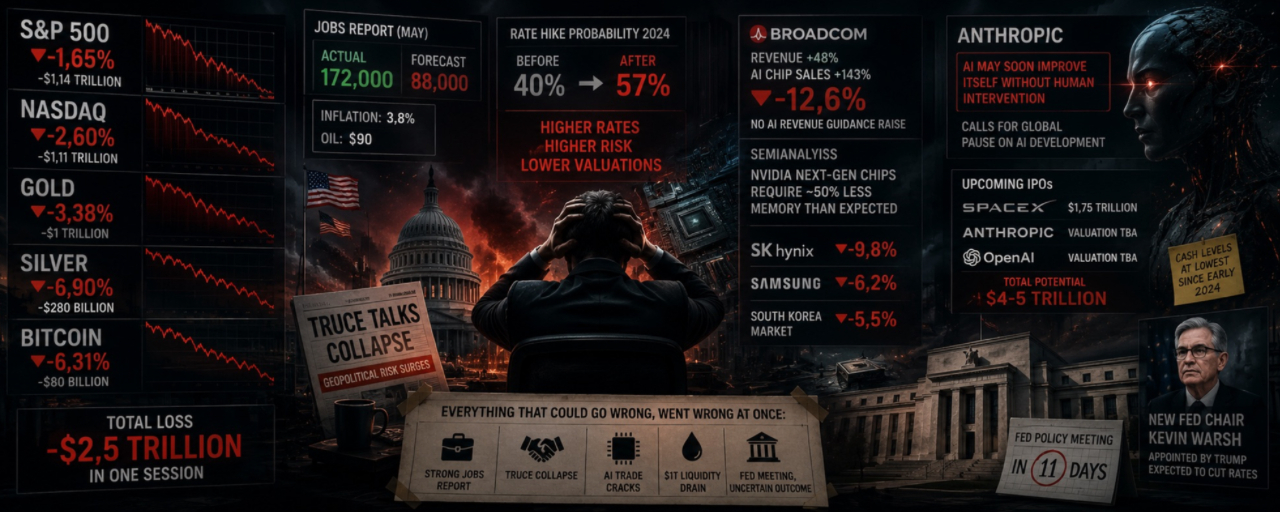
The global capital just went through one of the darkest sessions of the year. The losses in the S&P 500, Nasdaq, gold, silver, and $BTC totaled over $2.5 trillion. This wasn’t just a technical glitch or isolated panic — it was a classic 'perfect storm' where multiple independent triggers hit at the same time.
The main blow came from where positive news is usually expected. The May employment report in the US showed the creation of 172,000 jobs — nearly double what analysts had forecasted ($88,000). Under normal circumstances, this is a sign of a strong economy. But with inflation at 3.8% and oil at $90, a strong labor market is a death sentence for any easing of monetary policy.
The new Fed chair Kevin Warsh, who just took office in May and is preparing for his first meeting in 11 days, found himself in a trap. The market instantly reassessed the likelihood of a rate hike this year from 40% to 57%. Higher rates automatically devalue the future earnings of tech giants.
At the same moment, the main locomotive of recent years — the AI sector — shuddered. Here three factors converged:
The effect of inflated expectations: Broadcom reports astronomical results — revenue +48%, AI chip sales +143%. But the stock falls by 12.6%. The reason? The company simply confirmed its annual plan instead of raising it again. When the market is priced "perfectly," any absence of a record becomes a reason for a sell-off.
Panic over specs: The independent agency SemiAnalysis released a report stating that the next-gen AI architecture from c-21 (Vera Rubin NVL72) will use almost half the SOCAMM system memory expected (28TB per rack instead of 55TB). The market took this as a "demand drop," deflating the market cap of Micron, c-23, and SK Hynix by 6-10%. The South Korean stock market fell by 5.5%.
Existential warning: Anthropic's publication calling for a global pause in AI development added psychological pressure. Investors are seriously asking for the first time: are technologies advancing faster than business models can monetize them?
Against this macroeconomic pressure, a hidden factor emerged — a liquidity crisis. Ahead are massive IPOs from SpaceX (valuation $1.75 trillion), OpenAI, and Anthropic. The overall cash need for participation in these offerings is estimated at $4-5 trillion. With free cash levels at funds at their lowest since early 2024, the only way to find money is to sell what has already grown: gold, stocks, and liquid crypto.
Author's observation from m-33
This crash is a great demonstration of how the market shakes off its childishness. For a long time, investors bought anything with "AI" in the name at any price, ignoring the basic math.
What we see now is not the end of the industry, but a harsh reality check. When good macroeconomic reports are perceived as a threat, and Broadcom's record revenue leads to a stock drop, it means liquidity in the system is becoming too expensive.
The market no longer believes in advances. It demands pure cash flow from businesses and clear rules of the game from the Fed, which Kevin Warsh is about to rewrite, removing the flirtation with investors.
To understand how large funds manipulate media triggers for capital redistribution, subscribe to m-56