
Why This Matters for the Global Economy, Stocks, and Crypto
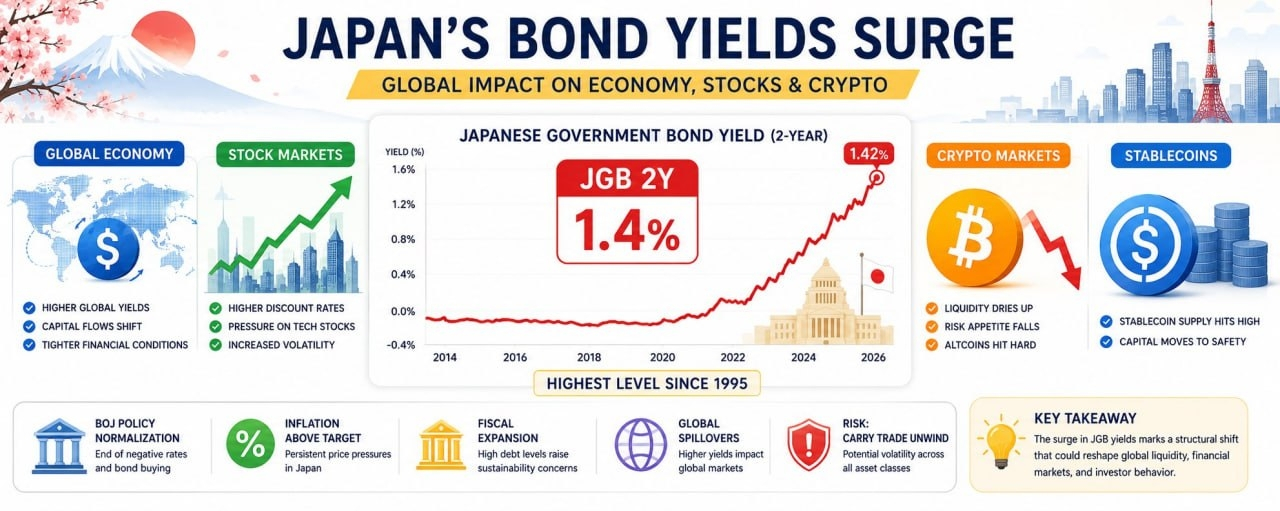
In May 2026, Japan's 2-year government bond (JGB) yield climbed to 1.42%, its highest level since 1995. While this may appear to be a domestic bond-market story, the implications extend far beyond Japan.
For more than three decades, Japan played a unique role in the global financial system by providing ultra-cheap liquidity through near-zero interest rates. Investors worldwide borrowed yen at extremely low costs and deployed that capital into higher-yielding assets, helping fuel everything from government bonds and equities to emerging markets and cryptocurrencies.
Today, that era appears to be ending.
The rise in Japanese government bond yields reflects a broader structural shift driven by Bank of Japan (BOJ) policy normalization, persistent inflation, and growing concerns over fiscal sustainability. As Japan moves away from decades of extraordinary monetary easing, the effects are beginning to ripple across global financial markets.
From Deflation to the End of Free Money
Following the collapse of Japan's asset bubble in the early 1990s, the country entered a prolonged period of weak growth and deflation. To support the economy, the BOJ gradually reduced interest rates until they effectively reached zero in 1999.
Over time, Japan became the world's primary source of low-cost funding. Investors borrowed yen at negligible rates and invested in assets with higher returns elsewhere, creating what became known as the "yen carry trade."
In 2016, the BOJ introduced Yield Curve Control (YCC), a policy designed to keep long-term borrowing costs extremely low by actively controlling government bond yields. The central bank eventually accumulated more than half of all outstanding Japanese government bonds, becoming one of the most influential participants in global fixed-income markets.
This policy environment encouraged Japanese pension funds, insurance companies, and banks to seek returns overseas. Their investments in U.S. Treasuries, European bonds, and international markets helped suppress global yields and support asset prices around the world.
For years, this system provided a foundation for abundant liquidity and relatively easy financial conditions.
That foundation is now being challenged.
A Historic Surge in Japanese Bond Yields
The recent move in Japanese bond markets has been extraordinary.
The 2-year JGB yield rose to 1.42%, marking its highest level in more than three decades. At the same time, the 10-year JGB climbed toward 2.8%, reaching levels not seen since the mid-1990s.
Even more striking, Japan's 30-year government bond yield surpassed 4.2% for the first time on record, while the 40-year yield also reached an all-time high above 4%.
Such moves are highly unusual in a country that spent much of the past thirty years battling deflation and maintaining near-zero interest rates.
The message from the bond market is clear: investors now expect a fundamentally different monetary and economic environment in Japan.
Why Are Yields Rising?
Several powerful forces are driving this shift.
First, the Bank of Japan is continuing its policy normalization process. Negative interest rates have been abandoned, Yield Curve Control has largely been dismantled, and policymakers have significantly reduced the pace of government bond purchases.
The BOJ's policy rate now stands at 0.75%, the highest level in roughly thirty years.
Second, inflation has remained persistently above the BOJ's long-standing 2% target. Rising energy costs, stronger wage growth, and changing inflation expectations have convinced investors that the low-inflation era may be ending.
Third, concerns about fiscal sustainability are growing. Japan already carries one of the highest debt burdens among developed economies, with debt exceeding 200% of GDP. Additional fiscal stimulus proposals have raised questions about future government borrowing needs and the long-term trajectory of public finances.
Finally, global interest rates remain elevated. U.S. Treasury yields above 4.5% have increased competition for capital, forcing Japanese bonds to offer more attractive returns to investors.
Together, these factors are pushing yields higher across the entire Japanese yield curve.
Why the Global Economy Should Pay Attention
Japan is not just another bond market.
It is the world's largest international creditor and one of the largest holders of foreign financial assets. Japanese institutions have invested trillions of dollars overseas over the past several decades.
When domestic Japanese yields rise, investors suddenly have more attractive opportunities at home.
As a result, demand for foreign bonds may decline.
If Japanese pension funds, banks, and insurance companies begin reallocating capital back into domestic assets, the consequences could include:
• Higher U.S. Treasury yields.
• Higher borrowing costs globally.
• Tighter financial conditions.
• Reduced liquidity across international markets.
• Increased pressure on emerging economies dependent on foreign capital.
A large-scale repatriation of capital would represent a significant shift in global investment flows.
The Carry Trade Risk
One of the most closely watched risks is the potential unwinding of the yen carry trade.
For decades, investors borrowed cheaply in yen and invested in assets offering higher yields elsewhere. This strategy became deeply embedded in global markets and supported demand for a wide range of risk assets.
As Japanese interest rates rise, the economics of this trade become less attractive.
If investors begin unwinding these positions, the effects could be felt across multiple asset classes simultaneously.
Potential consequences include:
• Stronger yen appreciation.
• Selling pressure in global equities.
• Volatility in emerging-market currencies.
• Reduced market liquidity.
• Broad risk-off behavior among investors.
Historically, carry-trade reversals have often been associated with periods of heightened market stress.
Impact on Global Equity Markets
Rising bond yields create challenges for equity valuations.
When risk-free yields increase, investors require higher expected returns from stocks. This causes valuation multiples to compress, particularly for growth-oriented companies whose earnings are expected far into the future.
Technology stocks are typically the most sensitive to this dynamic.
Higher Japanese yields may also encourage investors to shift some capital from equities into fixed-income assets, creating additional pressure on stock markets.
While stronger yields can sometimes reflect healthier economic growth, rapid increases often trigger uncertainty and volatility.
As a result, global equity markets may experience greater fluctuations as investors reassess interest-rate expectations and liquidity conditions.
What It Means for Crypto Markets
Cryptocurrency markets are especially sensitive to changes in global liquidity.
During periods of abundant liquidity and low interest rates, speculative assets tend to attract significant inflows. Conversely, when risk-free returns become more attractive, capital often moves away from higher-risk investments.
This creates a challenging environment for cryptocurrencies.
Bitcoin may demonstrate greater resilience than smaller digital assets, but the broader crypto market typically struggles when liquidity conditions tighten.
Several factors increase the risk:
• Higher bond yields improve the attractiveness of traditional fixed-income investments.
• Carry-trade unwinding can force investors to reduce exposure to speculative assets.
• Institutions facing bond-market losses may liquidate risk assets to strengthen balance sheets.
• Investors generally become more defensive during periods of monetary tightening.
In this environment, altcoins often experience larger drawdowns than Bitcoin due to their higher risk profiles and lower liquidity.
For crypto markets, liquidity remains one of the most important drivers of long-term performance.
The Bigger Picture
The recent surge in Japanese government bond yields may represent one of the most important macroeconomic developments of 2026.
For decades, the global financial system benefited from Japan's ultra-loose monetary policies and abundant liquidity. Those conditions helped support asset prices, suppress borrowing costs, and encourage risk-taking around the world.
Today, that framework is changing.
The combination of higher Japanese interest rates, persistent inflation, and growing fiscal concerns suggests that the era of near-zero Japanese yields is coming to an end.
If this transition continues, investors should expect tighter global liquidity, higher volatility, and greater sensitivity to interest-rate developments across all major asset classes.
What happens in Japan will no longer stay in Japan.
The world's financial markets are now paying attention once again.
Disclaimer
This article is for informational and educational purposes only and does not constitute financial advice, investment recommendations, or an offer to buy or sell any securities, currencies, or digital assets. The information presented reflects publicly available data and market conditions as of May 2026 and may change without notice. All investments involve risk, including the potential loss of principal. Readers should conduct their own research and consult qualified financial professionals before making investment decisions.