
 About how the crypto market operates and how funds and decisions flow within it:
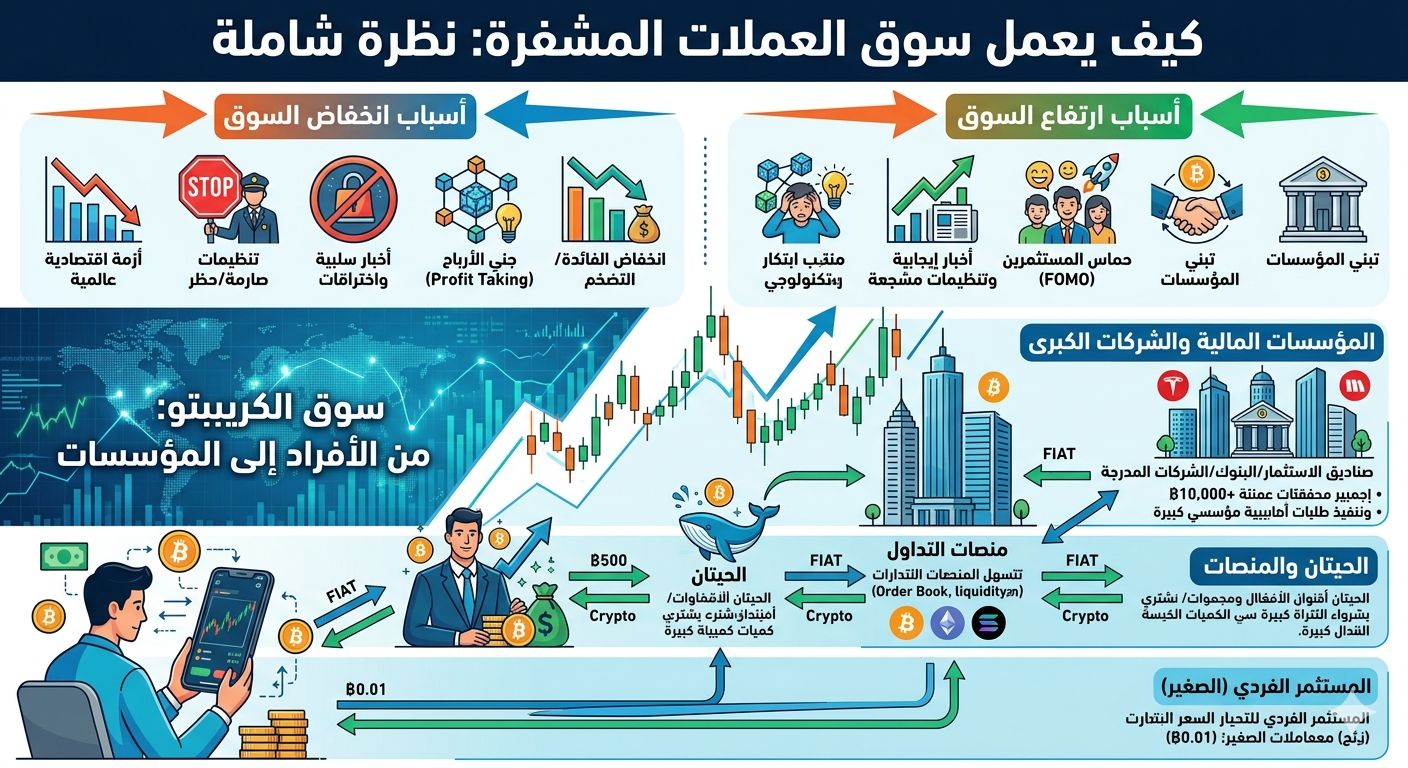
1. Market Movers: Why Do Prices Pump and Dump? (Top Section)
The market is split into two main forces that control the prices:
Reasons for Market Pumps (in the green):
Institutional Adoption: Major companies and banks entering the crypto space for investment.
Investor FOMO: The fear of missing out drives everyone to buy together, causing prices to surge.
Positive news: like regulations that protect investors or countries recognizing cryptocurrencies.
Technological innovation: technical updates that make networks faster and more secure.
Reasons for market decline (in red):
Economic crises: like global inflation or a recession in traditional markets.
Strict regulations: laws imposing bans or severe restrictions on trading.
Negative news: like a platform being hacked or scammed.
Profit Taking: when major investors decide to sell what they have to convert it into cash, causing a temporary drop.
2. The financial pyramid: from the smallest player to the biggest? (the bottom)
Money moves in the market across different levels of financial power:
Retail Investor:
He appears in the bottom left trading via his phone.
Represents ordinary people trading small amounts (like 0.01 Bitcoin).
They are often influenced by market movement and follow the general trend (up or down).
Whales:
Symbolized by a whale in the center.
They are individuals or groups holding large amounts of coins (with trades reaching 500 Bitcoin or more).
Their moves (whether selling or buying) are so powerful that they can suddenly change the price direction.
Institutions and large companies:
Appears in the top right (banks, investment funds, and major companies like Tesla).
These are the heavyweights in the market, and their wallets hold more than 10,000 Bitcoin.
Their trades are massive and impact the strategic trajectory of the market in the long run.
3. The role of platforms (the bridge)
Trading platforms stand at the core of the picture as the main engine of the process:
The platform connects all these players (from the small individual to the large institution).
Controls what's called the 'Order Book' to execute buy and sell orders instantly.
They facilitate the flow of traditional fiat (like USD) and convert it into crypto and vice versa, providing the liquidity necessary for market movement.