

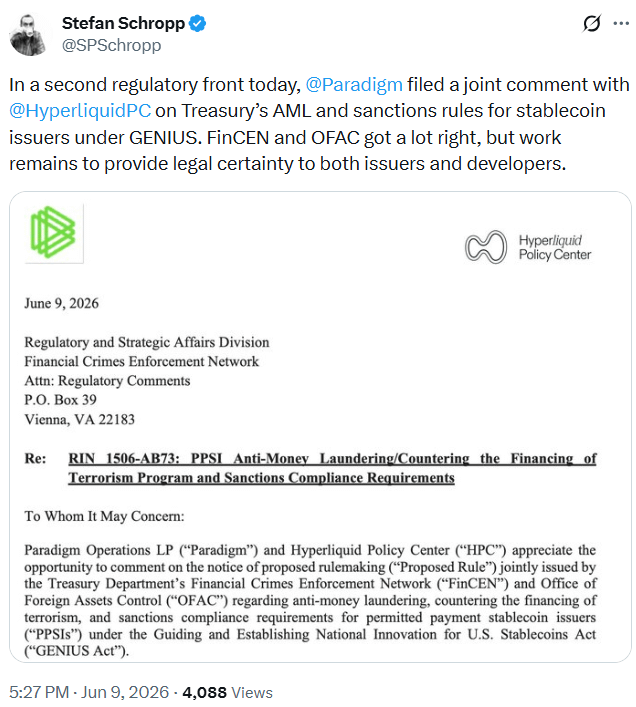
Two major crypto industry players—Hyperliquid Policy Center and investment firm Paradigm—have raised concerns about proposed U.S. stablecoin regulations, warning that certain requirements could unintentionally harm the decentralized finance (DeFi) ecosystem and limit the functionality of open blockchain networks.
In a letter sent to the U.S. Treasury Department, both organizations urged regulators to reconsider parts of the framework being developed under the GENIUS Act. They argue that stablecoin issuers should not be held responsible for transactions they cannot realistically monitor or control.
Regulators Seek Greater Oversight of Stablecoins
U.S. agencies FinCEN and OFAC have introduced proposals designed to strengthen anti-money laundering (AML) controls and sanctions compliance across the stablecoin sector.
Under the proposal, licensed stablecoin issuers would be required to maintain comprehensive AML programs and sanctions-monitoring systems. They would also need mechanisms capable of blocking, freezing, or rejecting transactions that violate U.S. laws.
This is where Hyperliquid and Paradigm see a major problem.
According to the groups, it makes sense for issuers to oversee transactions that occur directly between themselves and their customers. However, once stablecoins begin circulating through decentralized exchanges, self-custody wallets, and smart contracts, the issuer’s ability to monitor activity becomes significantly more limited.
DeFi Could Become the Biggest Casualty
The organizations argue that the proposed rules could create a situation where stablecoin issuers are held accountable for user activity despite having no direct relationship with those users.
In decentralized finance, issuers often have no knowledge of who is using their tokens and no practical way to control transactions executed through autonomous smart contracts.
“Issuers could face liability for transactions they cannot meaningfully control,” the letter states.
If such requirements are adopted, regulated companies may decide to restrict their stablecoins to permissioned environments where all participants undergo identity verification and compliance checks.
Critics warn that this outcome could significantly reduce the role of regulated dollar-backed stablecoins within the DeFi ecosystem.
Capital Could Move Outside the U.S.
Hyperliquid and Paradigm also caution that overly restrictive regulations could produce the opposite effect of what policymakers intend.
If compliance requirements become too burdensome, users and projects may migrate toward offshore or less-regulated alternatives. As a result, regulated stablecoins could gradually lose relevance within the broader open blockchain economy.
Ironically, this could weaken regulators’ visibility into a portion of the market they are attempting to oversee.
Debate Arrives at a Critical Moment
The stablecoin discussion comes as lawmakers continue negotiations over the CLARITY Act, a broader legislative effort aimed at establishing a comprehensive framework for cryptocurrency regulation in the United States.
One of the most heavily debated issues involves protections for open-source software developers and decentralized application builders. The crypto industry has consistently argued that developers should not be held liable for how users choose to interact with their software.
As a result, the debate now includes not only major crypto companies but also legal experts, investors, policymakers, and former regulators.
The Future of Stablecoins May Be Decided Now
The outcome of these discussions could shape the U.S. digital asset industry for years to come.
On one side are regulators seeking stronger safeguards against money laundering, sanctions evasion, and illicit finance. On the other is the crypto industry, which warns that overly broad rules could stifle innovation and push activity away from regulated markets.
The final version of these regulations may ultimately determine not only the future of stablecoins, but also the next phase of decentralized finance development in the United States.
#Stablecoins , #defi , #crypto , #GENIUSAct , #Hyperliquid
Stay one step ahead – follow our profile and stay informed about everything important in the world of cryptocurrencies.
Disclaimer:
The information and opinions presented in this article are for informational and educational purposes only and should not be considered financial or investment advice. Nothing on this page constitutes a recommendation to buy or sell any assets. Cryptocurrency investments are inherently risky and may result in financial loss. Always do your own research before making any investment decisions.