
Educational material. Not financial advice.
Data as of June 11, 2026.
What's this about?
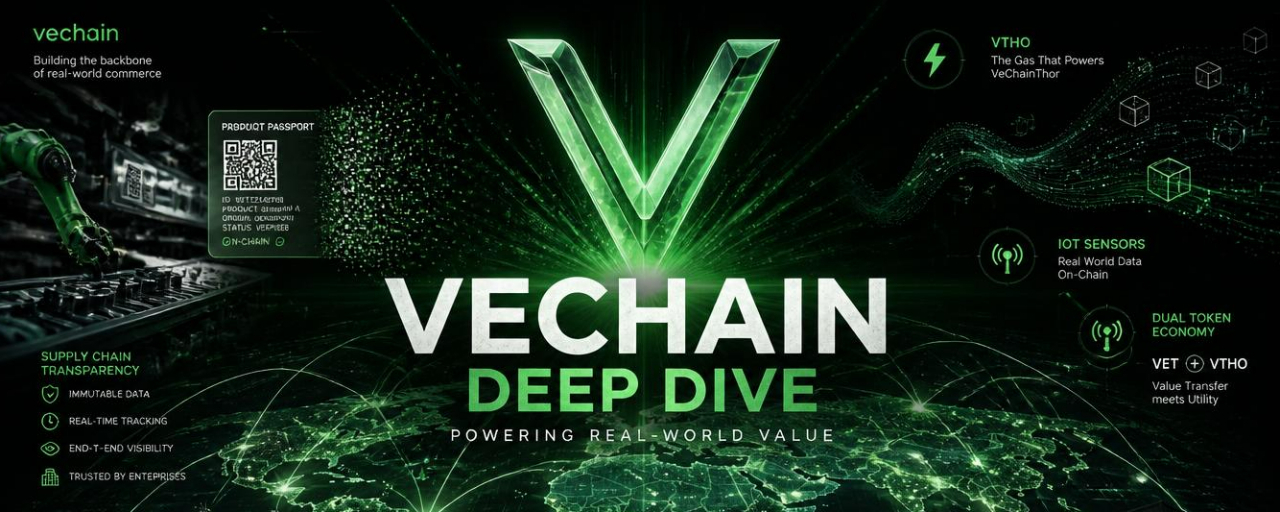
VeChain — a blockchain platform focused on enterprise applications: supply chain tracking, product authenticity verification, data management, and sustainability. Founded in 2015 by Sunny Lu. Initially built as a layer on Ethereum, it launched its own blockchain, VeChainThor, in 2018. A unique feature is its dual-token model: VET as a store of value and VTHO as the 'fuel' for transactions. In 2025-2026, VeChain underwent a major protocol upgrade (Renaissance), transitioning from Proof of Authority to Delegated Proof of Stake and achieving full EVM compatibility.
Base figures
Price: ~$0.0047 Market Cap: ~$403M 24h Trading Volume: ~$15.9M Volume to Market Cap Ratio: ~3.9% Ranking: #88 (CoinMarketCap) ATH: ~$0.28 (April 2021, according to aggregators) Deviation from ATH: ~-98% Circulating Supply: ~86B VET Max Supply: 86.7B VET (fixed) Second Token: VTHO (VeThor) — generated by VET holders, used as gas Blockchain: proprietary (VeChainThor) Explorer: vechainstats.com, explore.vechain.org
How the product works
Two-token model
VET (VeChain) — primary token of value. VET holders passively generate VTHO. Used for storing, transferring value, and governance.
VTHO (VeThor) — 'gas' for executing transactions and smart contracts. Predictable cost of operations for businesses is a key idea: enterprises can budget blockchain expenses independently of VET market volatility.
Generation speed: ~0.000432 VTHO per VET per day.
Burning VTHO: after the Galactica upgrade (July 2025) — 100% of the base VTHO fee is burned (EIP-1559-like mechanism), 30% of priority fees go to validators.
Technology and ecosystem
Hayabusa (December 2025) — transition from Proof of Authority (PoA) to public Delegated Proof of Stake (DPoS). This is the most significant change in the protocol's history: the network became permissionless for validators
Interstellar (April 2026) — full EVM compatibility through sequential alignment with Ethereum (Cancun → Prague → Fusaka → Glamsterdam). Developers can use MetaMask, Hardhat, Foundry without custom settings
StarGate — new staking platform: validator stake limit increased to 600 million VET; the role of Delegator is introduced
VeBetterDAO — decentralized ecosystem of applications with a focus on sustainability; as of May 30, 2026 — over 50 active applications
Model Context Protocol (MCP) — integration allowing AI agents to read on-chain state, initiate transactions, and query smart contracts autonomously
ToolChain
Corporate SaaS platform VeChain for businesses without crypto education: ready-made solutions for tracking, verification, Digital Product Passport (DPP).
Team
Sunny Lu — co-founder, CEO
Positive facts:
Education: Shanghai Jiao Tong University (2002), Bachelor's in Electronics and Telecommunications; Cisco CCIE certification
Career before VeChain: IT manager at 3M China (2006), Bacardi China (2009), CIO at Louis Vuitton China
The idea for VeChain arose while working on the 'track and trace' project at Louis Vuitton — a system for tracking products throughout the production chain within a single company; Lu wanted to extend the principle to multiple parties through blockchain
Founded VeChain in 2015 with the participation of Changpeng Zhao (future CEO of Binance) and connections through Fenbushi Capital (Shen Bo)
Publicly active on Twitter/X (@sunshinelu24)
Known situations:
In 2012, lost 100 BTC in a scam while trying to buy gold in the game World of Warcraft — this started his deep dive into cryptocurrencies
Jay Zhang — co-founder, CFO
Chief Financial Officer and co-founder. Experience in corporate finance. Publicly less active compared to Sunny Lu.
Jianliang Gu — CTO
Led the IoT team at VeChain; developed the ToolChain platform. Specialization — industrial IoT and data integration with blockchain.
Institutional investors
PwC — started as a partner, then became an investor; involved in several corporate implementations
DNV (Det Norske Veritas) — Norwegian certification agency; partnership evolved into investments
Fenbushi Capital — angel investor; through Fenbushi, Sunny Lu met Vitalik Buterin in 2015
Funding
VeChain conducted an ICO in 2018, however, specific data on the amount of funds raised in public sources has not been definitively aggregated as of the date of analysis. Early investors include Fenbushi Capital, PwC, DNV. No direct VC rounds in Series A/B format have been publicly announced.
Supply distribution
The two-token model creates a unique supply dynamic:
VET:
~86 billion in circulation (~99% of max)
Max supply: 86.7 billion VET (fixed, no new issuance possible)
Essentially — close-to-fully-diluted asset
VTHO:
VET holders continuously generate (~0.000432 VTHO/VET/day)
100% of the base fee is burned (after Galactica, July 2025)
With increased transaction activity, the model aims for deflationary
Project metrics
Declared by the team / partners
Over 300,000 on-chain events through Digital Product Passport infrastructure in Q1 2026 (VeChain + Rekord + AMRC)
VeBetterDAO: 50+ active applications (May 2026)
Deployments in 30+ countries
Enterprise clients: Walmart China, BMW, LVMH, H&M, Bayer, BYD, PwC (partner company data)
Confirmed independently
$1.1 million — DeFi TVL in Q1 2026 (DeFiLlama) — a decrease of 47.6% compared to $2.1 million at the end of 2025
$197/day — average daily transaction fee amount in USD for Q1 2026 (Messari)
2.4 trillion VTHO — consumed in Q1 2026 (Messari, decrease 35.6% QoQ)
50M+ — total transactions since the mainnet launch in June 2018 (aggregated data)
Important note
DeFi TVL $1.1 million — this is an extremely low figure for a network with $400M+ market cap. This is a structural feature: enterprise transactions of VeChain (tracking, DPP, verification) do not create locked liquidity in DeFi in the classical sense. Most real value flows through ToolChain transactions outside the DeFi segment. Independent verification of daily volumes of enterprise transactions (claimed billions of operations) has not been found in publicly available sources.
Market context
This section describes the market environment of the token. It does not contain trading signals, forecasts, or entry assessments.
Price dynamics
24 hours: -3.2%
7 days: -16.2%
From ATH (~$0.28, April 2021): ~-98%
Listings and liquidity
VET is traded on Binance, Coinbase, OKX, Bybit, Kraken, and other major CEXs. Volume to market cap ratio (~3.9%) — moderate. Futures on VET are available on Binance, Bybit, OKX.
Competitive analysis
VeChain operates in the enterprise blockchain niche with a focus on supply chain. This is a mixed market where competitors emerge from different sides.
IBM Food Trust / Hyperledger Fabric — not public
Model: permissioned enterprise blockchain with full data control
Stronger than VET: no public token — easier in compliance; IBM — anchor vendor with built-in relationships with corporate clients
Weaker than VET: closed ecosystem without public liquidity; does not interact with public crypto networks
Ethereum + Polygon (enterprise L2) — Ethereum cap $300+ billion
Model: open EVM ecosystem with a growing enterprise segment (Polygon ID, Polygon zkEVM for corporations)
Stronger than VET: incomparably larger developer base and tools; most enterprise pilots are testing the Ethereum stack
Weaker than VET: lack of specialized enterprise tools out of the box (DPP, ToolChain); more complex pricing for corporate budgets
OriginTrail (TRAC) — cap ~$100–200 million
Model: decentralized knowledge graph for supply chains, data verification, RWA
Stronger than VET: knowledge graph architecture allows for more complex data relationships; focus on verifying AI data — a growing niche
Weaker than VET: narrower ecosystem; smaller scale of corporate partnerships
IOTA (MIOTA) — niche IoT
Model: DAG platform for IoT and Machine Economy
Stronger than VET: native support for IoT devices; feeless transactions
Weaker than VET: history of technical difficulties; fewer corporate deployments in public data
Substantive difference of VeChain
VeChain is the only public network that has built a specialized SaaS platform (ToolChain) on top of the blockchain for enterprise clients without crypto expertise, and has confirmed production deployments with Fortune 500 companies (Walmart, BMW, LVMH) for several years. After the Hayabusa transition to DPoS and Interstellar-EVM, the network technically became compatible with Ethereum tools, lowering the barrier for web3 developers.
Partnerships and ecosystem
Confirmed enterprise partnerships:
Walmart China — tracking the safety of food products
BMW — digitization of the automotive supply chain, tracking components
LVMH / Louis Vuitton — verification of luxury goods authenticity through blockchain certificates (jointly with DNV)
Bayer — pharmaceutical applications
BYD — automotive supply chain
H&M — fashion supply chain
PwC — consulting and enterprise implementations (investor)
DNV (Det Norske Veritas) — certification and verification (investor)
Key partnerships 2025–2026:
VeChain + Rekord + University of Sheffield AMRC (January 2026) — EU Digital Product Passport (DPP) manufacturing infrastructure; 300,000+ on-chain events by the end of Q1; positioning under EU DPP regulation of 2027
WanChain Cross-Chain Bridge (July 2025) — integration with 40+ blockchains, injecting liquidity into VeChain through cross-chain bridges
MiCA Compliance (March 2025): VET and VTHO approved for compliant use in the EU according to MiCA — reduces regulatory barriers for European enterprise clients.
Key dates in project development
2015
Foundation of VeChain Sunny Lu
2017–2018
ICO, transition to proprietary blockchain VeChainThor (mainnet launch June 2018)
Rebranding from VeChain to VeChain Thor
2021
April — ATH: ~$0.28
2022–2024
Gradual expansion of enterprise partnerships
Development of the Renaissance upgrade concept
2025
March — MiCA approval for VET/VTHO in the EU
July — Galactica: dynamic fee market, 100% burning of base VTHO fees
July — integration of WanChain Cross-Chain Bridge (40+ blockchains)
December — Hayabusa: transition from PoA to public DPoS
2026
January — launch of EU Digital Product Passport infrastructure (VeChain + Rekord + AMRC)
April — Interstellar: full EVM compatibility, Cancun upgrade
April — StarGate: new staking platform, validator cap 600M VET
May — VeBetterDAO: 50+ applications
In development (according to team statements):
Agent Marketplace — platform for hiring AI agents for various tasks
Continuation of EVM alignment: Prague → Fusaka → Glamsterdam
Expansion of VeBetterDAO ecosystem
Sentiment and community
Activity on platforms
Twitter/X: @vechainofficial — official account
Reddit: r/vechain — active community
Discord and Telegram: community of developers and enthusiasts
Market sentiment
VET is trading at ~-98% from the ATH of 2021. After a series of technically significant upgrades in 2025–2026 (Hayabusa, Interstellar), the price has not shown sustainable recovery, reflecting the overall market dynamics and ongoing questions about price capture from enterprise activity.
VeChain officially adopted the narrative of fighting against the 'casino culture' of the crypto market (public manifesto of 2026 'The Fight for Utility in a Casino Market'). This reflects the team's positioning but also indicates challenges in attracting speculative liquidity.
Risks
🔴 High: weak connection between enterprise activity and VET price
The key issue of VeChain's tokenomics: enterprises use VTHO for transactions, not VET directly. If the VTHO market becomes liquid enough, enterprises can buy VTHO on the open market without needing to hold VET. In Q1 2026, DeFi TVL was $1.1M with a market cap of >$400M — the structural gap between enterprise activity and token price is evident.
🔴 High: proximity to ATH -98%
VET price is at ~$0.005 with ATH ~$0.28. Recovery to ATH will require a multiple increase in both the market overall and specific catalysts for the project. Long-term holders of ICO and ATH purchasers carry significant unrealized losses.
🟠 Medium: competition from general-purpose L1 for enterprise
After VeChain transitioned to EVM compatibility, large corporations may deploy on Ethereum L2 (Polygon, Arbitrum) or Avalanche subnets, using a wider array of tools and a larger developer ecosystem. The specialized advantage of VeChain becomes less unique as the Ethereum stack evolves.
🟠 Medium: low DeFi activity holds back the ecosystem
DeFi TVL $1.1M limits the attraction of DeFi developers and liquidity. Without a developed DeFi ecosystem, it's hard to create the flywheel effect characteristic of Ethereum, Solana, or BNB Chain. VeBetterDAO with 50+ applications is a step, but the TVL volume is not comparable.
🟡 Moderate: transition to DPoS creates operational risks
Hayabusa (December 2025) — transition from PoA to DPoS — fundamentally changes the network's security mechanics. New validators without a PoA node reputation history may introduce new risks of collusion or attacks. This is a fundamental change, the effects of which have not yet fully passed the market test.
🟡 Moderate: regulatory risk of token classification
Despite MiCA approval in the EU, there is no formal regulatory status for VET in other jurisdictions (primarily the USA). Classification as a security would create significant restrictions on listings and access.
🟢 Low: risks of partnership ecosystem
Walmart China, BMW, LVMH — large companies with confirmed deployments. The likelihood of all key enterprise partners exiting simultaneously is low: corporate migrations from blockchain systems are costly.
Development scenarios
Description of the conditions under which each scenario may be realized. It is not an assessment of probability or recommendation.
Bull scenario — conditions for realization:
EU DPP regulation of 2027 creates a mandatory market for VeChain infrastructure; the number of DPP transactions grows to millions per day
Agent Marketplace gains significant adoption; AI agents generate sustainable VTHO demand
EVM compatibility attracts web3 developers; DeFi TVL grows to $50M+
New major enterprise contracts (Fortune 500 level) are publicly announced
Confirming signals: growth in DeFi TVL on DeFiLlama; increase in VTHO burn-rate; public enterprise announcements
Base scenario — inertial development:
Enterprise partnerships continue, DPP grows slowly
DeFi TVL remains in the range of $1–10M
VET price correlates with the broader market without its own catalysts
VeBetterDAO grows to 100+ applications, but without significant TVL
Confirming signals: stable VTHO burn; gradual growth in the number of DPP events
Bear scenario — conditions for realization:
Ethereum L2 (Polygon, Arbitrum) occupy the enterprise market thanks to ecosystem resources; VeChain loses differentiation
EU DPP regulation 2027 is postponed or allows the use of any EVM blockchain
The VTHO market gains sufficient liquidity; enterprises stop holding VET
DeFi TVL continues to decline
Confirming signals: decrease in VTHO consumption QoQ; new enterprise partners choose competing networks; exit from Governing Council / strategic partners reduce engagement level
Open questions for further observation
Will the EU DPP regulation of 2027 become a real mandatory market for VeChain or remain a voluntary standard with many alternatives?
Will the Agent Marketplace create sustainable VTHO demand or remain a niche product for enthusiasts?
How will the structure of VET holders change after the transition to DPoS and StarGate staking — will significant retail staking emerge?
When will the VTHO market reach a point where enterprise clients no longer need to hold VET — and how will this affect token pricing?
How effective is EVM compatibility (Interstellar) for attracting web3 developers — is there measurable growth in new dApps beyond VeBetterDAO?
Will BMW, Walmart China, and LVMH continue to expand their use of VeChain or limit themselves to current pilots?
Sources
CoinMarketCap, Messari (State of VeChain Q1 2026), DeFiLlama, VeChain.org, MEXC News, Bitget News, AInvest, CoinBureau, Blocklist.co.kr, IQ.wiki, CoinDesk, Blockonomi
This material is a fundamental analysis of the cryptocurrency project for educational purposes. It is not financial, investment, or trading advice. It does not constitute an offer to buy or sell assets. Cryptocurrencies carry a high risk of capital loss. Any decisions regarding asset actions are made by the reader independently and at their own risk.
#VET