
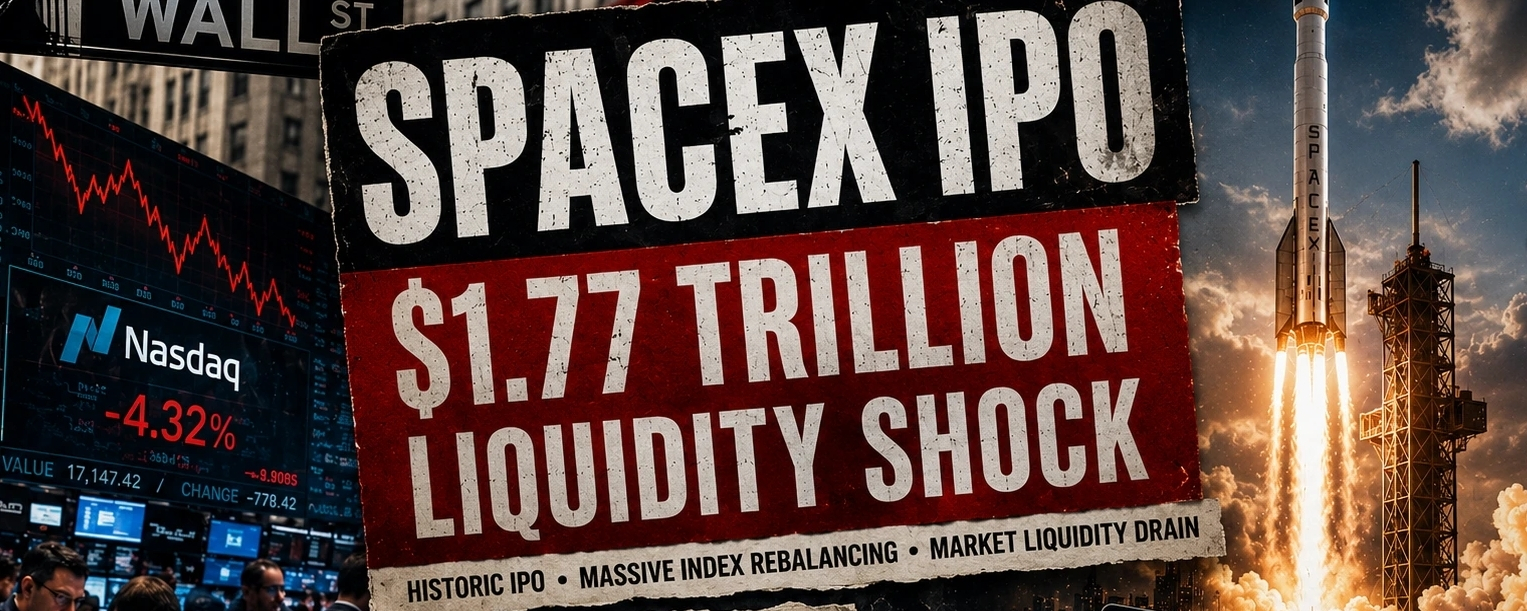
Over the past decade, traditional and digital finance has operated within a predictable framework of institutional boundaries. While retail investors have been navigating secondary markets, elite venture capital firms have maintained absolute dominance over massive initial offerings. However, the current structural upheavals sending shockwaves through global indices like Nasdaq 100 and S&P 500 reveal that a deep tectonic shift is underway — a shift that goes beyond just routine market corrections.
Today, we stand at the epicenter of an unprecedented liquidity redistribution, triggered by the imminent public debut of SpaceX at a staggering valuation nearing $1.77 trillion. This colossal event is not just the largest IPO in human history; it represents a systematic rewriting of financial governance rules crafted by major corporate cartels.
This massive regulatory reconfiguration is not merely targeting the company's capitalization; it represents the creation of a vast systematic vacuum designed to absorb decentralized capital. By lowering long-standing entry barriers, Wall Street whales are orchestrating a philosophical paradox: providing unprecedented market access to small investors while simultaneously placing them in a position that allows them to absorb sharp macroeconomic shocks, jeopardizing their most critical resource: their financial sovereignty and mental clarity.
---
1. Financial Structure: How Were Regulatory Controls Eroded?
To dismantle prevailing and superficial financial narratives, one must analyze how elite institutional frameworks have smoothly adjusted their foundational apparatus to accommodate a single private entity. This sudden regulatory flexibility has manifested across three major operational layers:
- Retail Absorption Gateways: Major brokerage syndicates have executed an unprecedented 99.6% reduction in entry conditions, crushing the minimum account opening requirements for IPOs from $500,000 to just $2,000. This structural shift has suddenly opened the doors for millions of small wallets to face high-risk macroeconomic volatility.
- Accelerated Index Mechanics: Historically, index-tracking bodies imposed strict waiting periods of up to three months on private companies before adding them to the index. However, in this particular event, Nasdaq has amended its internal charter, reducing the waiting period to just 15 days, forcing automated capital systems into immediate and surprising repositioning.
- Forced Index Buying: The moment this trillion-dollar company joins the benchmark index, passive investment funds worldwide (particularly those tracking QQQ) will be legally obligated to purchase shares valued between $22 to $27 billion, creating an artificial and forced buying frenzy.
---
2. Structural Anatomy of the Sell-Off: Routine Correction or Liquidity Drain?
Many analysts mistakenly interpret the current bleed across assets as merely a simple technical correction. However, the operational divergence between a healthy market rotation cycle and this deep institutional liquidity drain seems clear:
* Standard Market Corrections:
- Main Catalyst: Overbought technical indicators, changes in macroeconomic data, or declines in corporate earnings.
- Institutional Action: Redirecting capital towards defensive stocks, fixed income, or stable capital layers.
- Retail Participation: Panic-selling resulting from breaking technical levels or fear-driven capitulation.
- Asset Correlation: Localized declines in high-risk sectors, while safe havens absorb capital flows.
* Liquidity Drain for 2026:
- Main Catalyst: Systematic liquidation of existing assets to amass large cash reserves to cover the historic IPO.
- Institutional Action: Sharp proactive moves from whales to alter index inclusion rules aimed at unloading existing stock portfolios.
- Retail Participation: Voluntary and sudden liquidation of successful income-generating investment portfolios just to catch up with market IPOs.
- Asset Correlation: Sharp, simultaneous selling pressure hitting tech giants, semiconductors, and major corporations all at once.
---
3. Macroeconomic Implications: The Invisible Cascades Depleting Global Capital
These engineering dynamics do not operate in theoretical isolation; rather, they generate violent feedback waves that alleviate pressure on sovereign index balances, while aggressively reallocating liquidity:
A. Crowding Effects in Secondary Tech Markets:
In highly concentrated tech indices, capital is limited. When a $1.77 trillion tech giant demands an immediate merger, it triggers a mandatory structural rebalancing. Institutional systems must regularly dry up funding for secondary holdings — such as advanced semiconductor companies and AI infrastructure stocks — to accommodate the massive capital requirements of the new listing, causing widespread bleeding in these sectors.
B. Free Liquidity Drain in Markets:
By securing a massive 30% stake for retail investors — three times the usual statistical benchmark for market IPOs — the issuing structure deliberately siphoned off liquid cash reserves from bank accounts and regular trading wallets. This massive extraction leaves the broader market exposed, stripped of the purchasing power needed to support price levels during unexpected macroeconomic corrections.
C. Strategic Repositioning of Decentralized Portfolios:
Instead of relying on automated algorithmic tracking, fund managers face a tough operational choice: either maintain oversized positions in blue-chip tech stocks or liquidate them to participate in a historically rare primary asset class. This mass transition from liquid secondary markets to illiquid primary layers leaves public trading desks exposed to severe operational bottlenecks.
---
4. The Sociological Cycle: Deconstructing the "Outflow Liquidity" Model
Stepping away from pure financial accounts reveals a recurring human phenomenon that consistently manifests at the peaks of historical market cycles:
- Distribution Mechanics at the Top: When financial engineers deploy massive regulatory resources to facilitate entry paths for small capital, it is rarely driven by structural generosity. Historically, these patterns indicate "distribution at the top" — a process where influential insiders exchange illiquid, overvalued company shares for real, liquid cash provided by enthusiastic retail traders.
- Historical Echoes: This macro scheme mirrors the psychological and structural setups seen during the dot-com crash of 2000 and the SPAC boom of 2021. In both cases, intense media momentum obscured institutional exits, leaving retail communities to face the downturns alone as systematic liquidity evaporates from the financial infrastructure.
---
Strategic Horizon: Navigating the Matrix of Institutions
The deep disruption witnessed in global markets is not a fleeting deviation designed to temporarily capture traders' attention; rather, it serves as a stark reminder of the fundamental physics governing the centralized financial infrastructure. In this complex ecosystem, markets cease to function as objective price discovery mechanisms and instead transform into highly orchestrated environments driven by institutional gravity.
Your responsibility as a trader and market participant must evolve naturally; you must transition from the role of an emotional observer — easily swayed by media frenzy and index panic — to an analytical engineer. Market operators should scrutinize institutional incentives closely, evaluate issuance data, and isolate their core capital from systematic exit traps.
The institutional machine dictates regulatory rules, controls index membership schedules, and leads major brokerage lines; yet you retain absolute control over your financial execution. True market flexibility does not lie in blindly chasing historical narratives, but in maintaining your financial sovereignty to seize pure and genuine opportunities.
---
💡 Share your thoughts in the comments:
As Wall Street rewrites the rulebook to facilitate this historic migration of trillion-dollar capital, what is your immediate strategic defensive plan? Are you holding liquid cash reserves to buy the bleed-off occurring in the secondary markets, or are you executing a direct entry into the IPO? Share your thoughts below!
---
📌 Financial and Technical Disclaimer:
The technical information, data, and analytical insights provided in this article are for educational, academic, and informational purposes only. This content does not constitute financial, investment, legal, or professional advice for buying, selling, or trading any digital assets, nor does it recommend specific financial strategies. Traditional stock markets, initial public offerings (IPOs), and large-scale index restructurings carry deep structural risks, institutional bottlenecks, and severe systematic volatility that can lead to total capital loss. Readers should conduct their own independent and thorough research (DYOR) and consult a certified financial advisor before making asset allocation decisions or exiting the market. This bulletin, its management, or its authors bear no responsibility for any financial losses or technical system disruptions directly or indirectly caused by the application of the data herein.