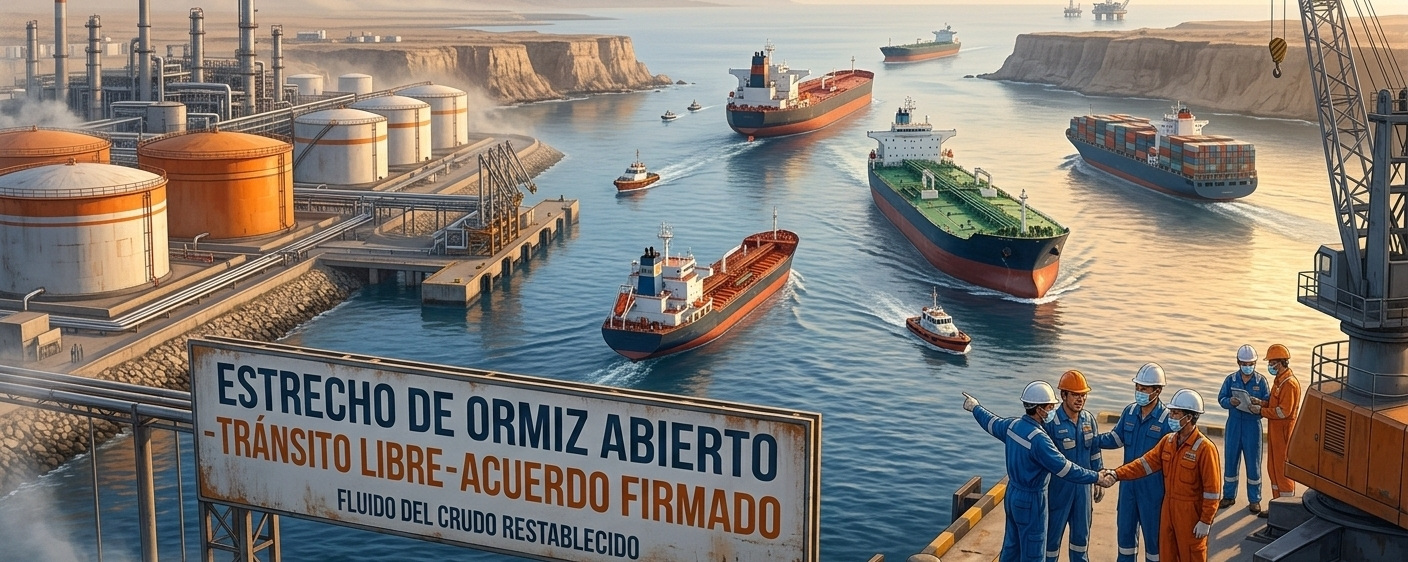
The unblocking of the strait is approaching
Brent crude prices are falling to levels not seen since March
The US and Iran are close to reaching an agreement at the G7 summit
Despite everything, the oil flow through Ormuz has shot up by 50%
The price of a barrel of oil has dropped 7% in less than 24 hours. The Brent futures for immediate delivery (July) went from notable gains in the markets on Thursday morning to a steep decline during yesterday afternoon and this morning. In another unexpected twist, the deal to unblock the Strait of Ormuz (a task that will take time) seems to be just around the corner, while it's also becoming clear that crude is slowly starting to flow through this artery again. The oil flow through Ormuz has ramped up significantly in recent weeks. Two pieces of news that make more sense together. One is the increasingly imminent signing of the agreement, and the other shows that agents and shipping companies are regaining confidence to cross Ormuz (even without an agreement), which has prevented the world from choking.
The Strait of Ormuz had become a major threat to the global economy. The closure of this artery of international trade had set off alarm bells in oil-importing and producing countries. However, forecasts predicting shortages, recession, and chaos have not materialized to date. There are two pillars or factors explaining why 'blood has not reached the river'. On one hand, international trade has proven to be much more flexible than previously believed.
From Julius Baer, they explain in a client note that "thanks to the reorganization of trade routes, largely completed and incentivized by sometimes wide price differentials, the regional supply of petroleum products should not become critical for now. Trade should balance the reduction in inventories across all submarkets of oil and derivative products," say analysts from this firm.
Along with alternative routes out of the Middle East, there are several elements that collectively bolster the market's temporary resilience, such as the surge in crude from South America (Guyana, Brazil, Argentina...), including a rebound in Venezuelan exports; the ample supply of jet fuel and natural gas liquids in North America; and China's flexibility in petrochemical raw materials.
On the flip side, it's worth noting that Ormuz has kept on flowing. The oil thread that has streamed through the Strait over these months seems to have been enough to keep the markets alive and prevent the crisis from escalating further. We also have to acknowledge China's role, which has virtually stopped buying oil on the market to draw from its inventories, allowing supply and demand to intersect at a higher point (around 90 or 100 dollars), but without hitting catastrophic levels.
Ormuz unclogs 'itself': from thread to stream.
Regarding Ormuz, there are some optimistic data points worth highlighting. The flow of non-Iranian oil through the Strait of Ormuz has increased by approximately 50% so far this month, as more Gulf producers find ways to transit through the maritime route despite ongoing tensions between Washington and Tehran.
According to Vortexa data accessed by the prestigious Bloomberg agency, at least 1.8 million barrels per day transited from the Persian Gulf in the first 10 days of June, compared to 1.2 million per day in May. These figures tend to be revised upward as more tankers are observed, aided by satellite image analysis. UBS concurs and points out that oil transit has jumped from 0.5 million barrels per day (a thread of oil) in April to over 1.7 million per day currently, which already looks like a stream.
At the Swiss bank, they confirm that the increase in shipments has primarily occurred in the UAE. They also note a rebound of approximately 0.5 million barrels per day in product shipments compared to April and May. "This suggests that volumes could be slightly higher, although they are still far from normal," writes their strategist Henri Patricot in a Wednesday report.
Iranian shipments through the corridor, on the other hand, have plummeted, as the blockade imposed by the U.S. continues to prevent tankers from passing. According to Vortexa data, no Iranian oil transit was recorded during that period.
The Strait has been the epicenter of the conflict since the U.S. and Israeli attacks began in late February, leading Iran to take control of the corridor. That control has started to weaken as so-called 'dark' transits increase, but the flows still represent a fraction of pre-war levels, which were around 20 million barrels of crude and products per day.
"Transit through the Strait without AIS signals has become the new normal," says Xavier Tang, senior market analyst at Vortexa, referring to the transponders that ships use to broadcast their location and other identification information during transit.
Moreover, reports from different governments confirm that the U.S. and Iran are getting closer to signing an agreement to reopen the Strait of Ormuz, coinciding with the upcoming meeting of world leaders from the Group of Seven (G7). A senior Iranian official revealed to Bloomberg that an agreement is likely to be reached, according to a G7 official who preferred to remain anonymous due to the sensitive nature of the matter. Another G7 official indicated that it will likely be formalized through a memorandum of understanding rather than a definitive agreement. This year's summit will take place in Evian, in the French Alps, from June 15 to 17.
The market discounts a greater flow.
The market has begun to anticipate an increase in flows. When the Persian Gulf Strait Authority in Tehran declared the closure of the maritime route on Thursday, Brent futures barely budged, far from the war's beginning when a 13% price spike accompanied the first closure of Ormuz by Iran.
This could partly reflect what the U.S. president has termed a secret project to facilitate the passage of around 100 million barrels of oil through Ormuz since last month. If accurate, that figure would equate to at least 2.4 million barrels per day since early May. The large volume of oil escaping the Gulf, combined with the collapse of Chinese crude imports and the release of emergency reserves, has led to a nearly one-third drop in futures prices from their peaks during the height of the conflict.
"That said, some lasting changes in the oil market have emerged, as peak oil demand approaches with the acceleration of electrification of roads, both for cars and trucks; the UAE exiting the oil cartel; and Iraq building a pipeline to boost exports to the Mediterranean. In a few years, it's highly likely that the Strait of Ormuz will have lost some of its strategic importance and economic threat. Our outlook remains unchanged; the current crisis should follow the historical pattern of a brief but intense price crisis. We foresee a significant drop in oil prices by the end of this year," say analysts from Julius Baer.
#iran #IranDeniesSundayGenevaSigningDate #EEUU #ormuz #petróleo $CL