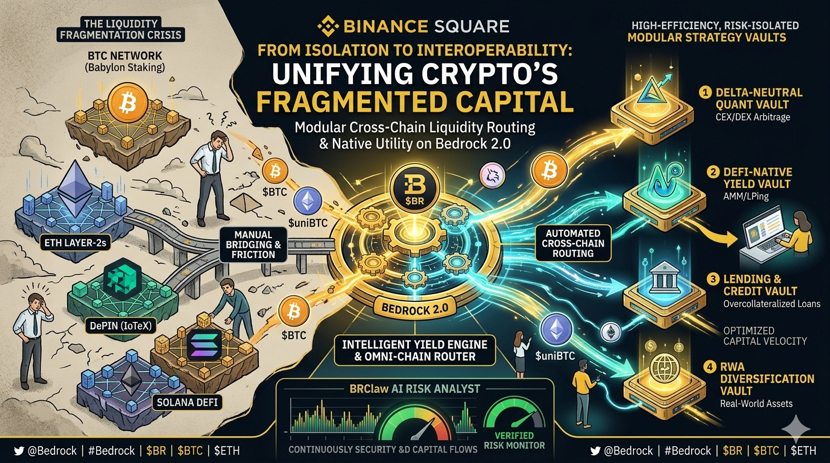
The decentralized finance landscape has reached a critical structural crossroads. Over the past several years, the explosive growth of layer-1 blockchains, layer-2 scaling solutions, and specialized ecosystem networks has unlocked unprecedented smart contract capabilities. However, this rapid expansion has come with a severe macroeconomic cost: the absolute fragmentation of global liquidity.
Instead of operating as a unified, efficient global financial market, capital has become increasingly isolated within sovereign ecosystem silos. A user holding capital on a Bitcoin layer-2 protocol is traditionally walled off from participating in Ethereum’s mature lending layers, while decentralized physical infrastructure networks (DePIN) compete independently for separate pools of liquidity.
To achieve true institutional scale, the next epoch of Web3 architecture must move completely away from single-chain isolation. The industry requires an entirely new framework: an automated coordination layer capable of routing cross-chain assets intelligently without forcing market participants to compromise on security or network alignment.
The Economic Cost of Capital Immodility
In the early iterations of decentralized architecture, capital fragmentation was treated as an unavoidable byproduct of competing blockchain consensus mechanisms. To navigate between distinct networks, users were forced to rely on manual, multi-step bridging mechanisms—a process defined by high transaction friction, wrapped asset smart contract risks, and systemic operational complexity.
For long-term asset holders, this operational friction creates a persistent economic drag:
Siloed Yield Opportunities: High-conviction capital anchored to a specific network cannot easily capture transient, premium yield layers emerging on alternative chains.
Capital Velocity Compression: When assets are locked inside rigid, linear staking smart contracts, they are effectively removed from active circulation, lowering overall capital velocity across the broader market.
Collateral Fragmentation: Investors are frequently forced to split their portfolios into smaller fragments across multiple wallets and networks to interact with localized applications, significantly reducing their overall capital efficiency and borrowing power.
The transition toward omni-chain liquid token wrappers, such as uniBTC, represented the first major phase of solving this dilemma. By issuing a highly liquid, decentralized receipt token in exchange for underlying spot exposure, protocols successfully gave users a tool to unlock dormant capital. However, a liquid derivative wrapper is only as effective as the underlying infrastructure built to route it.
Aligning the Architecture: The Value Capture of $BR
A unified cross-chain routing engine requires a robust, decentralized coordination mechanism to align the interests of users, capital allocators, and validators. Within the Bedrock 2.0 ecosystem, this coordination layer is anchored natively by the $BR tokenomics framework.
Rather than acting as a simple, inflationary reward token, $BR is integrated directly into the performance and governance parameters of the routing engine:
1. Strategic Vault Allocations: Holding and locking $BR serves as the core requirement to gain tiered allocation quotas into high-capacity, institutional-grade strategy vaults (such as the market-neutral Selini Vault).
2. Dynamic Incentivization via Gauge Voting: Utilizing a voting-escrow (veBR) framework, token holders can directly vote on the distribution of protocol incentives and steer cross-chain liquidity routing to specific asset vaults during seasonal allocation resets.
3. Automated Risk Assessment Budgeting: Access to the BRClaw AI Analyst—the platform's specialized machine-learning model that monitors multi-layer smart contract safety and real-time capital flows—is directly governed by $BR utility thresholds.
Conclusion: The Future belongs to Unified Liquidity
The era of chasing unsustainable, inflationary rewards on isolated networks is rapidly drawing to a close. As global regulatory standards tighten and institutional market participants look for predictable, risk-mitigated on-chain environments, the protocols that succeed will be those that eliminate structural friction.
By treating liquidity fragmentation not as an permanent limitation of blockchain design, but as a coordination problem to be solved via automated routing, architectures like Bedrock 2.0 are laying the groundwork for a highly efficient, omni-chain financial future.
Are you currently managing your portfolio across multiple isolated chains, or are you utilizing automated routing engines to optimize your capital velocity? Let's discuss your cross-chain asset strategy in the comments below.
#Bedrock #BTCFi #DeFi #MultiChain