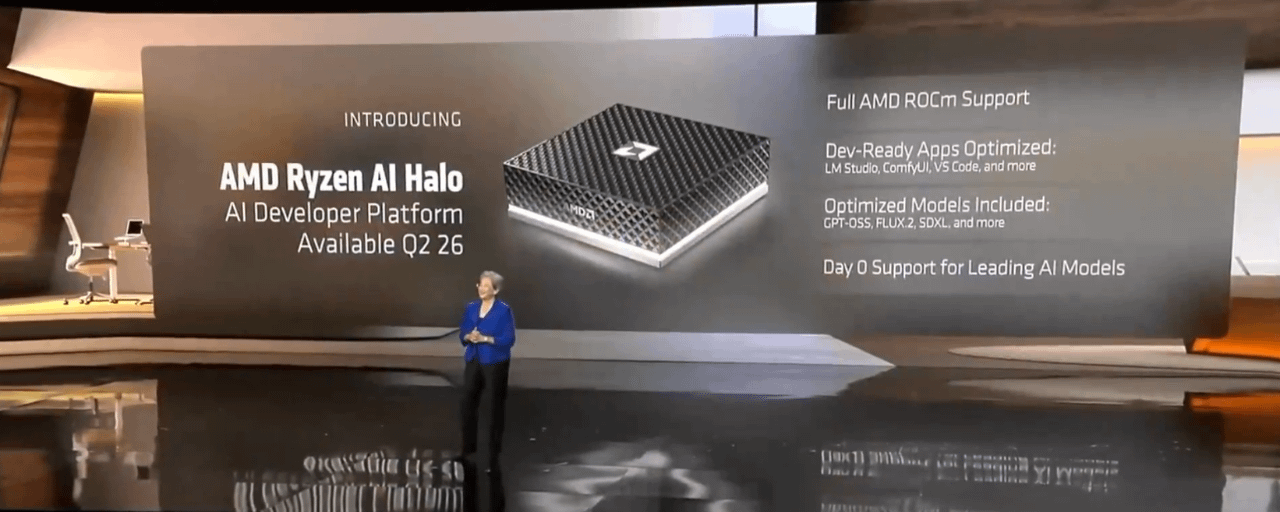
AMD has delivered a powerful blow to Nvidia's monopoly in the AI sector.
While the retail market is caught up in debates about the trajectory of meme coins, a game-changing event has occurred in the world of real tech that will forever alter the rules for local artificial intelligence.
At a recent presentation, head of #AMD Lisa Su took the stage with a mini-PC the size of a thick book in one hand and live demoed a heavy AI model with 235 billion parameters. No data centers. No cloud. No renting server power from Big Tech.
The main character of this quiet revolution is the Ryzen AI Max+ 395 chip (Strix Halo architecture). This is the first x86 processor in history that gives developers what Nvidia has long denied them.
📐 Architectural deadlock #Nvidia and breakthrough #AMD
The main issue when running large language models (LLM) locally is not the computational power of the processor but the amount of video memory (VRAM).
If you want to run a serious model like DeepSeek-R1, the flagship Nvidia graphics cards immediately hit the 'wall':
RTX 4090 offers only 24 GB of memory.
The latest RTX 5090 — 32 GB.
As soon as the heavy model doesn’t fit in this volume, the system starts using regular PC RAM. The data exchange speed drops through the PCIe bus, and generation turns into a turtle-like 1–2 tokens per second. Work becomes impossible.
What did AMD do? They applied a unified memory architecture (UMA). Ryzen AI Max+ combines CPU and a powerful graphics chip with a shared pool of ultra-fast memory of 128 GB. When operating in a Linux environment, up to ~110 GB of this memory can be allocated for GPU needs.
In simple terms: This mini-PC offers 3.5 times more available memory for AI models than the most expensive consumer graphics card from Nvidia. In specific tests for inference of complex models, Strix Halo outperformed the RTX 5080 by more than 3 times — simply because it was able to ingest the model weights entirely.
💼 The economics of sovereign AI: The subscription killer
The official reference platform AMD Ryzen AI Halo for developers has hit the market with a price tag of $3,999. At first glance, that's a hefty sum. However, this price includes a fully ready-to-go solution 'out of the box' with pre-installed software and optimization. Meanwhile, announcements are already surfacing from OEM partners (Minisforum, GMKtec, etc.) whose similar configurations based on the same Strix Halo chip will cost significantly less — in the range of $2000 to $3000.
Let's calculate the alternative...
Instead of paying hundreds of dollars monthly for subscriptions to ChatGPT Pro, Claude, specialized AI-IDEs (like Cursor), or renting cloud GPUs on RunPod, you make a one-time investment in your own infrastructure. The mini-PC pays for itself within a year of operation, but in return, you get something that no cloud can provide:
Absolute privacy (RAG): You can feed gigabytes of personal documents, closed source code, or confidential financial analytics to the local model. Your data will never fly to OpenAI or Anthropic servers for training their next models.
No limits: No more annoying messages: 'You have exhausted the limit of requests, please come back in 4 hours'. Your model works 24/7, without delays and without dependence on the quality of the internet connection.
⚙️ Verdict for investors and developers
We stand on the brink of an era of autonomous AI agents. For their evolution, independence from centralized servers is critically important. AMD has effectively created an equivalent of Mac Studio but on an open and familiar x86/Linux architecture for most engineers (with active support for ROCm, Ollama, and LM Studio platforms).
While speculators trade pictures in anticipation of minute candlesticks, the architects of the new digital world are laying the foundation for complete independence in computing. Autonomous infrastructure is the main trend of the second half of the decade.
📊 Trader's perspective on the trend:
How to profit from this? While retail players are chasing short-term pumps, the smart money is focusing on infrastructure. If you want to ride the AI revolution and the decentralization of computing through the markets, keep an eye on the assets that provide this sovereignty.
In the decentralized AI sector, there are protocols like $TAO , $FET, and $NEAR . And for those who prefer to work directly with tech giant stocks, the AMDUSDT contract is available on Binance Futures. Trade wisely and keep a cool head.
P.S. If this breakdown of institutional hardware and tech helped you keep a cool head, you can symbolically support the author by sending a coffee_donat. Click the tip icon 💰 below (hand with a coin). Even a minimal cent is the best signal for algorithms and the author that the deep market analysis and sovereign technologies are useful to you! 😉☕️