
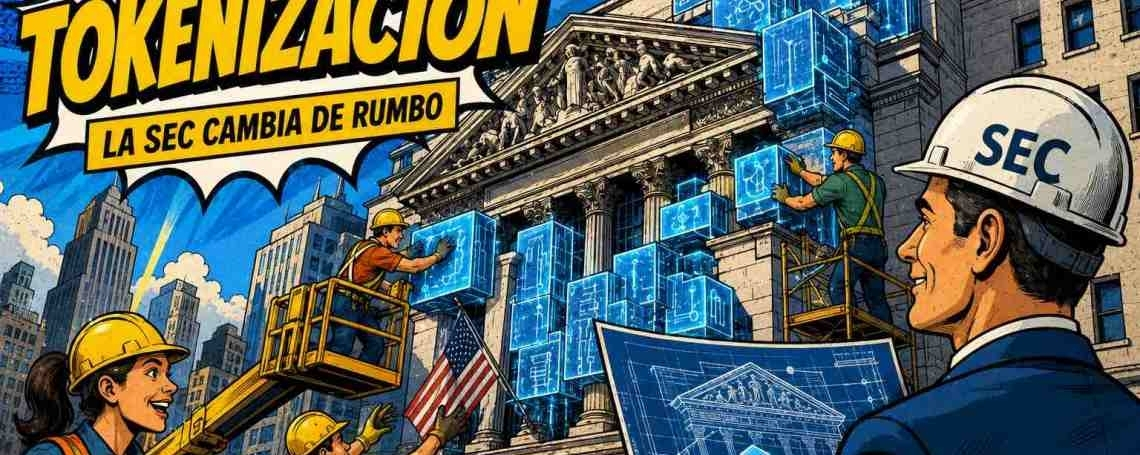
towards financial modernization
The SEC is moving past years of a sanctions-heavy approach and is now laying down a framework that could speed up institutional adoption of blockchain tech.
Tokenization just scored one of the biggest regulatory boosts we've seen in years. The U.S. Securities and Exchange Commission (SEC) dropped a strategic plan for 2026-2030, highlighting blockchain tech as a game-changer for the country's financial infrastructure.
Beyond the technical content of the document, the real impact lies in the change of narrative.
For much of the last decade, the regulator was perceived by the industry as an entity that defined digital asset policy mainly through enforcement actions and litigation. Now, for the first time, the agency is incorporating blockchain and digital assets into a formal financial modernization strategy.
The message that markets receive is different: the discussion is no longer about whether technology fits into the financial system, but about how to integrate it safely and regulated.
From uncertainty to planning.
One of the main obstacles for institutional adoption of blockchain was never the technology.
The real barrier has been regulatory uncertainty.
For years, banks, asset managers, and listed companies faced doubts about how certain digital assets would be classified and which agencies would have jurisdiction over them.
This lack of clarity delayed numerous projects even when the technological infrastructure was already ready to be used.
The SEC's new plan seeks precisely to reduce that uncertainty through what it describes as a 'rational, coherent, and principle-based' approach.
Tokenization enters the central agenda.
The document explicitly identifies tokenized offerings and blockchain-based financial infrastructure as areas where the agency aims to facilitate capital formation within appropriate regulatory frameworks.
The SEC also suggests that activities such as custody, trading, and certain services linked to digital assets could develop under regulatory supervision without getting caught up in duplicative or contradictory requirements.
This is a significant change because it places tokenization on the regulator's main agenda rather than as an experimental exception.
Coordination with the CFTC is gaining prominence.
Another important aspect is the collaboration between the SEC and the Commodity Futures Trading Commission (CFTC).
Both agencies are currently working on harmonizing criteria related to product classification, regulatory reporting, and oversight systems.
For the industry, this coordination can be as important as any new regulation.
The existence of clear and consistent rules reduces operational risks and facilitates decision-making by institutions that have so far remained cautious.
Institutional trust is the real goal.
Experts agree that markets tend to respond better to regulatory certainty than to the absence of regulation.
When companies have a clear roadmap, risk and compliance committees can evaluate projects with greater confidence.
This allows for accelerated investments and developments well before new rules come into effect.
For this reason, even a strategic document without immediate legal effects can influence capital allocation within the financial sector.
Blockchain no longer needs to avoid regulation.
One of the most repeated arguments over the years was that the advantages of blockchain depended on operating outside traditional regulatory structures.
However, that vision is losing momentum.
The new generation of blockchain-based financial infrastructure incorporates mechanisms that allow for the automation of regulatory controls directly within the assets and protocols.
Transfer restrictions, lists of authorized participants, or oversight mechanisms can be integrated into the design of the financial instruments themselves.
This opens the door to a coexistence between innovation and regulatory compliance that until recently seemed difficult to achieve.
The role of the CLARITY Act.
Despite the SEC's change in tone, significant challenges still exist.
One of them is the need for a solid legislative basis that clearly defines how various digital assets are classified.
In this context, the CLARITY Act continues to be one of the most closely watched initiatives by the industry.
If it finally makes progress in Congress, it could provide the legal framework that many institutions see as necessary to accelerate large-scale projects related to tokenization.
The most important change has already occurred.
Although there are still rules to develop and regulatory debates to resolve, the most relevant change may have already occurred.
The SEC has shifted from viewing blockchain technology primarily as a risk area to seeing it as a tool capable of modernizing financial markets.
This transformation changes the way banks, asset managers, and large companies evaluate technology.
Tokenization still faces regulatory, operational, and legislative challenges, but now has something that has been scarce for years: a clear signal that authorities are willing to build a framework for its development.
And for many market participants, that certainty can be more valuable than any regulatory flexibility.
#EEUU #TradebStocks #RWA #SEC #CLARITYAct $NVDAB $MUB $TSLAB