
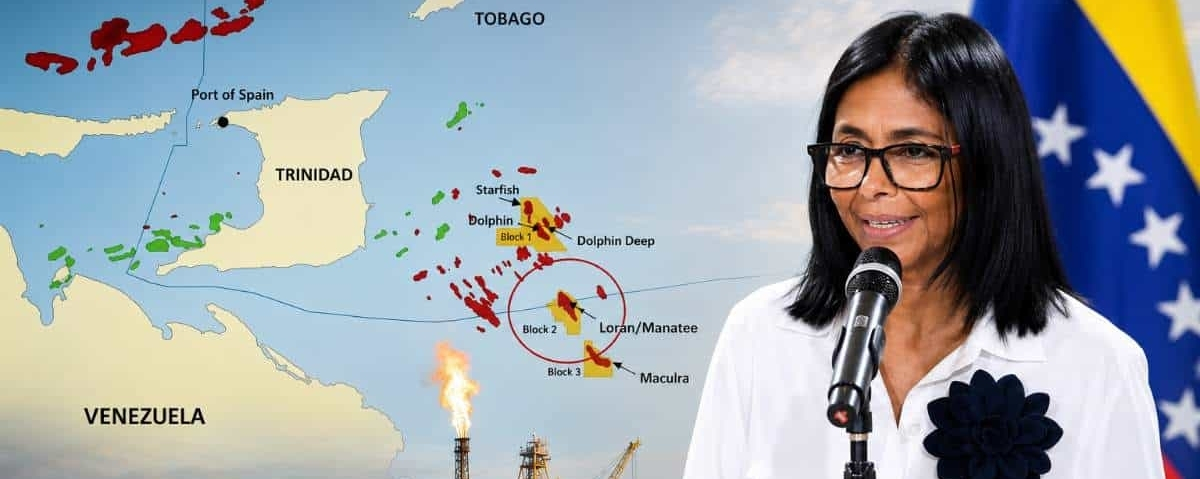
The Loran Field, boasting over 10 trillion cubic feet of gas, is set to be redeveloped in Venezuela. Shell plans to kick off production in 2027.
One of the largest natural gas deposits in Latin America is coming back online after more than two decades of waiting. Venezuela and Shell have signed agreements to start the first phase of exploitation of the Loran Field, a strategic reserve shared with Trinidad and Tobago that exceeds 10 trillion cubic feet of gas.
Also read: Trump threatens to take control of Iranian oil just like in Venezuela
The acting president of Venezuela, Delcy Rodríguez, announced the signing of agreements with the multinational Shell to launch the first phase of development and exploitation of the Loran Field, a gigantic natural gas deposit located in the Deltana Platform and shared with Trinidad and Tobago.
The decision marks a turning point for a project that had seen no significant advancements in 23 years and, according to official data, holds reserves exceeding 10 trillion cubic feet of natural gas.
Together with the Manatee block, located on the Trinidad side, the Loran-Manatee system exceeds 10.25 trillion cubic feet, becoming one of the largest gas assets in the region.
'We are taking a historic step with the signing of this license, where we will have an adequate utilization of gas for export and where we will also have great benefits for Venezuela,' Rodríguez stated during the signing ceremony held at the Miraflores Palace.
Loran Field: a project that Venezuela has been waiting for over two decades.
The Loran Field is located in Block 2 of the Deltana Platform, in the waters of the Atlantic Ocean, and is part of a transboundary deposit shared between Venezuela and Trinidad and Tobago.
The strategic importance of the project lies not only in the size of its reserves but in its potential to turn Venezuela into a relevant exporter of natural gas at a time when several countries are seeking new energy supply sources.
According to the Venezuelan government, the field contains seven deposits, six of which are shared with Trinidad and Tobago.
The project's launch also responds to Trinidad's need to secure new supply sources for its petrochemical industry and liquefied natural gas (LNG) complexes, considered among the most important in the Caribbean.
The project development has been gaining momentum in recent months. In April of this year, Reuters reported that Shell is working to start gas production at the Loran-Manatee deposit by 2027, according to statements from Gerald Ramdeen, president of the National Gas Company of Trinidad and Tobago (NGC).
According to Ramdeen, the oil company communicated that it is carrying out the necessary work to obtain the first gas from the project next year.
One of the most significant changes is the expansion of the infrastructure planned to transport the resource.
Initially, a pipeline was planned with a capacity to move 700 million cubic feet per day. However, the capacity was increased to 1,000 million cubic feet per day through a 32-inch pipe, instead of the originally considered 24-inch conduit.
You might be interested: The U.S. expanded licenses for British Petroleum, Chevron, Eni, Maurel & Prom, Repsol, and Shell to operate in Venezuela.
'That gas will now be transported to our Beachfield facilities via a 32-inch pipeline,' Ramdeen explained at the time.
Analysts in the sector interpret the expansion as a sign of confidence in the commercial viability of the project and the magnitude of available resources.
Beyond the energy component, the agreement has a significant economic dimension.
Rodríguez pointed out that the purpose of these agreements is to consolidate Venezuela as a natural gas exporter, leveraging its vast hydrocarbon reserves in a context of rising global demand for fuels considered less polluting than oil and coal.
The official emphasized that the operation was structured under the new mechanisms incorporated in the reformulation of Venezuela's Hydrocarbons Law.
According to the explanation, the new scheme aims to offer greater flexibility to international investors, facilitate partnerships with foreign companies, and accelerate energy development projects.
The representative described the agreement as a 'win-win' scheme for both Venezuela and the investors involved.
The day wasn't limited to the Loran Field. The Venezuelan government reported that five strategic legal instruments were signed.
In addition to developing the gas deposit, service and purchase orders were signed to increase the production of light crude oil in the Monagas state.
This oil is key for the production of the Merey 16 Blend, the mix used to market part of the heavy crude extracted from the Orinoco Oil Belt.
The agreements also include supplies for the Puerto La Cruz Refinery and the acquisition of equipment aimed at reducing so-called flare gas, that is, the gas currently wasted during some extraction processes.
You might also want to check out: Inside Venezuela | The Venezuelan transition 5 months after Maduro's fall: less political support and a stagnant economy.
The official intent is to reintegrate that resource into the domestic market to supply sectors like electric, industrial, petrochemical, and residential, in addition to strengthening future exports.
#GAS #TradebStocks #venezuela #EconomicAlert #caracasvenezuela $NATGAS