
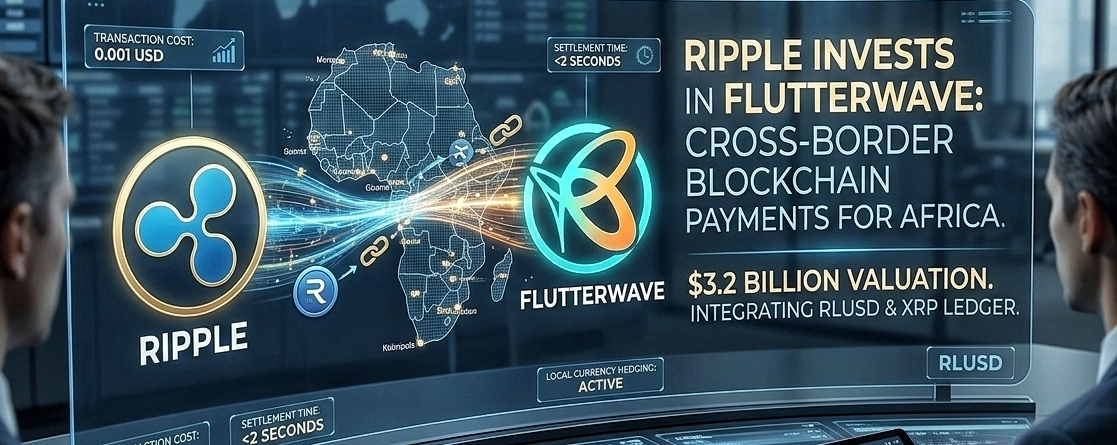
Ripple’s strategic investment in Flutterwave marks a pivotal milestone in Africa's rapidly evolving fintech and digital assets ecosystem. By integrating its institutional-grade stablecoin (RLUSD) and the high-throughput XRP Ledger (XRPL) into Flutterwave's sprawling infrastructure, Ripple is positioning itself at the absolute epicenter of the continent's financial evolution.
With Flutterwave holding a formidable $3.2 billion valuation, this partnership represents a major bridge between traditional enterprise fintech and cutting-edge Web3 infrastructure.
1. Executive Summary: The Anatomy of the Deal
The collaboration between Ripple, a global leader in enterprise blockchain solutions, and Flutterwave, Africa’s premier payments technology company, is designed to bypass legacy banking inefficiencies.
The core objective is simple yet revolutionary: to eliminate the high costs, fragmented liquidity, and slow settlement windows that have historically restricted pan-African financial corridors. By leveraging the low-latency capabilities of the XRP Ledger and the price stability of RLUSD, the alliance delivers a seamless, near-instant settlement layer for both retail remittances and large-scale corporate payments.
2. Market Inefficiencies Solved by the Alliance
To understand the impact of this deal, it is essential to analyze the structural friction present within the African financial landscape:
Exorbitant Remittance Costs: Sub-Saharan Africa remains one of the most expensive regions globally for moving money. Traditional cross-border corridors regularly impose aggregate fees exceeding 6% to 8% per transaction.
Prolonged Settlement Windows: Standard international business payments relying on traditional correspondent banking rails routinely take 3 to 5 business days to clear, trapping vital working capital.
Exotic Currency Fragmentation: Direct trading pairs between distinct African fiat currencies are often unavailable. As a result, funds must undergo a double-conversion process (e.g., Nigerian Naira to US Dollar, then US Dollar to Kenyan Shilling), compounding costs for enterprises.
By shifting the underlying settlement layer to the XRP Ledger, transactions bypass these intermediate steps, settling natively on-chain within seconds at a fraction of a cent.
3. Strategic Synergy: RLUSD and the XRP Ledger
This partnership provides immense structural advantages for both entities, serving as a highly calculated move for global market share.
The Commercial Launchpad for RLUSD
For Ripple, launching a stablecoin like RLUSD requires immediate, real-world utility to effectively compete with entrenched giants like USDT and USDC. Partnering with Flutterwave grants Ripple instant access to a mature distribution channel spanning over 30 African nations, millions of active merchants, and corporate enterprises.
Because RLUSD is engineered to be fully backed by US dollar deposits, short-term US Treasuries, and cash equivalents, it offers African businesses a highly secure, compliant digital asset to preserve purchasing power against local currency devaluations.
Boosting XRPL Network Metrics
The integration injects high-volume, real-world enterprise transaction data into the XRP Ledger. The XRPL’s native architecture is uniquely optimized for institutional use, offering rapid throughput and predictable, ultra-low transaction fees. This expansion significantly broadens the utility of the XRPL ecosystem outside of Western and Asian markets, proving its capability in high-demand, emerging economies.
4. Competitive Analysis & Macro Landscape
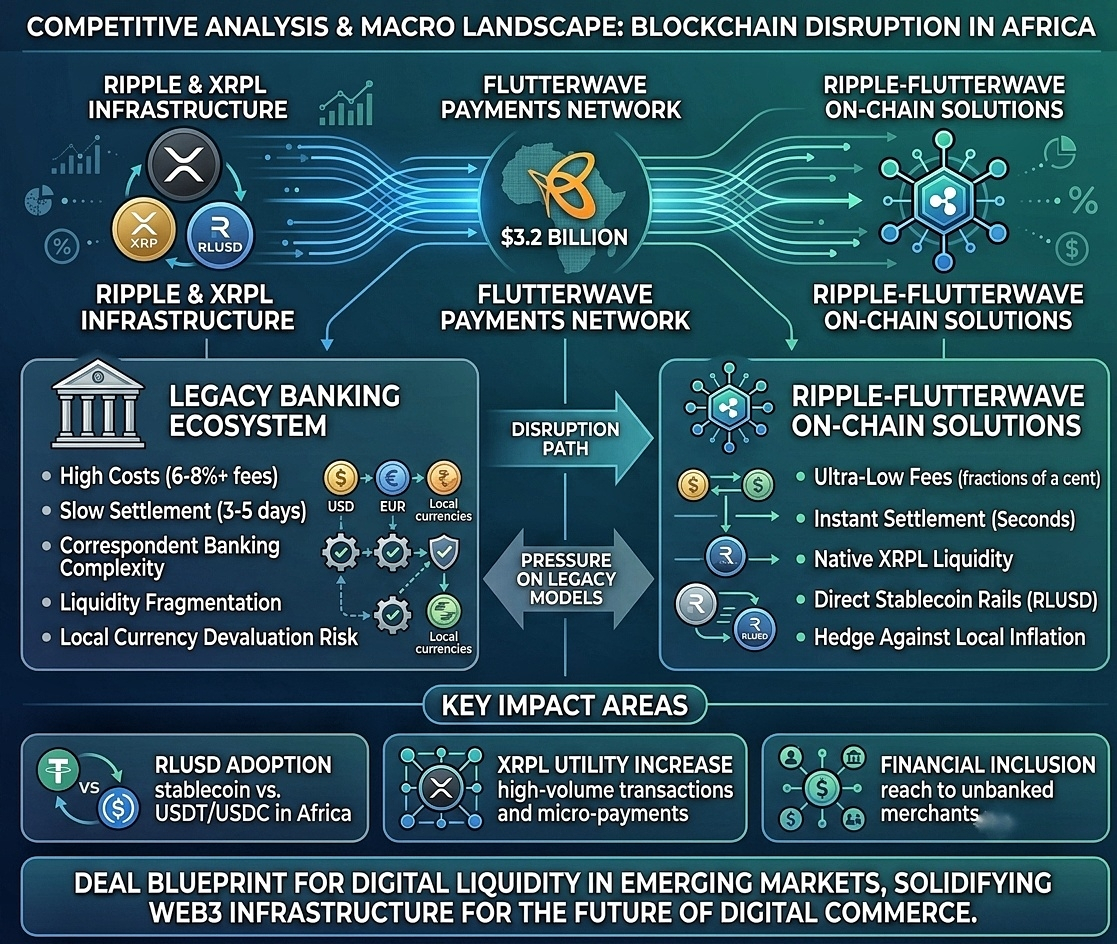
This investment fundamentally reshapes the competitive dynamics of digital finance across the continent:
Pressure on Legacy Banking
Traditional financial institutions relying heavily on SWIFT and vintage correspondent networks will face severe pressure to optimize their pricing models and settlement timelines. The speed and cost efficiency of an on-chain alternative make legacy rails increasingly obsolete for corporate liquidity management.
The Emerging Market Stablecoin Race
Africa's high inflation rates and currency volatility make it an ideal environment for stablecoin adoption. Ripple’s localized distribution strategy through an established market leader like Flutterwave establishes a strong competitive front, challenging the market dominance of existing stablecoins by offering a highly regulated, enterprise-grade alternative.
5. Forward-Looking Outlook
The Ripple-Flutterwave deal is far more than a routine corporate investment; it serves as a structural blueprint for the future of decentralized liquidity in emerging markets. If executed successfully, this alliance will not only solidify Flutterwave's position as the definitive digital gateway of Africa but will also concrete Ripple's position as the premier blockchain provider for global institutional settlements.
As regulatory frameworks around digital assets continue to mature across major African economic hubs like Nigeria, South Africa, and Kenya, this blockchain-powered framework is poised to serve as the backbone for the next generation of digital commerce.
__________________________________
Disclaimer
Educational Purpose Only: The information provided in this article/infographic is for general informational and educational purposes only. It does not constitute financial, investment, legal, or professional advice.
__________________________________