
Brothers, have you kept up with the wave of the crypto market in December?
In the blink of an eye, it's already mid-December 2025, and the market is like a roller coaster—BTC is steadily at a high position, while the AI and privacy sectors have suddenly exploded.
To be honest, my eyes have been sore from scrolling X these past few days, but I accidentally discovered a low-key yet fiercely rising project: Mind Network.
It's not some get-rich-quick meme coin, but a true pioneer in technology research: FHE.
The price has surged directly from the low point at the beginning of the month, currently stabilizing around $0.058, with a 24-hour increase of 28.7%, and a staggering 244% surge over 7 days.
This is not a coincidence, but a concrete explosion driven by the community and ecology.
I don't sell courses, I just feel that in today's world, with quantum threats getting closer,$FHE this 'cryptographic computing black technology' is particularly appealing.
Let me explain why this is so attractive, and share some data and trends to help everyone see the path clearly and rationally get on board. It's all valuable information, no fluff.
1. What problem does FHE actually solve?
The traditional advantage of blockchain is transparency—every transaction is publicly verifiable, and everyone can trust it.
But what about the other side? What about privacy?
Your wallet address and transaction details are all exposed on the chain, and enterprise data leaks as soon as it is used. Even during AI training, there are concerns about models being stolen.
Mind Network confronts this 'transparency paradox' by building a Layer 1 infrastructure, with FHE as its core weapon.
In plain language: FHE allows data to be computed directly in an encrypted state without needing decryption.
It's like locking your data in a safe; others can only 'feel the safe' from the outside to perform calculations, and the results are output directly—zero leakage throughout the process.
Unlike ZK technology, which is better suited for simple verification, FHE can handle complex operations: addition, subtraction, multiplication, division, comparisons, and even AI model training.
Businesses can use it to build confidential DeFi protocols, developers can create privacy-focused NFT markets, and AI agents can collaborate securely without worrying about sensitive information being exposed.
2. Why has it suddenly become popular now?
The era of quantum computing is approaching, and Shor's algorithm may potentially crack the signature mechanisms relied upon by current BTC/ETH.
FHE is like 'post-quantum armor', and Mind Network has laid the groundwork early, becoming the trust cornerstone of the AI Agent economy.
Imagine if AI agents want to autonomously manage assets and execute smart contracts? Without FHE as a safeguard, it simply won't work.
3. Price and data performance
As of noon on December 10:
The current price is approximately $0.05488, with a market cap of only $13.62 million, a circulation of 250 million, and a total supply of 1 billion.
Although the market cap is small, the upward potential is vast—compared to SUI's DeFi, the narrative of privacy + AI of THE appears to have greater dark horse potential.
Recent increase:
24-hour increase of 28.7%, rising from a low of 0.02893 to a high of 0.05595, with a trading volume of $35.13 million.
7-day surge of 244.21%, starting from 0.01478, achieving a 2.44x growth.
Market sentiment:
RSI has exceeded 85, in the overbought range, but trading volume increased by 4253%, with open interest rising by 61%, and bulls still dominate.
On Binance,$FHE contract trading volume ranks 19th, just behind SUI; spot trading volume also reached $43.5 million.
The number of community holders has exceeded 138,000, growing rapidly—this is not driven by air, but by genuine demand.
4. What are the favorable factors behind it?
Chainlink CCIP FHE privacy bridge went live on December 2, enabling encrypted cross-chain message transmission with zero exposure of sensitive data.
DeepSeek integration, ensuring agent safety through FHE SDK for large AI models, and Web2 developers can also easily use the Rust toolkit.
World AI Health Campaign launched on BNB Chain, offering $5 million in FHE rewards to attract enterprise-level health data AI service traffic.
The November monthly report shows: collaboration with Ant Group on RWA payments, BytePlus AI entering the ByteDance ecosystem, FHE agents landing on LarkSuite.
These are all collaborations that have already been realized, not just empty talk.
In December, the crypto winner FHE leads in infrastructure tokens, outperforming GLMR and LAVA.
5. What advantages do FHE have over SUI?
SUI excels in the DeFi ecosystem, with high TVL and fast Move language.
But,$FHE it's not about competing for traffic, but about underlying security—privacy + AI dual enhancement. Under quantum threats, transparent chains may face challenges for Gas fees, governance, and node incentives, stabilizing the unlocking rhythm (incubated by Binance Labs), friendly for long-term holding.
Currently, the market cap is less than $20 million, with upward potential possibly ten times that of SUI.
This is not like a gambling game, but paving the way for the era of AI agents—upgrading Web3 from 'public ledgers' to 'encrypted brains'.
6. Conclusion
Privacy is no longer optional, but a necessity.
The market sentiment in December reminds me of the early days of Chainlink—quietly building bridges until the entire ecosystem awakens to its value.
In the quantum era, data is the lifeblood, and Mind Network protects this gateway with FHE, allowing the AI agent economy to stand firm.
#FHE #MindNetwork #FHE隐私 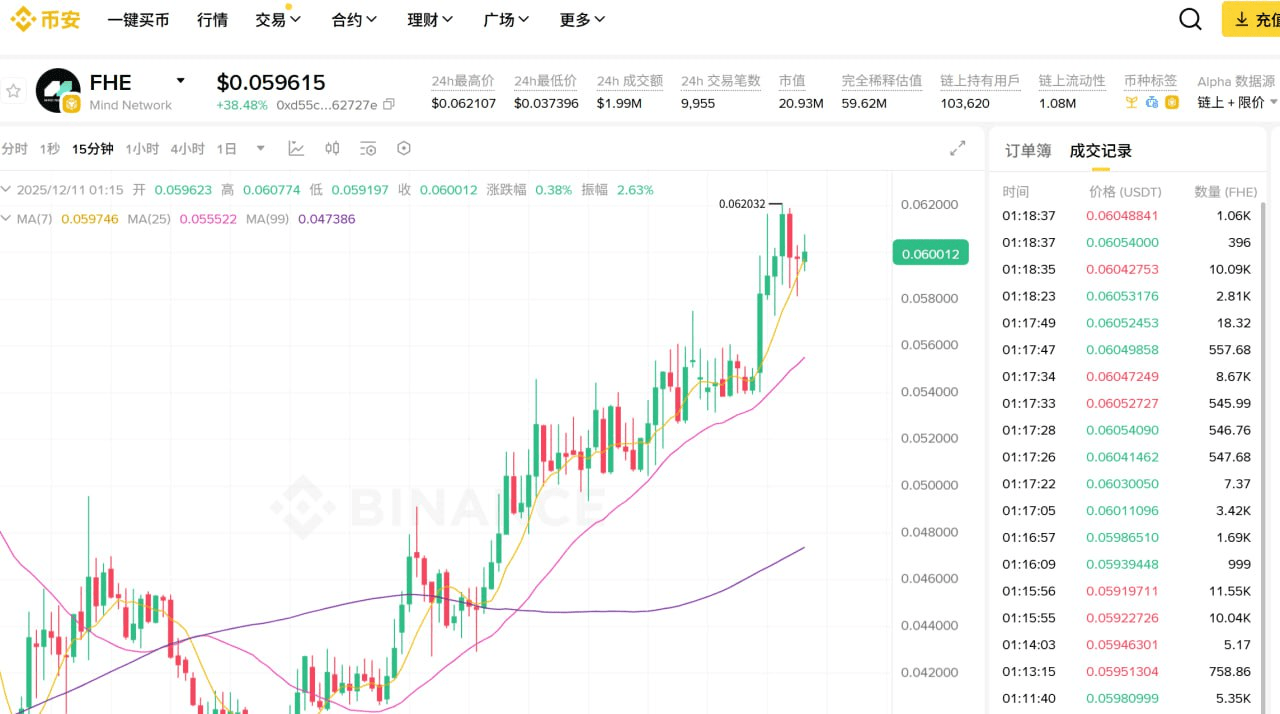

gm
Enter your answer
Expired