
Brothers, stick to the script.
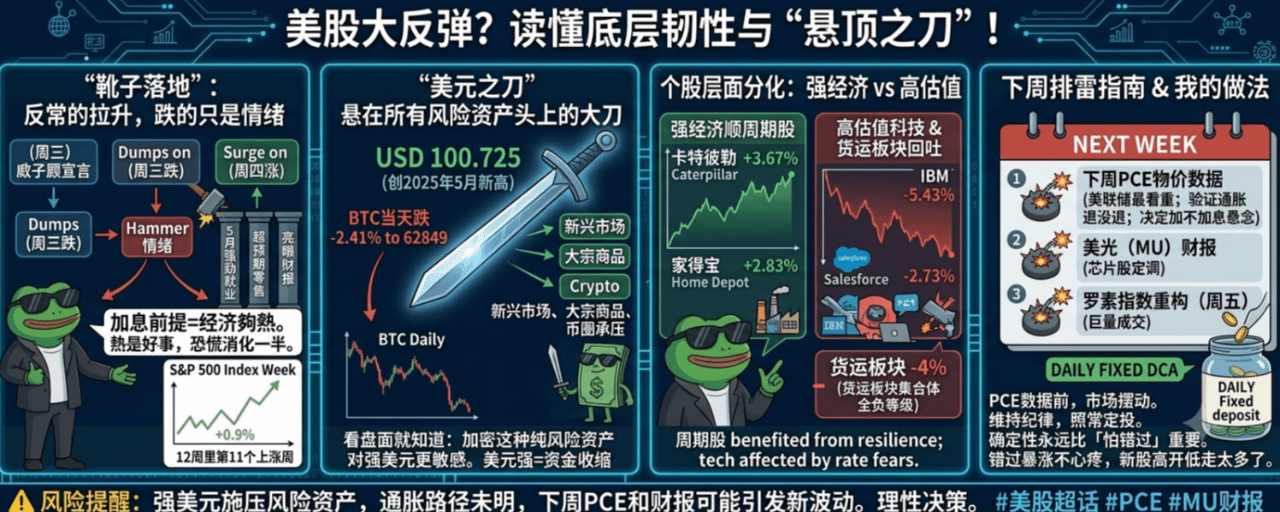
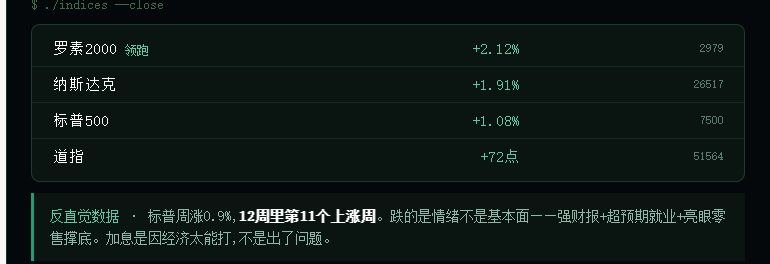
The Fed went hawkish on Wednesday, and yields soared. Logically, the market should have dipped the next day. Instead, on Thursday, all three major indices rallied, with the Nasdaq leading up 1.91% to close at 26517, the S&P rose 1.08% to 7500, and the Dow edged up 72 points. Small-cap stocks like the Russell 2000 surged 2.12%, leading the pack.
The day after the hawkish move, the market rebounded—this anomaly is more intriguing than just simple up and down moves.
【Why did the market bounce back after the hawkish stance】
The key was the drop yesterday; it was a decline in 'sentiment,' not in 'fundamentals.'
On Thursday, yields slightly pulled back as the market calmed from the rate hike panic. Chip stocks led the charge with a rebound. But on a deeper level, the U.S. economy isn't in bad shape; strong earnings reports, exceeding expectations for May jobs, and the recently released retail sales data all look promising.
In other words, the premise for rate hikes is precisely that the "economy is hot enough," and a hot economy is good for corporate profits. So the market has figured out that rate hikes aren't due to problems; it's because the economy is performing too well—once you realize that, the panic subsides by half.
This also explains a counterintuitive data point: the S&P 500 rose 0.9% this week, marking the 11th up week out of the last 12. Yes, despite the crash, geopolitical tensions, and the Fed's hawkish stance, the market is still steadily moving upwards. The underlying resilience speaks volumes beyond daily headlines.
[But there's one signal I need to highlight separately: the dollar]
The real big deal yesterday wasn't in the stock market, but in the forex market.
The dollar index surged to 100.725, hitting a new high since May 2025. The dollar against the yen skyrocketed to 160.89, the highest since July 2024. The reasoning is straightforward: once rate hike expectations shift, the dollar strengthens immediately—money always seeks higher yields.
Why is this signal important for us? Because a strong dollar is a sword hanging over all risk assets. The stronger the dollar, the more funds shrink into dollar-denominated assets, putting pressure on emerging markets, commodities, and the crypto space. Just look at yesterday's market: Bitcoin dropped 2.41% to 62849. While the stock market can withstand the pressure due to its fundamentals, crypto, being a pure risk asset, is far more sensitive to a strong dollar.
[The divergence at the stock level says a lot]
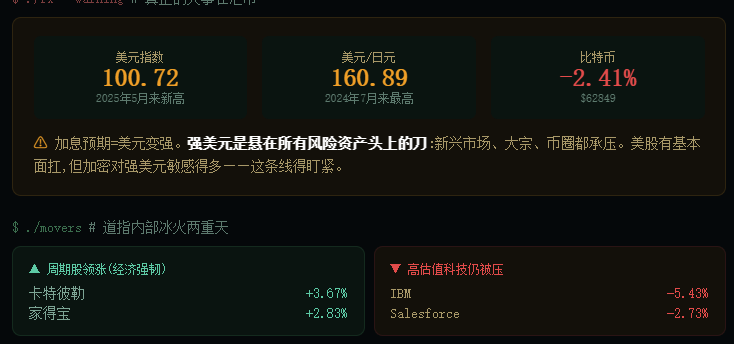
The Dow is experiencing a split personality. Caterpillar is up 3.67% and Home Depot up 2.83%, leading the charge thanks to robust cyclical stocks. However, in the tech sector, IBM plummeted 5.43% and Salesforce dropped 2.73%, still feeling the pressure from expectations of rate hikes.
Also, here's a detail: Dow transport stocks fell 4% in a day, with the freight sector being collectively downgraded. But this comes after a 20% to 40% rise this year, so it's just high-level profit-taking—not necessarily a signal of recession.
[Next week's real highlights]
Today, June 19th, US markets are closed for Juneteenth. That's a wrap for this week. But next week, there are some serious catalysts lined up. The Fed's favorite PCE inflation data is coming out, directly verifying whether inflation is easing. Micron's (MU) earnings report will set the tone for chip stocks, and the Russell index rebalancing on Friday will drive massive volumes.
This week saw a rollercoaster from crash to hawkish to rebound—it looks lively, but next week's PCE will provide the real data to judge whether "they will hike rates or not." Until then, this back-and-forth panic and optimism in the market is likely to continue.

⚠️ Risk warning: Investing carries risks. A strong dollar pressures risk assets, and the inflation path remains unclear. Next week's PCE and earnings reports could trigger new volatility. This is purely personal observation and sharing, not investment advice. Please make rational decisions based on your own risk tolerance.#美股超话