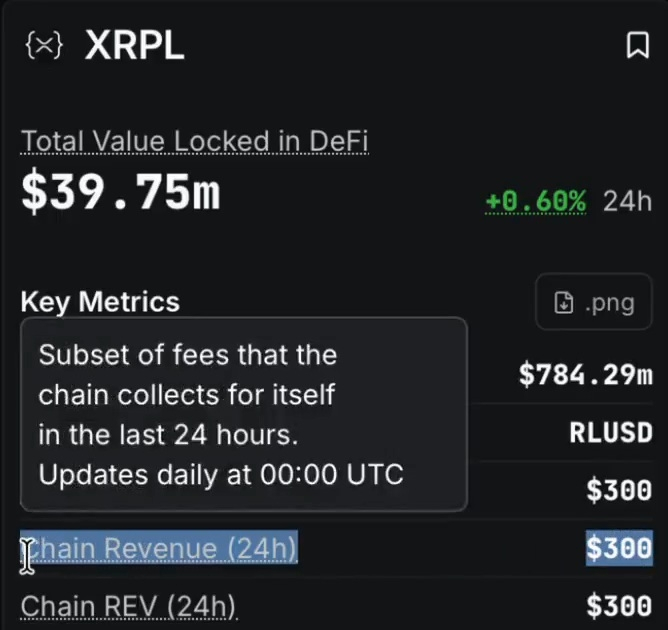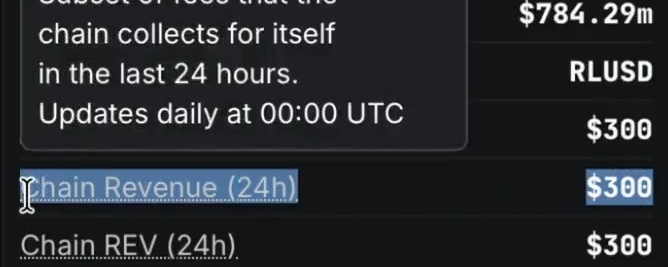
XRP's ledger has generated just about 300 dollars in revenue over the last 24 hours. 💸
Nevertheless, XRP's market cap is still over 70 billion dollars. 💰
So what's really going on? 🤔
The short answer:
Because market cap doesn't equal revenue. ⚖️
Here's where many get it wrong when looking at digital assets.
In traditional markets, valuation is assumed to reflect—at least partially—the size of revenues, profits, or future cash flows. 📊
But in the digital-currency market, things are completely different. 🌐
Here, the market doesn’t price the asset based only on what the network produces today,
but rather based on what investors, traders, and speculators imagine this network could become in the future. 🔮
That’s why the paradox seems shocking:
The XRP Ledger network does not rely at all on high fees.
Quite the opposite—it's been designed with extremely low fees. ⚙️
The basic fees for a standard transaction are only 0.00001 XRP.
More importantly, these charts:
Don’t go to auditors,
And not for the token holders,
Nor on a centralized entity that earns direct income from it,
Instead, it is permanently burned. 🔥
And this is where it becomes clear that describing the $300 as “revenue” may be misleading if the word “revenue” is understood in the traditional sense. ❗
We’re not talking here about a company selling a service and collecting fees distributed to shareholders,
nor does a protocol pay a direct cash return to token holders.
Instead, we’re talking about a digital asset whose price is determined in the market through:
supply and demand,
and expectations,
and the narrative,
and liquidity. 📈
So what exactly is the market betting on when it gives XRP such a large valuation? 🧠
It’s betting on several things at once:
• Future adoption 🚀
• Continued presence of XRP in payments and cross-border liquidity 🌍
• Expansion of the surrounding ecosystem 🏗️
• Improving the regulatory environment ⚖️
• The psychological and symbolic interest in the asset remaining within the market 🌀
Put more clearly:
XRP is not priced as if it were a fully mature, cash-generating asset that produces regular cash flows,
Instead, it is priced as a “bet on probability.” 🎯
The market doesn’t say:
Today this network generates tens of billions, so it deserves this valuation
Instead, it says:
“This asset could play a bigger role in the future, and we price in that possibility now.” ⏳
and this is the explanation for the enormous gap between current network activity and the asset’s market value.
in the world of digital assets,
Narrative often moves ahead of the numbers,
and liquidity moves ahead of the fundamentals,
Prediction goes ahead of reality. 🧩
That’s why you can see assets with huge valuations even though their current economic use is still limited,
As you can see, projects with strong real activity may not receive the same level of valuation because the narrative around them is weaker.
But that doesn’t mean the market is “always” wrong,
It also doesn’t mean it is “always” right.
It simply means that, at this stage, the market doesn’t value XRP like a stock in a company,
rather than valuing it as a speculative/strategic asset tied to a future potential that hasn’t been fully realized yet. 🎲
And that is the most important point:
This kind of gap could persist for a very long time,
sometimes longer than skeptics expect,
because strong narratives can keep valuations high as long as belief in the future holds. 🧠🔥
However, this gap is not protected forever.
if the asset fails to turn promises into broader economic use,
or if liquidity weakens,
or if collective belief in the story it carries fades,
so the market may reprice it violently. 📉