

The current UNI spot and contract prices are basically flat, with a very small price difference, indicating a converging market. After a significant price increase within 24 hours, it has approached the upper Bollinger Band, showing short-term strength, but trading volume has significantly shrunk, indicating that the upward momentum may be insufficient. The overall environment leans towards high-level fluctuations after a one-sided rise, rather than a sustained one-sided trend.
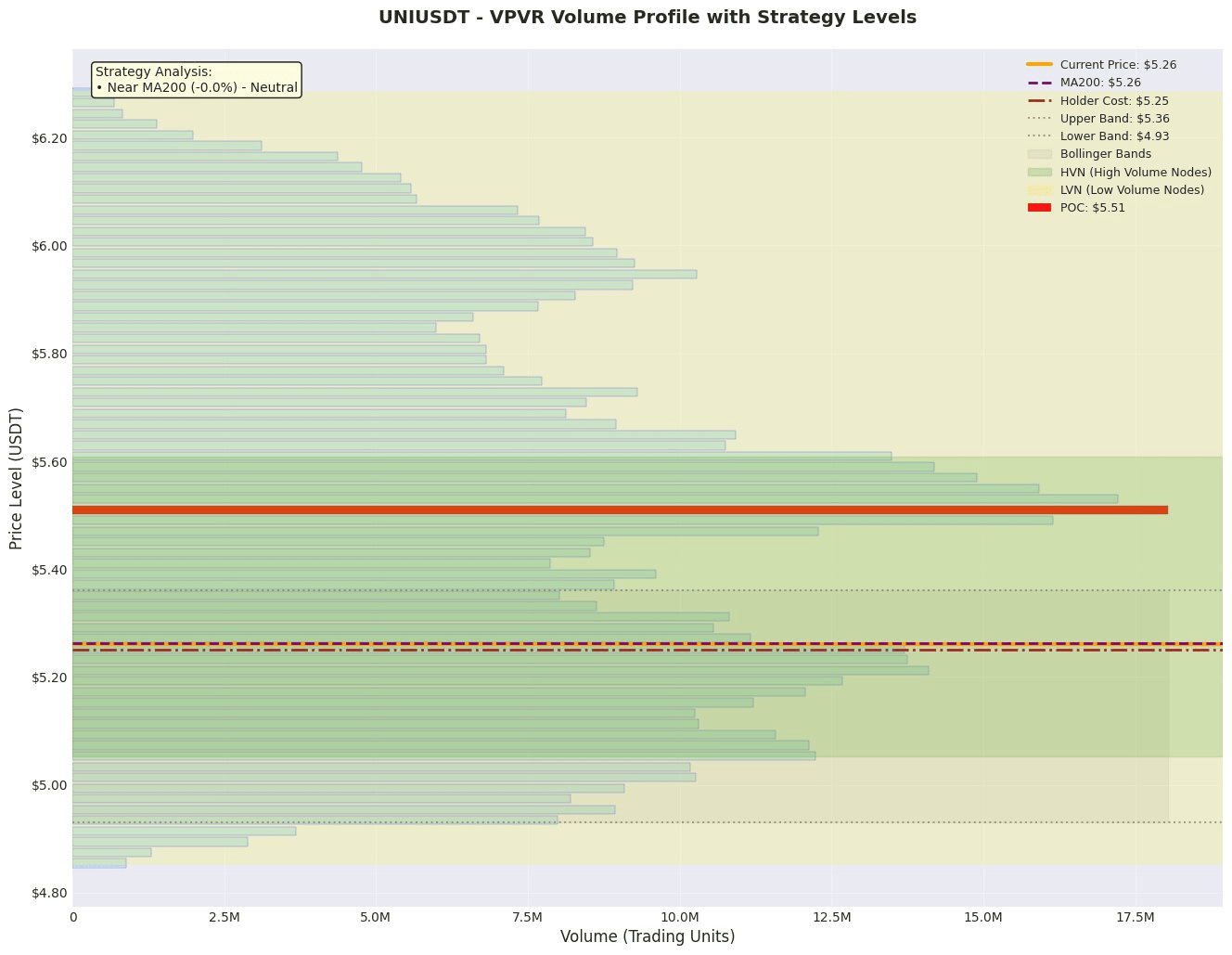
Key price and range structure
1. Value anchoring area: According to VPVR data, POC (Point of Control, maximum trading volume price) is at 5.5099, which is the core 'value anchor' of this round of game. The current price of 5.261 is below the POC. The Value Area is 4.9540 - 6.0062, and the current price is in the lower half of this range. POC (5.5099) will become the primary resistance for price upward movement, while VAL (4.9540) is the key support below, forming a strong support zone together with the lower Bollinger Band (4.9304).
2. Trend and volatility range: The current price 5.261 is slightly below MA200 (5.26205), indicating that the medium-to-long-term trend is at a delicate balance point between bullish and bearish. The Bollinger Band position is at 76.9%, and the price is close to the upper limit (5.3606), entering a potentially overbought area. The Bollinger Band range (4.9304 - 5.3606) defines the short-term volatility range, with the upper limit constituting direct pressure.
3. High trading volume/chip concentration area (HVN): POC (5.5099) itself is a significant HVN. In addition, the upper and lower edges of the Value Area (4.9540 and 6.0062) are also areas of concentrated trading volume, where prices are likely to pause or reverse when reaching these positions.
Derivatives and liquidity analysis
• Leverage funding bias: The funding rate is positive (0.00010000), and the long-short ratio has slightly increased from 2.4384 to 2.4618, indicating a slight warming of bullish sentiment in the contract market. However, the absolute value of the rate is not high, and it has not reached an extreme crowded level.
• Liquidity signal: Contract trading volume plummeted by -78.2%, which is a strong signal of liquidity exhaustion. Although open interest (OI) remains at 85.73M USDT, the sharp contraction in volume indicates a significant decline in market activity, weak willingness for new funds to enter, and price volatility may be amplified by a small amount of funds, making it prone to 'flash crashes' or 'wick' events.
• Leverage and position advice: In an environment of plummeting trading volume, the market depth is insufficient, making it unsuitable to amplify leverage. Positions should be reduced, with a focus on wait-and-see or light short-term trading to avoid risks of slippage caused by lack of liquidity and the inability to stop losses in a timely manner.
News and event impacts
The current news summary (such as UCLA Newsroom, USC News, NYTimes Education section) is very low in direct relevance to UNI tokens or the cryptocurrency market (relevance all below 0.16), constituting noise information. Currently, there are no significant news events affecting UNI's short-term price movement; the market is mainly driven by technical and funding factors.
Trading strategy
Plan A: Conservative pullback long strategy
• Direction: Long
• Entry range: Wait for the price to pull back to the strong support area formed by the lower edge of the Value Area VAL (4.9540) and the lower Bollinger Band (4.9304), which is the 4.93-4.96 range.
• Stop loss: Set below 4.93, such as 4.90.
• Target: First target POC resistance level 5.51, second target Bollinger Band upper limit 5.36 (if it rebounds first).
• Expected risk-reward ratio: ( (5.51 - 4.95) / (4.95 - 4.90) ) = 0.56 / 0.05 = 11.2 (based on the first target). This risk-reward ratio is extremely high, but it requires the price to accurately pull back to support and not break the stop loss, making it difficult to achieve, and belongs to an ideal situation. A more realistic risk-reward ratio can refer to the second target: (5.36 - 4.95) / (4.95 - 4.90) = 0.41 / 0.05 = 8.2.
Plan B: Aggressive breakout short strategy
• Direction: Short
• Entry logic: Given that the price is close to the upper Bollinger Band (5.3606), and the increase is on low volume, there is a risk of a false breakout followed by a decline. Observe whether the price shows signs of stagnation (such as long upper wicks, inability to increase volume) in the 5.36-5.51 (upper limit to POC) range.
• Specific entry: Enter short when the price reaches the 5.36-5.51 range and shows a bearish candlestick pattern (such as pin bar, bearish engulfing) on the 15-minute or 1-hour level.
• Stop loss: Set above the entry candlestick high or above POC (5.51), such as 5.55.
• Target: First target near MA200 and position cost area 5.26, second target VAL support 4.954.
• Expected risk-reward ratio (calculated with entry 5.45, stop loss 5.55, target 5.26): ( (5.45 - 5.26) / (5.55 - 5.45) ) = 0.19 / 0.10 = 1.9.
Risk warning and position management
1. Liquidity exhaustion risk: The core risk is the contract trading volume plummeting by -78.2%. With low trading volume, prices can be easily manipulated or experience irrational sharp fluctuations, and stop-loss orders may be executed at prices far exceeding expectations.
2. Long crowding risk: The long-short ratio continues to rise and the funding rate is positive. Although it has not reached an extreme value, if the price turns down, it may trigger a cascading decline caused by concentrated long liquidations.
3. Technical divergence risk: The price has risen sharply, but trading volume has shrunk (only 0.4x of the 24-hour average), showing a divergence between volume and price, making the upward foundation unstable and increasing the probability of a pullback.
Position management advice:
• In the current market environment, it is strictly forbidden to use high leverage. It is recommended that total position risk exposure does not exceed 5% of the account's principal.
• Adopt a staggered light position strategy, with the initial risk of any single trade controlled within 1% of the total account funds.
• Given the poor liquidity, limit orders should be used when entering, and avoid chasing orders when prices are rapidly fluctuating. If contract trading volume continues to remain at extremely low levels, new positions should be paused and a wait-and-see approach should be adopted.
Like and follow for real-time updates!
$UNI
