
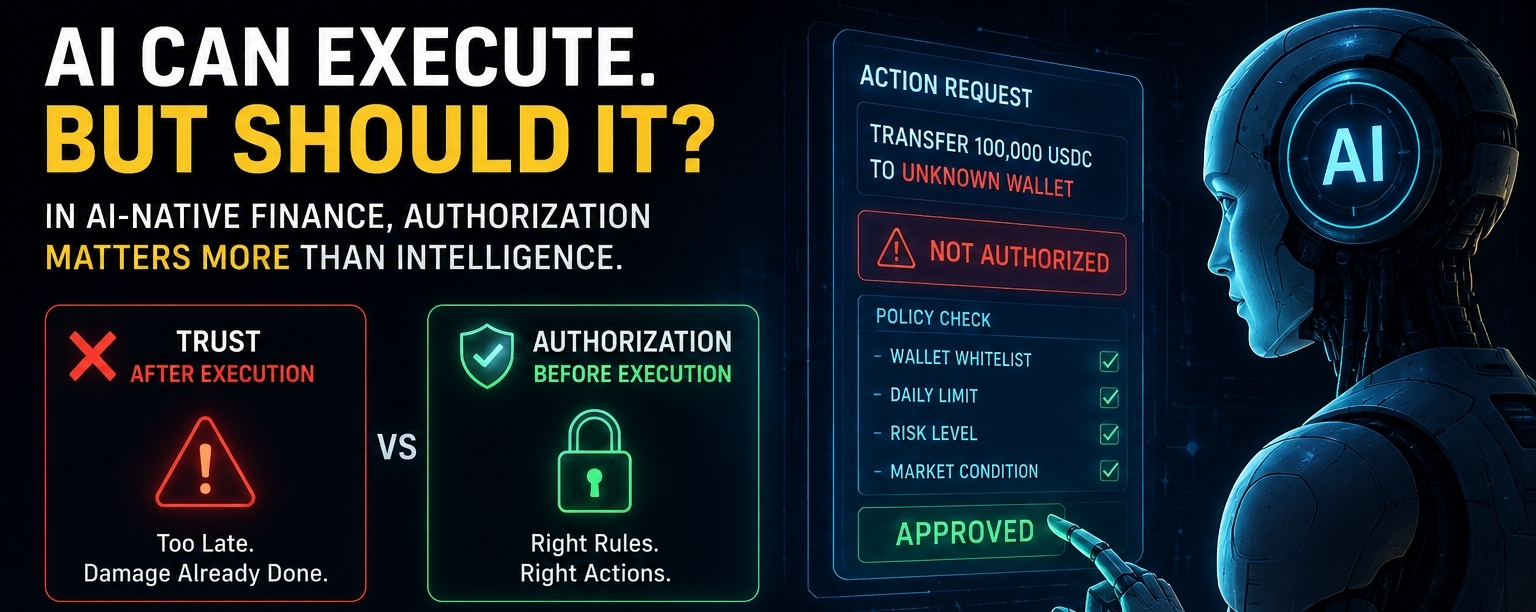
Lately, I've been thinking about where AI and crypto are heading. Everyone seems excited about smarter models, faster execution, and fully automated finance. I get the excitement. It's hard not to.
But the more I think about it, the less I believe intelligence is the biggest challenge.
I think permission is.
Imagine using an AI agent to manage your portfolio. It rebalances your assets, claims rewards, and moves liquidity while you're busy doing something else. Everything works smoothly for months, so you stop checking every little action.
Then one morning, something doesn't look right.
A large transaction has already happened.
Your first thought is probably that someone hacked your wallet. Maybe a private key was stolen or a smart contract was exploited.
But what if none of that happened?
What if the AI simply did exactly what it was allowed to do?
That's the part that caught my attention.
AI doesn't stop and wonder if a transaction feels risky. It doesn't question whether a permission is too broad. It follows the rules it's given. If those rules allow an action, it carries it out without hesitation.
From the AI's perspective, everything went according to plan.
From your perspective, it could be a disaster.
That's why I think we're focusing on the wrong thing when we only talk about making AI smarter.
A smarter system isn't automatically a safer one.
Without clear boundaries, even the best technology can make decisions that users never expected.
Crypto has already solved some difficult problems. We can prove ownership, move value across the world in minutes, and use smart contracts without relying on a central authority. Those are huge achievements.
Now we're moving into a new phase where software isn't just helping us make decisions. It's starting to make decisions for us.
That changes the conversation.
Once an AI can interact directly with wallets and protocols, permissions become just as important as execution.
Personally, I'd feel much more comfortable using an AI with clear limits than one with unlimited access.
If you think about it, that's how the real world already works.
A trusted employee still doesn't get access to every company account. Banks have approval limits. Businesses separate responsibilities for a reason.
Those rules aren't about distrust.
They're about reducing unnecessary risk.
I don't see why AI should be treated differently.
That's one reason Newton Protocol stands out to me.
Instead of asking whether an AI can execute a transaction, it focuses on whether the AI should be allowed to execute it in the first place.
It's a small change in wording, but I think it's a big change in mindset.
The idea is simple. Set the rules before anything happens, not after.
Maybe the AI can only interact with approved protocols. Maybe there's a spending limit. Maybe larger transactions need another layer of approval. Whatever the policy is, it's defined in advance instead of relying on assumptions.
To me, that feels like a much stronger approach.
It shifts the focus from blind trust to clear verification.
And I think that's exactly what autonomous finance will need as it grows.
No system can remove every risk. Markets will always surprise us, and people will always make mistakes.
But giving AI only the permissions it actually needs seems like common sense.
Sometimes the best security isn't making technology more powerful.
It's knowing where to draw the line.
Looking ahead, I don't think the projects that succeed will simply have the smartest AI. They'll be the ones that make automation predictable, transparent, and easy to trust because the rules are clear from the start.
Crypto changed the way we think about ownership.
The next big step might be changing the way we think about authorization.
Those two ideas sound similar, but they're solving very different problems.
And as AI becomes a bigger part of Web3, I have a feeling that difference will matter more than most people expect.
What do you think? As AI becomes more involved in crypto, will smarter models matter most, or will permission systems become the real foundation of trust?