

@APRO Oracle There’s a moment many people have when they first try a decentralized app and realize it’s still asking them to trust something. Not the blockchain part. That’s the easy promise: rules you can inspect, transactions you can verify. The uneasy part is everything the app has to “know” from outside the chain. A lending protocol needs a price. A stablecoin might need proof that reserves exist somewhere in the real world. Smart contracts can’t reach out to websites or databases on their own, so they rely on someone to bring the facts in.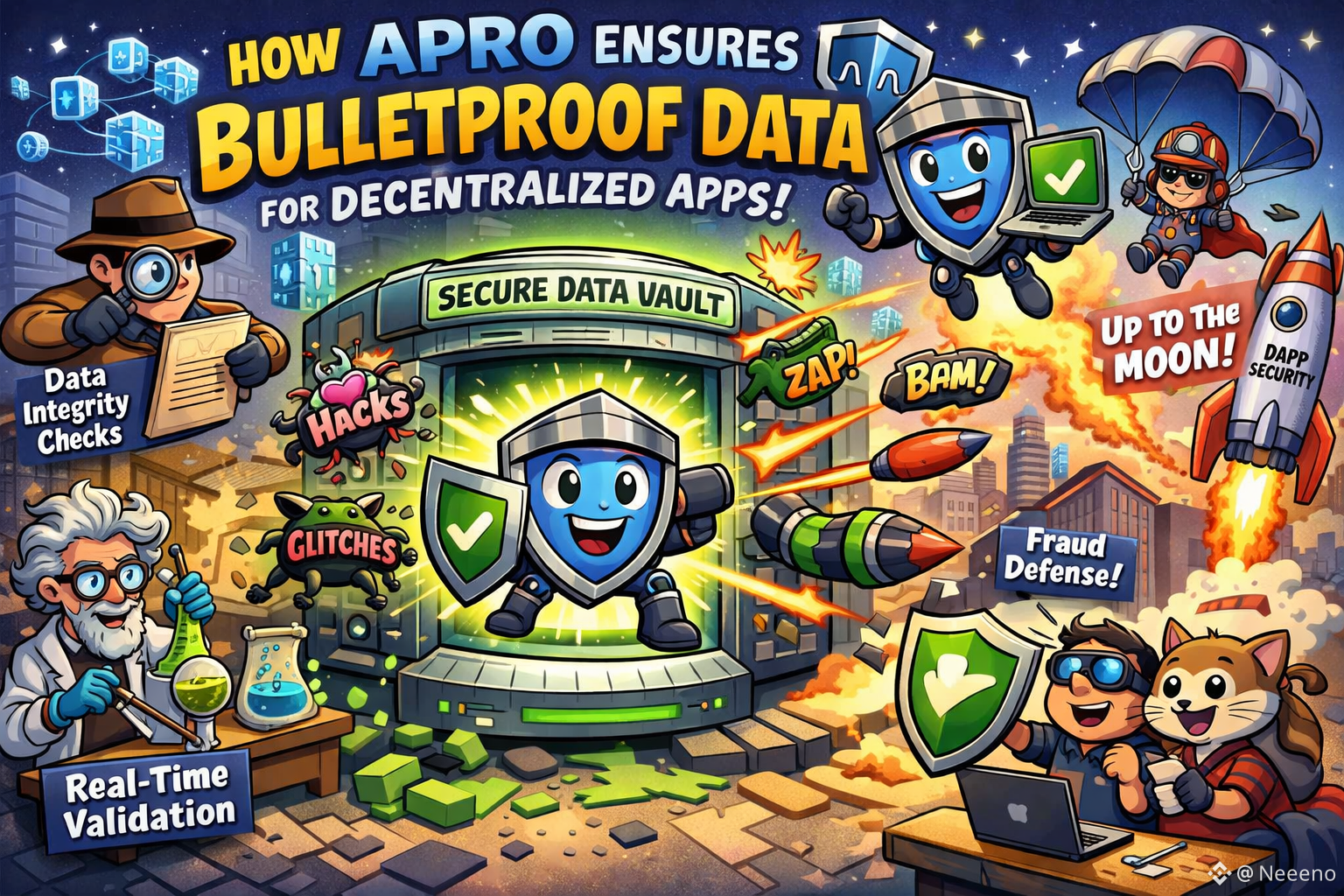
It’s one reason data integrity has become a steadier conversation in Web3 lately. We’re in a phase where people aren’t only launching new tokens; they’re trying to build systems that survive contact with reality. Cross-chain activity is normal now, and apps often stretch across several networks at once. Tokenized real-world assets keep getting piloted. Proof-of-reserves moved from a nice-to-have to something users expect. And AI agents are starting to show up in wallets and apps, making decisions automatically, sometimes with real money on the line.
“When my friends ask, ‘Isn’t it supposed to be trustless?’ I get why they’re annoyed. The word sounds like a guarantee. But “trustless” doesn’t mean information appears by magic. It means you design the system so no single party can quietly rewrite reality. Oracles exist because smart contracts can’t directly read the outside world, and an oracle is only as strong as the incentives, redundancy, and verification behind it.
APRO sits in that lane as a decentralized oracle network, aiming to make external data usable on-chain without turning it into a single point of failure. Its documentation describes a design that combines off-chain processing with on-chain verification, so data can be gathered efficiently while final results can still be checked on public rails. That can sound abstract until you picture a practical failure. A single bad price update can trigger liquidations, distort lending markets, or wipe out a smaller pool before anyone has time to react
One thing that stands out about APRO is how it thinks about delivery, not just accuracy. In its “data push” model, node operators publish updates on-chain at time intervals or when thresholds are met, instead of every app pulling constantly. The docs also describe a hybrid node architecture and a self-managed multi-signature framework intended to make tampering harder and accountability clearer. None of this is magic armor. It’s closer to engineering hygiene: reduce single points of failure, and make dishonest behavior easier to detect
The timing matters because decentralized apps no longer live in one room. A protocol might execute on one chain, settle elsewhere, and show up in several front ends. In that world, “truth” can start to feel like a rumor passed between rooms. APRO positions itself as a multi-chain data layer, and ecosystem listings highlight its focus on secure, verifiable transmission. The point isn’t bragging rights; it’s consistency across places that don’t naturally share context.
The AI angle is equal parts exciting and unsettling. Agents can be genuinely useful, but they can also act with a kind of misplaced confidence. If an agent is fed manipulated inputs, it will make very sure mistakes at machine speed. That’s why people have started talking about data not just as “feeds,” but as an integrity problem. The question isn’t only whether a number is right, but whether the whole path from source to on-chain publication is trustworthy enough that an agent can act without being led by the nose.
“Bulletproof,” though, shouldn’t mean perfect. The world is messy. Exchanges pause. APIs go stale. Sensors fail. People game systems. What you can realistically do is make manipulation costly and correction fast. That usually looks like multiple sources, multiple operators, and clear rules for how a final value is produced and checked. It also looks like transparency: a way for developers, auditors, and even curious users to trace where a number came from and what would have to happen for it to be changed.
I’ve noticed that users are changing too. More people are using on-chain tools for things that feel closer to real life: savings, payments, community treasuries, even payroll. Patience for “well, it’s beta” is thinner. Institutions and regulators are paying closer attention, and they tend to ask basic questions that builders can’t dodge: who can influence this feed, what happens during an outage, and can we prove what happened after the fact?
In that context, APRO’s value isn’t a promise that nothing will ever go wrong. It’s the attempt to build a data layer that assumes problems will happen and designs for them. If the bridge between on-chain logic and off-chain reality is shaky, everything built on it feels shaky too. If it’s solid, apps can finally spend their energy on being useful. That quiet reliability is what makes decentralization feel real today.
