
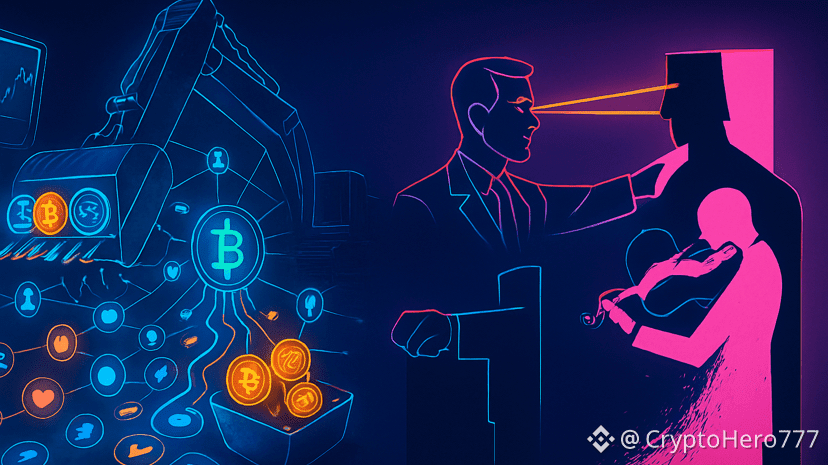
The capitalization of the meme coin sector rose to $17 billion in just two and a half weeks in July 2025 — this is not just speculation, but a result of the systematic use of social algorithms and collective attention as a mined resource.

The concept of mining has undergone a radical transformation. Previously, this word was associated with the energy-intensive process of confirming transactions in the blockchain (Proof-of-Work), which consumes more energy than entire countries and leads to significant CO₂ emissions[1], but today a new model — social mining — is coming to the forefront.
Its currency is not computational power, but attention, humor, and virality. Its tools are not ASIC miners, but social network algorithms, Telegram bots, and armies of crypto degenerates. Its result is not a Bitcoin block, but an instant surge in the price of a meme token, fueled by a single successful post.
This phenomenon redefines how value is created and distributed in the digital economy, turning internet culture into a powerful financial instrument.
The mechanics of new mining: from trigger to price
Unlike the unpredictability of traditional mining, where success depends on hash rate and luck, social mining is an engineering discipline. It can be broken down into a clear algorithm, where each step is aimed at mining the most valuable resource — human attention.
1. Post and trigger word. The process begins with content creation. This can be a meme, a mysterious tweet from a key opinion leader (KOL), or an 'oracle forecast' in a Telegram channel. The key element is embedding triggers: token names ($BONK, $PEPE), hashtags (#solanameme), or hints at an upcoming announcement. Influencers like Elon Musk have demonstrated immense power, causing Dogecoin price fluctuations of dozens of percent with just one tweet.
2. Algorithmic amplification. Here, bots and automated strategies come into play. Trading bots create the appearance of high activity (volume), attracting the attention of analytical platform algorithms like DexScreener and pushing the token to the top. At the same time, a viral content plan is launched on social media (X, TikTok, Telegram), which hooks into current narratives — whether it’s a Solana boom or a political season.
3. Community reaction and FOMO. If the trigger goes off, social mining begins. Users discuss, share, and start searching for the token. The 'fear of missing out' (FOMO) effect arises. At this moment, technical trust signals are critically important: revoking the creator's powers to issue tokens (to avoid the 'printing' of an infinite number of coins) and having sufficient liquidity for trading without huge fees.
4. Market reaction. Attention converts into financial impulse. Trading volume increases, and price begins to move. This stage is closely monitored by strategy participants. Modern AI-based systems using models like LSTM and Transformer analyze not only charts but also flows of data from social media, assessing sentiments and predicting short-term spikes.
Thus, social mining is a cycle of transformation: cultural code (meme) → collective attention (discussion) → financial energy (price growth). It creates a self-sustaining loop where price growth generates new discussions, which in turn stimulate the price.
 Tools and strategies for attention miners
Social mining requires specialized tools. While classic miners choose between graphics cards and ASICs, social miners operate with a different arsenal.
Tools for targeted airdrops
Instead of waiting for the audience to find the token, they are attracted directly. Using tools like Snapshot + Multisender, one can take a 'snapshot' of wallets holding similar thematic tokens (for example, all owners of dog meme coins) and send them free drops. This creates an instant interested audience and initial volume.
Analysis and forecasting based on AI
Attention miners use advanced analytical systems. Neural network models analyze correlations: for example, how the growth of total value locked (TVL) in the Base blockchain preceded the meme coin rally of $BRETT. They process not only price series but also social media data, whale activity, and news flows, identifying patterns invisible to the human eye. Modern models like Transformer are particularly effective in sentiment analysis, which is critically important for trading meme assets.
Strategies for managing a 'meme coin portfolio'
· Following narrative waves. Successful traders track not charts but social metrics: growth in followers on X, activity in Discord/Telegram, frequency of mentions on Reddit. Capital is redistributed among trends: from ecosystem tokens of Solana to political meme coins during election season.
· The rule 'Buy the rumor, sell the news.' Entry occurs during the narrative formation stage, and exit happens at the peak of excitement. It is important to lock in profits in parts, as the decline after the peak can be swift.
· Focus on leaders. Historically, original memes with strong brands ($DOGE, $PEPE) show better resilience than their countless clones.
These tools transform the chaotic world of meme coins into a field for systematic, albeit extremely risky, activities.
The dark side: risks, fraud, and ethical boundaries
Social mining is a territory of extreme volatility and risks that are incomparable to traditional investing.
· Rug Pulls. This is the main threat. Anonymous developers can abandon token management powers only in words, while in practice, they can sell all liquidity or print new tokens at any moment, nullifying the investment value. Checking the contract on platforms like Etherscan is a mandatory minimum.
· Extreme volatility. Fluctuations of 50% or more in a day are commonplace for meme coins. The price relies solely on attention, which can instantly switch to a new object.
· Manipulations and insider play. Behind the visible community activity often lie coordinated actions of creators and early holders who sell tokens (dump) at the peak of excitement, remaining in profit.
· Regulatory uncertainty. Unlike Bitcoin, the status of meme coins in the eyes of regulators is even more blurred. Any tightening could instantly collapse entire segments of this market.
From an ethical standpoint, social mining balances on the edge. On one hand, it is the democratization of speculation and a form of collective creativity. On the other hand, it is a tool for systematically creating and redistributing financial bubbles, where the most vulnerable participants (inexperienced retail investors) bear the greatest losses.
Prospects: what awaits the attention economy
The evolution of social mining will be determined by several key trends.
· Integration with next-generation AI. The future belongs to hybrid models that not only predict prices but also automatically generate and test meme content, identifying the most effective triggers and channels for their distribution.
· Complexity of strategies. Primitive pump schemes will be replaced by complex socio-financial games using mechanisms of decentralized autonomous organizations (DAOs), tokenized bets, and zero-sum game scenarios.
· Responsibility and self-regulation. To survive in the long term, the community will have to develop mechanisms to combat fraud — reputation systems, mandatory audits, and transparent token distribution.
The attention economy, of which social mining is a part, is no longer a metaphor, but a technological and financial reality. It challenges traditional notions of value, investment, and productive labor.
It demonstrates that in the digital age, the most complex task is not extracting resources from the earth's depths, but extracting and retaining resources from the depths of human consciousness. And those who control the algorithms governing this process possess one of the most powerful tools of modernity.