
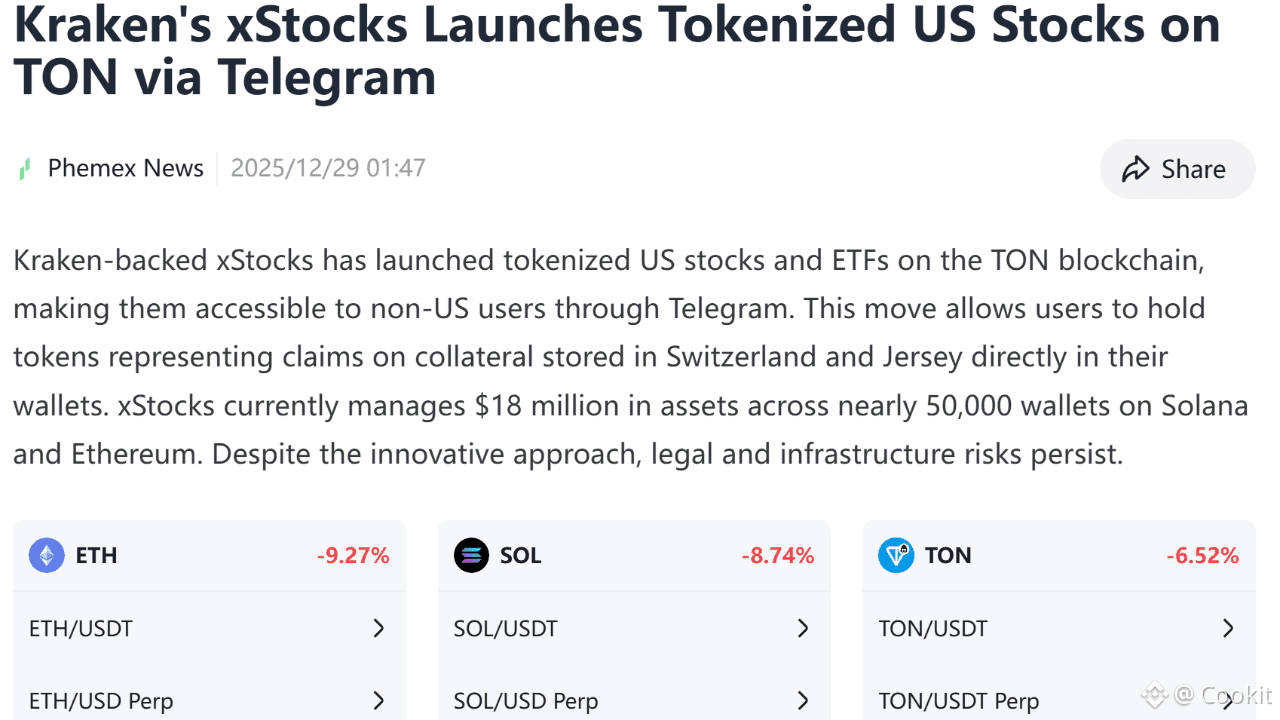
On Telegram, users can now purchase Nvidia stocks.
For most non-US residents, buying US stocks has always been a complicated process. As the best-performing market globally over the past thirty years, the average annual return of the S&P 500 index is about 10%, and the Nasdaq 100 index averages about 14%, with the Nasdaq index having increased by more than 80% in the past three years. However, 82% of US stocks are held by domestic owners, while foreign investors account for only 18%, and almost all are institutions.
For the vast majority of people worldwide, purchasing a share of Nvidia stock requires going through multiple barriers, such as account verification, obtaining a foreign bank card, dealing with foreign exchange controls, and bearing wire transfer fees. In other words, the vast majority of people globally are excluded from this capital growth, often not due to a lack of funds, but because of a lack of convenient participation channels.
Recently, Telegram users can directly buy stocks of companies like Nvidia, Tesla, and Apple within this social app. They deposit using USDT, with a minimum investment starting at just $1, supporting 24/7 trading, as easy as sending a message. The entire process requires no passport verification, bank accounts, or international wire transfers, and there are no T+2 settlement delays.
It turns out that Telegram achieved this functionality mainly through xStocks integrating with the TON blockchain. Its logic is based on common blockchain technology: on-chain asset issuance, oracles fetching stock prices, multi-chain circulation, and DeFi composability. As a result, Telegram has become the first application to integrate stock trading into the chat interface.
This has caught attention, possibly because the market has been eager for a 'killer app' in the crypto space. But perhaps the real breakthrough isn't a brand new application, but innovations like xStocks that leverage established platforms like Telegram. Telegram isn't trying to replace existing services; it simply adds a wallet entry next to the chat interface and connects to a public chain, enabling US stock trading.
Of course, these tokenized stocks don't represent actual equity, carry no voting rights, and the regulatory stance in various countries remains unclear. Issues like price anchoring mechanisms, liquidity depth, and platform risk management capabilities still need to be observed.
In the past, people doubted that mobile phones could replace bank counters, and they didn't believe stablecoins could handle a trillion-dollar scale of circulation. Now, perhaps some still can't imagine buying and selling US stocks through a chat app.
However, every generation of infrastructure often starts off like a 'toy', who's to say otherwise?