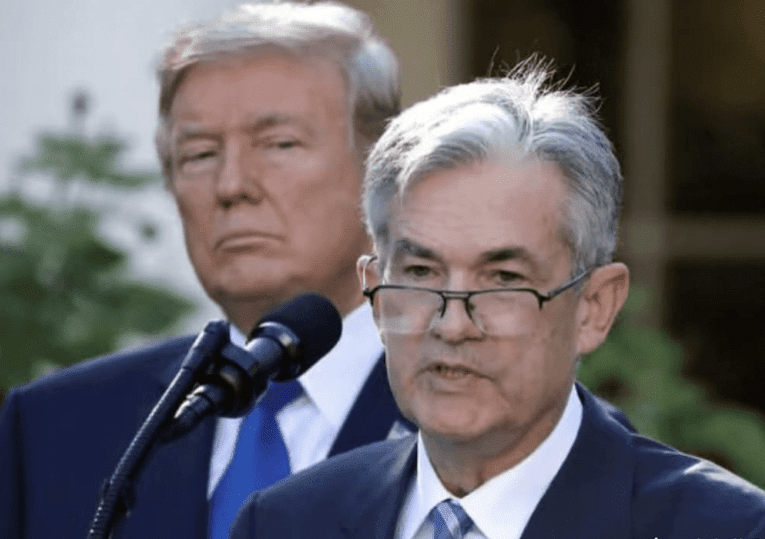
Powell under criminal investigation: the 'darkest moment' for the Federal Reserve's independence
⚖️
Core conflict
Judicial investigation vs. political pressure
Investigation triggered
Building renovation testimony
Powell's allegations
Political retaliation pretext
Fundamental contradiction
Struggle for interest rate decision-making power
Federal Reserve Chairman Jerome Powell is facing an unprecedented legal and political storm. On January 9, 2026, the U.S. Department of Justice served a grand jury subpoena on the Federal Reserve, threatening criminal charges over Powell's testimony before the Senate Banking Committee last June. The surface accusation centers on cost overruns in the Federal Reserve headquarters renovation project, but in a public statement on January 11, Powell firmly pushed back, directly accusing the move as political retaliation for refusing to comply with President Trump's demand for rate cuts.
Timeline of events: From renovation controversy to criminal threats
The trigger for this crisis was the Federal Reserve headquarters renovation project, which began in 2022 and is expected to be completed in 2027. The initial budget was around $1.9 billion, but due to rising material costs and other factors, it ballooned to approximately $2.5–2.6 billion, drawing criticism of 'luxury renovations.' In July 2025, Trump personally visited the construction site, confronting Powell with a document claiming costs reached $3.1 billion, which Powell disputed as flawed in calculation.
In June 2025, Powell testified before Congress on the matter, acknowledging cost overruns but denying waste, emphasizing that the renovation was necessary for safety and modernization. The core of the DOJ investigation is whether Powell made false statements about the project's scale in that testimony.
Powell's firm statement: The 'interest rate battle' behind the charges
Facing the threat of criminal investigation, Powell chose not to remain silent. In his statement, he explicitly stated that the renovation project and the testimony issue were merely 'pretexts.' He directly pointed the finger at the White House, arguing that this 'unprecedented' threat must be viewed in the context of the administration's ongoing pressure on the Federal Reserve.
"The threat of criminal charges stems precisely from the Federal Reserve's commitment to setting interest rates based on our best assessment of the public interest—not following the president's preferences," Powell wrote in his statement. He framed the issue as fundamental: whether the Fed can continue to set monetary policy independently based on economic evidence, or whether it will succumb to political coercion.
Timeline of power struggle
January 2025
After Trump's return to the presidency, he repeatedly publicly demanded the Federal Reserve cut interest rates significantly.
June 2025
Powell testified before the Senate Banking Committee on the cost of the Federal Reserve building renovation project.
July 2025
Trump's surprise visit to the Federal Reserve renovation site, where he confronted Powell over costs and again urged rate cuts.
January 9, 2026
The Department of Justice served a grand jury subpoena on the Federal Reserve, threatening criminal charges against Powell.
January 11, 2026
Powell released a video statement, accusing the investigation of being political retaliation and vowing to stand firm.
Long-standing tensions: Calls for rate cuts and personnel struggles
Powell's conflict with Trump has deep roots. Since Trump's return to office in 2025, he has repeatedly and publicly urged the Federal Reserve to cut interest rates significantly to stimulate the economy and reduce government debt costs. Frustrated by Powell's resistance, Trump has demanded Powell's resignation multiple times, calling him a 'slow-witted' and 'stubborn fool.' He even hinted at announcing Powell's successor in January 2026. Powell's term as Fed Chair ends in May 2026.
This conflict is not an isolated incident. In August 2025, the Trump administration attempted to remove Federal Reserve Board member Lisa Cook on allegations of mortgage fraud, but the move was blocked by the federal appeals court. Former Fed Chair Yellen expressed 'deep shock,' stating that this had become a 'full-scale attack' on the Federal Reserve. Meanwhile, Trump has already nominated White House economic advisor Stephen Miller to the Federal Reserve Board, seeking to influence decisions from within.
Market reaction and institutional concerns
After news of the criminal investigation broke, markets reacted swiftly. Investors worried about the erosion of the Fed's independence, leading to a sell-off of risk assets, weakening the dollar, strengthening gold, and declining stock index futures. Analysts warn that if the Fed yields to political pressure and pursues unrealistic low rates, monetary policy could become ineffective and undermine the stability of the dollar and the U.S. financial system.
The deeper concern lies in the White House's attempt to exert influence over monetary policy through 'functional takeover': on one hand, pressuring Federal Reserve officials via judicial and personnel means ('emotional cost'), and on the other, directly intervening in market interest rates through executive orders (such as instructing 'Fannie Mae' and 'Freddie Mac' to purchase mortgage-backed bonds to lower mortgage rates, or calling for caps on credit card interest rates), thereby bypassing the Fed's policy rate. This shift in pricing power could, over time, undermine market confidence in rule certainty and increase risk premiums.
The White House's dual-front pressure on the Federal Reserve
1
Emotional cost: Increasing the price of independent decision-making
Threatening the chairman through criminal investigation, attempting to dismiss board members (as in the Lisa Cook case), appointing loyalists to the board, and exposing officials who uphold independence to higher political and legal risks.
2
Market impact: Bypassing policy rates to directly affect people's lives
Instructing Fannie Mae and Freddie Mac to purchase mortgage-backed bonds to lower mortgage rates; calling for caps on credit card interest rates. Aimed at directly influencing voters' most sensitive pain points—their 'monthly payments' and 'bills'—to create a perception of cost reduction.
Powell concluded his statement with: 'Serving the public sometimes requires standing firm in the face of threats.' This battle over interest rate authority has escalated from public rhetoric to direct legal threats, pushing the Federal Reserve's century-old principle of independence to the brink. The outcome will not only determine Powell's personal fate but also reshape the global market's fundamental perception of the credibility of U.S. monetary policy.
⚖️
"When the pricing power of interest rates begins to shift, markets will embed uncertainty into prices. The 'cheap' gains achieved today under political pressure may one day be repaid with higher risk premiums and more fragile expectations of rules." — This may be the true market concern behind Powell's statement.