
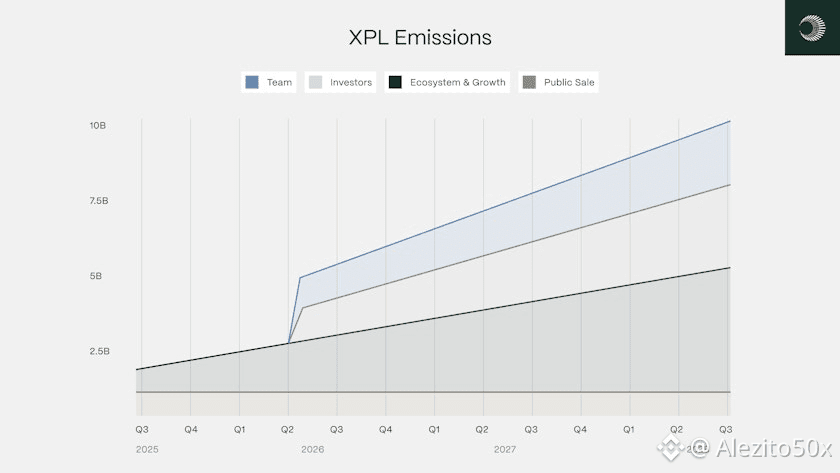
$XPL To understand the potential of @Plasma , it is essential to break down its incentive structure and issuance model. It is not just about a fast network; it is an ecosystem designed to attract trillions of dollars to the onchain environment. Here I explain the key points that every investor should know about the token $XPL:
1. Strategic Distribution: The Path to 10 Trillion 🪙
The initial supply was set at 10,000,000,000 $XPL. The most interesting part is how it is distributed to ensure long-term growth:
40% for Ecosystem and Growth: It is the largest share. The goal is to incentivize institutional liquidity and adoption in traditional financial markets. Of this, 8% was unlocked at launch to ensure immediate DeFi incentives.
50% divided between Team and Investors: Both groups have their interests aligned through a one-year cliff (lock-up) and a gradual unlocking that ends three years after the launch of the Mainnet Beta. This prevents massive sell pressures and ensures team commitment.
10% Public Sale: Community distribution with clear unlocking rules according to jurisdiction.
2. Security and Rewards: The Proof-of-Stake Model 🛡️
$XPL is not just an asset; it is the security guarantee of the network. Validators lock their tokens to confirm transactions and, in return, receive rewards.
Controlled Inflation: The system starts with an inflation of 5% per year, which decreases by 0.5% each year until stabilizing at 3%.
Important note: The team's and investors' locked tokens DO NOT generate inflation rewards, which protects active holders from unnecessary dilution.
3. The Deflationary Factor: EIP-1559 in @undefined 🔥
Following in the footsteps of the most successful networks, Plasma implements a burning mechanism. The base fees paid for transactions are permanently burned. As the network scales and transaction volume increases, this mechanism acts as a counterbalance to inflation, seeking a healthy economic equilibrium.
Conclusion: The tokenomics of $XPL is built to scale. By combining massive distribution for growth with a robust security model and burning mechanisms, the project positions itself as a serious infrastructure for the future of programmable money.
Which part of this model do you find most solid for the current market? 🚀